
C2 The Periodic Table
Slides in this set (6)
-
C2.1 Development of the periodic table
- The periodic table of elements developed as chemists tried to classify the elements
- It arranges them in an order in which similar elements are grouped together
- The periodic table is so named because of the regularly repeating patterns in the properties of elements
- 1808 Dalton: Order of atomic weights
- 1864 Newlands: Ordered by mass, noticed properties of every eighth element was similar, didn't take into account undiscovered elements
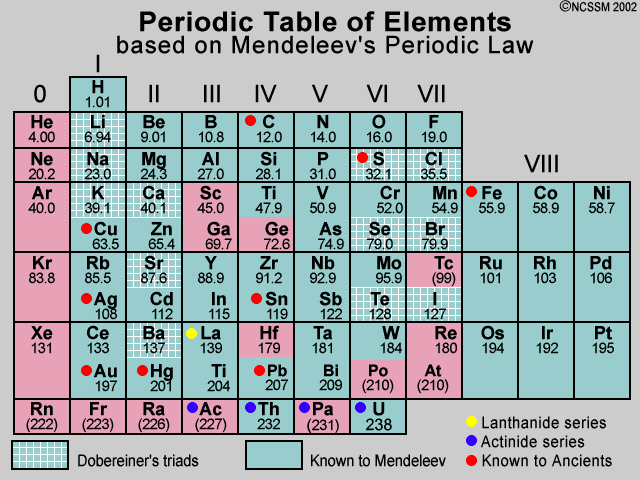
- 1869 Mendeleev's periodic table left gaps for the unknown elements
- When newly discovered elements matched his predictions, his table was accepted by the scientific community
- Caption: Mendeleev's periodic table
-
C2.2 Electronic structures and the periodic table
- The atomic number of an element determines its position in the periodic table
- The number of electrons in the outermost shell of an atom determines its chemical properties
- The group number in the periodic table equals the number of electrons in its outermost shell
- The atoms of metals tend to lose electrons whereas those of non metals tend to gain electrons
- The noble gases in group 0 are unreactive because of their very stable electron arrangements
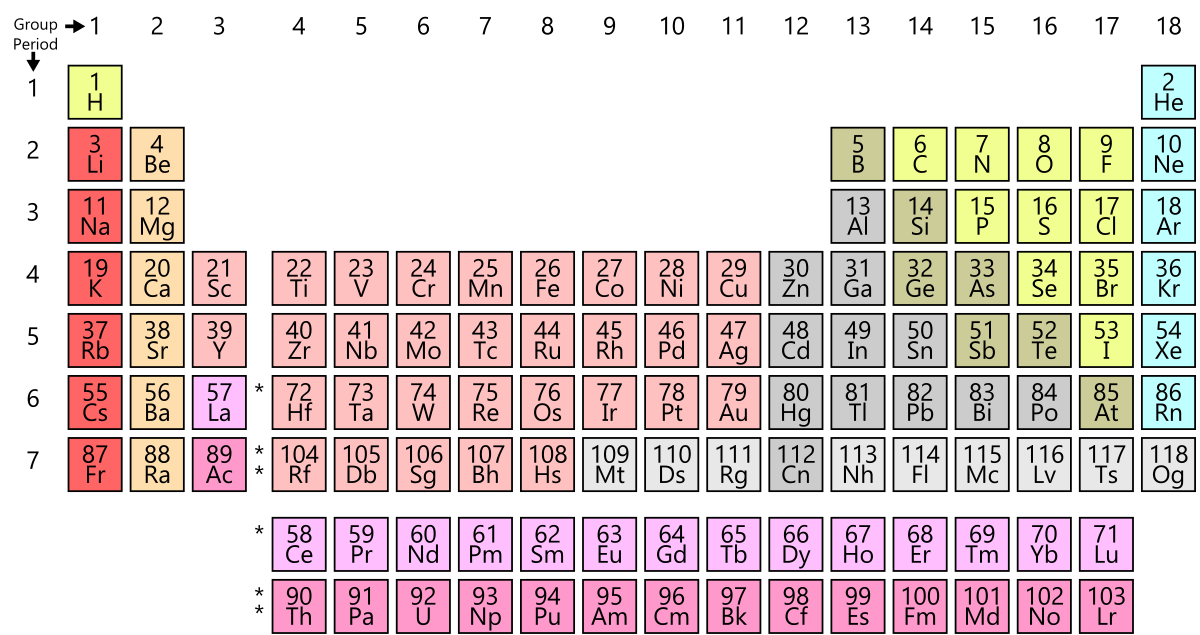
- Caption: The periodic table
-
C2.3 Group 1 - the alkali metals
- The elements in group 1 are called the alkali metals
- They have a silvery, shiny surface, becomes dull in air
- Easy to cut, low density, density increases going down
- Melting points and boiling points decrease going down the group
- All the metals react with water to produce hydrogen and an alkaline solution containing the metal hydroxide
- They form 1+ ions in reactions to make ionic compounds
- These are generally white and dissolve in water giving colourless solutions
- The reactivity of the alkali metals increases going down the group
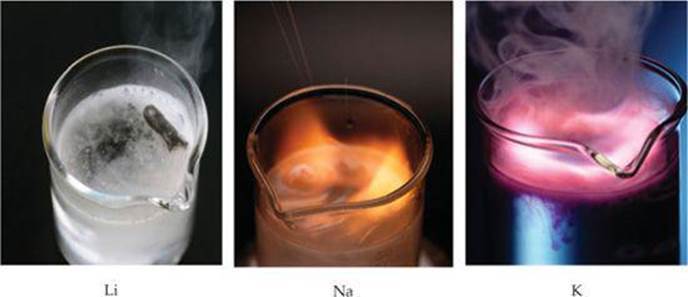
- Caption: Lithium, sodium and potassium reacting in water
-
- They all form 1- ions, halides, in their ionic compounds with metals
- They are all diatomic
- Melting points increase going down
- Poor conductors of heat and electricity
- They form covalent compound by sharing electrons with other non-metals
- A more reactive halogen can displace a less reactive halogen from a solution of one of its salts
- The reactivity of halogens decreases going down the group
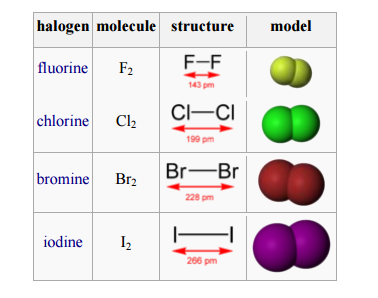
- Caption: The colours of the halogens
-
- The electrostatic attraction between the electrons in the outermost shell and the nucleus depends on:
- the distance between the outermost electrons and the nucleus
- the number of occupied inner shells which provide a shielding effect
- the size of the positive charge in the nucleus
- The increased nuclear charge due to extra protons in the nucleus is outweighed by the other two factors
- it is easier for the larger atoms to lose electrons going down a group and harder for them to gain one
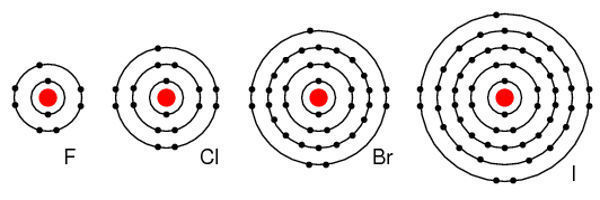
- Caption: Electronic structure of the halogens (note the sizes)
-
- Compared with the alkali metals, transition elements have much higher melting points and densities
- Stronger and harder
- Good conductors of heat and electricity
- Have high densities
- High melting points, except mercury
- Much less reactive
- Do not react vigorously with oxygen or water
- Can form ions with different charges in compounds that are often coloured
- Transition elements and their compounds are important industrial catalyst
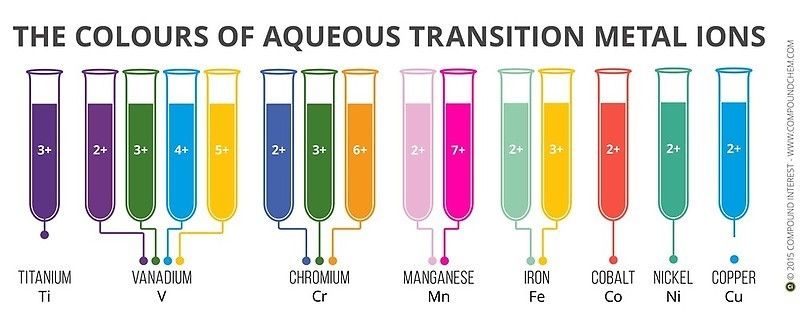
- Caption: The colours of aqueous transition metal ions
Information
- Description
- GCSE Chem (1 Atoms, bonding and moles) Slide Set on C2 The Periodic Table, created by Jess Wang on 31/03/2019.
- Created by
- Jess Wang
- Views
- 0
- Rating