
P4 & 5 Recap
Slides in this set (10)
-
- Starter
- 1. What is the Relative mass for Protons, Electrons and Neutrons
- 2. What is the Relative Charge for Protons, Electrons and Neutrons
- 3. Describe the atom structure
-
- 1. The Relative Mass for Proton is 1, Neutron is 1 and Electrons is very small
- 2. The Relative Charge for Proton is +1, Neutron is 0 and Electron is -1
- 3. There is an atom and inside the atom is a nucleus and inside the nucleus there are protons and neutrons. Orbiting the Nucleus is the Electrons
-
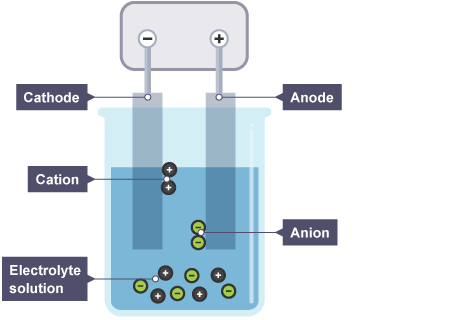
- Electrolysis means splitting up ionic compounds with electricity.
- An ion is a charged atom but a better way to put it is a loss and gain of electrons.
- The ion with a negative charge is called anion and its attracted to the anode during electrolysis
- The ion with a positive charge is called cation and its attracted to the cathode during electrolysis
- Caption: A diagram of the set up of Electrolysis
-
- Electrodes are rods that conduct electricity and they are made from Carbon.
- REMEMBER -
- Metals always form at the negative Electrode (Cathode)
- Non - Metals always form at the positive Electrode (Anode)
- What does OIL RIG stand for?
-
- OIL RIG stands for Oxidation is Loss and Reduction is Gain
- Oxidation is loss of Electrons and Reduction is gain of Electrons
- Reduction occurs at the Cathode
- Oxidation occurs at the Anode
- https://www.youtube.com/watch?v=NxuvwnRuylU
-
- Lead (Pb2+) will be attracted to the anode
- Bromine (Br-) will be attracted to the cathode
-
Electrolysis to extract Metals
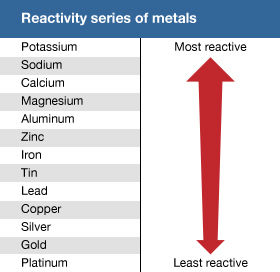
- Why cant we use Carbon to extract metals?
- Aluminium is more reactive than carbon
-
Electrolysis at aqueous solutions
- Rules at the anode - The least reactive anion gets discharged
- Rules at the cathode - If the Halide (Group 7) is present it will always get discharged
-
- Mg2+ + 2e- --> Mg = CATHODE
- Ca2+ + 2e- --> Ca = CATHODE
- 2cl- ---> 2Cl + 2e- = ANODE
- 2Br- ---> 2Br + 2e- = ANODE
-
- https://www.youtube.com/watch?v=AhTRiL6xjBA
Information
- Description
- Electrolysis
- Created by
- Habiba Hussain · Dec 2020
- Updated
- Mar 14, 2021
- Views
- 0
- Rating