
Atomic Structure & The Periodic Table
Slides in this set (4)
-
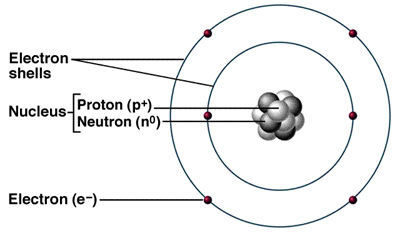
- Caption: Atomic Stricture
- Element- substance which contains only one type of atom.
- Atomic Number- The number of protons in the nucleus.
- Mass Number- Total number of protons and neutrons. (can be calculated by subtracting the atomic number from the mass number e.g mass number- atomic number=neutrons.
- Number of protons= Number of electrons
- Number of neutrons= mass number- proton number
- 59- Mass Number
- CO- Symbol for Element
- 27- Atomic number
-
Charges: Protons, Neutrons & Electrons
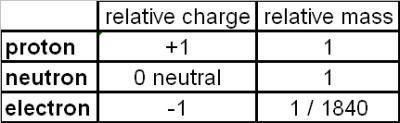
- Caption: Charges
-
Isotopes & Electronic Structure
- Isotopes- atoms that have the same number of protons but different number of neutrons.
- Atoms are more stable (less reactive) if they have a full outer shell of electrons. Only Atoms in group 8 e.g helium and neon have full outer shells of electron.
- Atoms in group 1 to 7 do not have a full outer shell of electrons so they want to fill their outer shell.
- From group 1-3 the shells lose electrons.
- In Group 4, the shells lose & gain electrons.
- From group 5-7 the shells gain electrons..
- Working out an elements electronic structure
- 1. Find the element in the periodic table,, work out what period it is in and draw that number of circles around the nucleus.
- 2. Work out which group the element is in and draw that number of electrons in the outer circle
- With 8 for group 0 elements
- 3. Fill the other circles with electrons (only two electrons in the first and 8 in the rest).
- 4. Finally count your electrons and check that they are equal to the atomic number.
Information
- Description
- IGCSE Chemistry Slide Set on Atomic Structure & The Periodic Table, created by younissafa9930 on 21/01/2016.
- Created by
- younissafa9930
- Views
- 0
- Rating