
Business Year 2 Theories
Slides in this set (15)
-
- S trengths
- W eaknesses
- O pportunities
- T hreats
- Strengths and Weaknesses are internal factors.
- Opportunities and Threats are external factors e.g. political, legal, economic, social, technological and environmental factors, and competitive behaviour.
- SWOT Analysis helps to develop a strategy.
- It considers the business' individual circumstances.
- Advantages
- Can be redone to take into account changing conditions
- Lets the business know where it has competitive advantage over its rivals
-
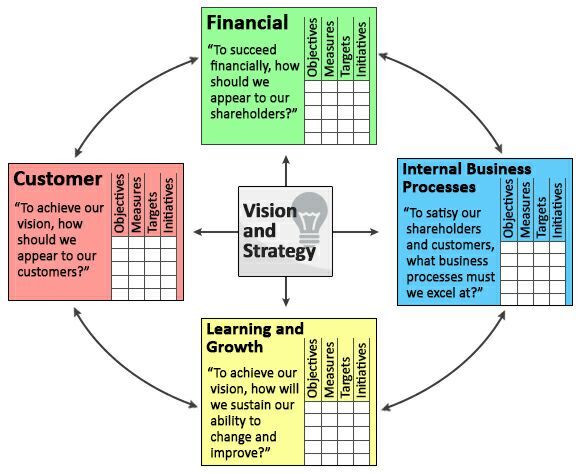
Kaplan and Norton's Balanced Scorecard Model
- Used to assess business performance
- Used in developing, implementing and monitoring strategy
- Uses both financial and non-financial data
- Advantages
- Treats the business as a number of dependent functions (means that all departments need to consider how their actions will impact others)
- A balance between the needs of different stakeholders
- Disadvantages
- Possibility of an information overload
- Potential conflict if one target contradicts another
-
Elkington's Triple Bottom Line
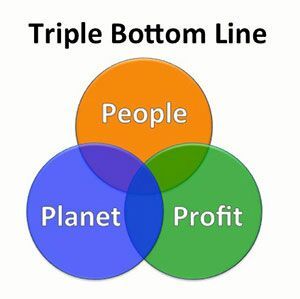
- People - a company's social values and the way it treats its employees and the local community
- Planet - a company's environmental values and impact on the environment
- Profit - the financial or economic value of the company
- Performance of each of these three areas are assessed and reported back to stakeholders.
- To implement the model, the business must set objectives for performance in each of these three areas.
- These objectives can be used by managers to guide strategic planning and to monitor the strategy's effectiveness.
- It can be more difficult to measure the impact of the business on people or the planet than financial performance.
- By assessing its performance in these three areas, the business is more likely to consider its actions in each area and alter its behaviour or culture if necessary.
- It's a good way of assessing overall performance as it takes into account the fact that businesses might have other objectives than just increasing their profit.
-
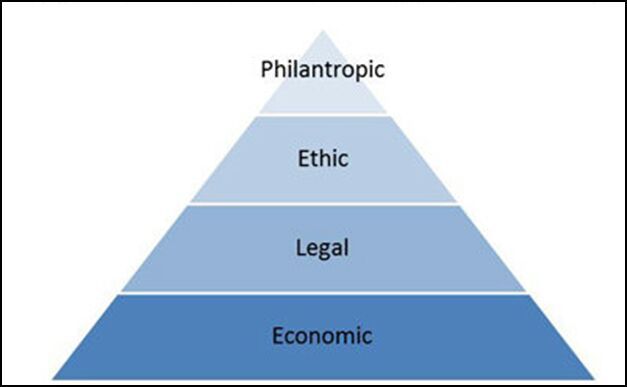
- CSR - Corporate Social Responsibility - the idea that a company should go above and beyond what is required by law to help society
- Philanthropic Responsibilities
- To be a good corporate citizen and to contribute resources to improve lives
- Ethical Responsibilities
- To do the right thing and avoid harm
- Legal Responsibilities
- To obey laws and regulations
- Economic Responsibilities
- To be profitable, so the business survives
- Used to analyse business decisions
-
- Barriers to Entry
- How easy it is for new firms to enter the market
- In the interest of existing firms to make it hard for new firms to get in
- High start up costs (e.g. expensive equipment) might deter new firms from entering the market
- Buyer Power
- Buyers want products at as low a price as possible
- Buyers have more power when there are few buyers and many sellers
- Buyers have more power when products are standardised
- A supplier's main customer can negotiate special deals and lower price.
- :Supplier Power
- Suppliers want to get as high a price as possible
- Suppliers have more power when there are few suppliers and lots of firms buying from them
- If it costs customers to switch suppliers, this gives the suppliers more power
- Threat of Substitutes
- How likely consumers are to buy an alternative
- The willingness of customers to substitute is a factor affecting competitiveness
- Relative price and quality are important (buyers are unlikely to change to a poor value product)
- For undifferentiated products, the threat is higher than for unique products
- Rivalry
- Rivalry is intense in a market with lots of equally sized competitors and in young industries where competitors are following growth strategies.
- Industries with high fixed costs and those producing standardised goods have intense rivalry.
-
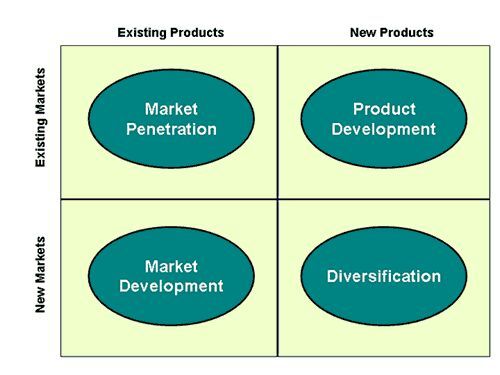
- Compares the level of risk involved with the different growth strategies
- Helps managers decide on a direction for strategic growth
- Advantages
- It forces managers to think about the expected risk of moving in a certain direction
- Disadvantages
- It fails to show that market development and diversification strategies also tend to require significant change in the day to day workings of the company
- Some people believe that it oversimplifies the options available for growth.
-
Porter's Three Generic Strategies
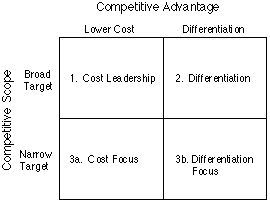
- Cost Leadership
- Lowest cost of production for a given level of quality
- Big business benefitting from economies of scale can use. This strategy
- In a price war the business can remain profitable, even if they have to lower prices because of low costs
- Differentiation
- Requires a product with unique attributes which consumers value so that they think it's better than rival products
- Allows businesses to charge premium prices
- Businesses that are innovative and offer quality products can benefit from this strategy
- Risks: competitors may try to imitate, consumers tastes change
- Focus
- Concentrates on niche market segments to achieve cost advantage or differentiation
- Suits firms with fewer resources who can target markets with specific needs
- Firms using this strategy usually have loyal customers which makes it hard for competitors
-
- Helps a business choose it's positioning strategy based on its competitive advantage and its market scope
-
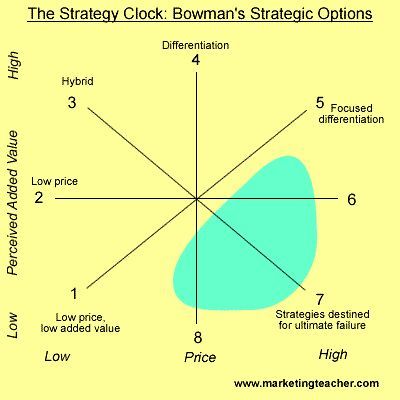
- Used to analyse the competitive position of a company.
- Corresponds to a strategy of low price products with low added value - only successful if products sell in high volume
- Corresponds to the cost leadership section of Porter's Strategic Matrix
- Hybrid area - modest prices with high perceived added value
- Corresponds to the differentiation section of Porter's Strategic Matrix
- Corresponds to the differentiation and focus section of Porter's Strategic Matrix
- Up to 8 - high price with fairly low perceived added value - unless a company has a monopoly, these positions will fail
-
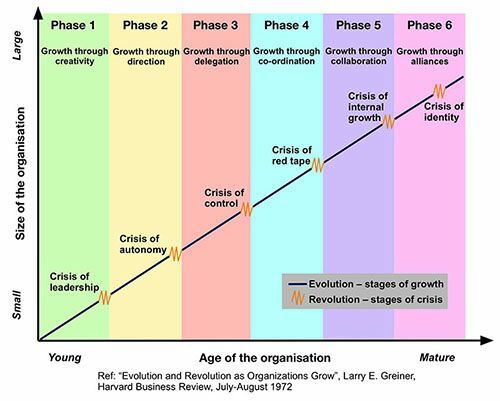
- Shows each phase of growth is followed by a crisis.
- Phase 1 - Creativity --> Leadership Crisis
- Startups are often very creative however once it has grown to a reasonable size, it will need strong leadership to give the company direction and structure.
- Phase 2 - Direction --> Autonomy Crisis
- Leaders set up formal organisational structure however once employees have more experience they will want more say in decisions and the business will be too big for senior managers to manage everything. More autonomy is needed through delegation.
- Phase 3 - Delegation --> Control Crisis
- More power and responsibility is delegated to middle managers and the organisational structure may become decentralised. Leaders may try to regain control in order to have a more coordinated business.
- Phase 4 - Coordination --> Red Tape Crisis
- Control is regained by senior managers and certain decisions become centralised. New procedures are implemented to coordinate but there may be too many of them which leads to decreased efficiency as people are constantly waiting around for decisions to be made or approved.
- Phase 5 - Collaboration --> Growth Crisis
- To continue growing, some formal procedures are replaced by collaboration between departments and teams. More focus on communication and information management. Company may struggle to grow internally and may have to consider external growth.
-
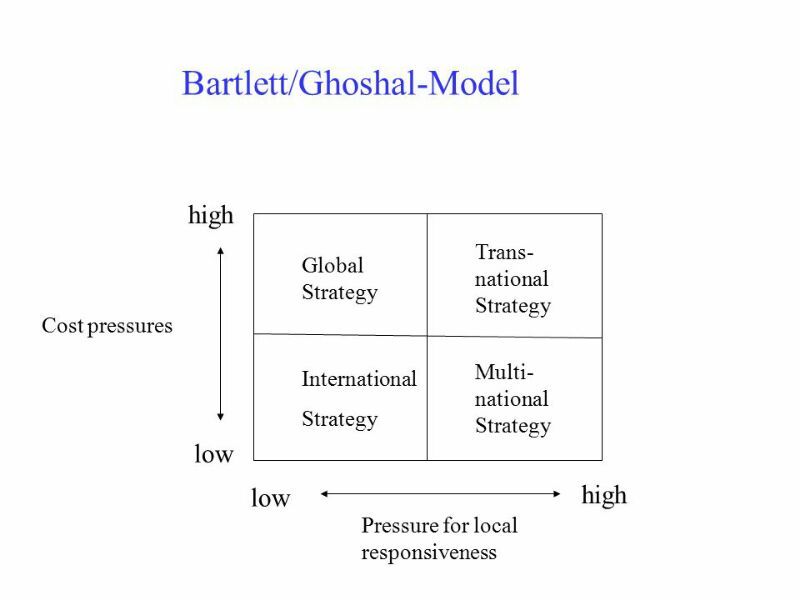
Bartlett and Goshal's International Business Strategies
- International Strategy
- If pressure for localisation is low (demand in both other countries and home country is similar) and pressure to reduce costs is low, international strategy is adopted.
- Business structure is centralised with most research and decisions made at head office
- Multidomestic Strategy
- When demands of the markets are very different and there is little pressure to reduce costs, multidomestic strategy is implemented.
- Different branches of the business will look and work differently and products will be adapted and promoted to suit local markets.
- Knowledge won't be shared between the separate branches.
- Global Strategy
- When demands of the markets are similar and global coordination of the business could reduce costs, a global strategy is implemented.
- Will be centralised and will coordinate operations across countries to take full advantage of economies of scale.
- Products will remain standardised and innovation and development will take place at a central location however the knowledge and resources will be passed on to the different branches.
- A business may decide to only sell specific products in certain countries rather than its full range.
- Transnational Strategy
- When pressure to reduce costs and pressure to meet local needs is high, a transnational strategy is implemented.
- It's focus is on developing knowledge and ideas locally and sharing them globally in order to benefit the whole business.
- The business structure will balance between centralisation and decentralisation where the responsibilities passed down to each branch of the business are based on experience and capabilities.
-
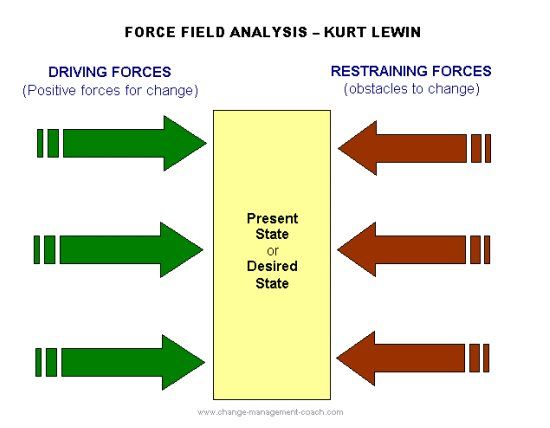
- It helps a business to understand change in different situations.
- The diagram shows the plan and the forces supporting the plan and the forces opposing the plan.
- The forces are written down and then numbered to show how significant they are from 1 (least) to 5 (most).
- The numbers add up to show the total force for and against the plan.
- It can help the business decide whether or not to go ahead with the plan.
- It can also help managers work out how forces could be strengthened or weakened.
-
- Kotter and Schlesinger's Four Reasons for Resistance to Change
- Self-Interest
- People are more concerned with their own situation rather than the success of the business. If they can't see how the change directly benefits them, they will resist it.
- People can't see that ultimately a more successful business may have individual benefits too.
- Misunderstanding
- People also resist change when they don't fully understand what it meas for them. They will think that they have more to lose than to gain until they are told otherwise.
- Poor communication from management can lead to incorrect information being passed down to the workforce. This breeds uncertainty and confusion and will increase anxiety amongst employees.
- Businesses need to have a high level of trust between employees and managers to prevent misunderstandings.
- Low Tolerance of Change
- People get used to completing tasks the way they know and will resist change if they fear that they won't be able to develop the new skills required after the change. They may believe that they won't perform as well in the new situation and they will lose their job security.
- There may also be a loyalty to existing relationships and methods as these are known and established.
- Different Assessments of the Situation
- The key stakeholders may have strong disagreements over the reasons for change and therefore there may be an inability to accept the need for change.
- They may not be able to see the advantages brought by the change - they may only see the disadvantages.
- They may agree that a change is needed but think they have a better idea of what to change.
-
- Kotter and Schlesinger's Six Ways of Overcoming Resistance to Change
- Education and Communication
- Managers need to raise awareness of the reasons for change and how it will be carried out.
- The process usually involves discussions, presentations and reports which should clearly communicate the reasons behind the planned change and identify the benefits for the business and the individuals.
- Participation and Involvement
- Key stakeholders should be involved in the design and implementation of the change.
- If they participate in the process then they will feel more engaged and their ideas form part of the change.
- If people become part of the process, it'll be more difficult for them to resist the change.
- Facilitation and Support
- Listening to the concerns of the workforce by holding regular meetings will help workers to adjust as they'll feel supported
- It can also help the business to meet the needs of the workers.
- Support groups can help workers to overcome their anxiety about the changes.
- Businesses should provide training for workers who will be required to gain new skills.
- Negotiation and Agreement
- Giving stakeholders opportunities to negotiate and compromising over key sticking points can lead to full agreement over the proposed change.
- Financial/Non-financial incentives may need to be offered by the business in order to obtain full acceptance of the change.
- If full agreement can't be made then voluntary redundancy or early retirement may be offered to employees who are resisting change.
- Manipulation and Co-Option
- An employee who is resisting change may be given a desirable role in the process in order to gain their cooperation.
- Can be a risky strategy - roles often give the worker little power and they can feel tricked into agreeing to change.
- A manager may manipulate the information regarding the change e.g. exaggerating the extent of a financial crisis and state there's no other alternative.
- If it is found out that the manager has manipulated information, they will have lost the trust of their workers.
- Explicit and Implicit Coercion
- In order to speed up the process, a person may be threatened to comply with the planned changes or face consequences.
- The consequences of resistance could be clearly stated or just implied.
- Consequences include: redundancies, losing out on promotion opportunities, transfers to other departments, etc.
-
Handy's Types of Organisational Culture
- Power Culture
- Centralised structure
- Power cultures may struggle if the business grows and cannot be run from the centre
- Employees are likely to be resistant to change because they don't have the opportunity of giving their opinions on changes; might also have a lack of faith in senior managers as they feel they are out of touch with the day -to-day activities of the business.
- Role Culture
- Common in bureaucratic firms where authority is defined by job title.
- Decisions come from senior managers - employees don't have the opportunity to get involved in the decision making process.
- Tend to have poor communication between departments so respond slowly to change - can result in them losing out to competitors in new or expanding markets where strategies need to be developed and implemented quickly.
- Tend to avoid risk for fear of failure which means that change is rare.
- Any changes brought in will meet resistance as employees are not used to doing things differently.
- Person Culture
- Common in loose organisations of individual workers e.g. doctors, solicitors
- Objectives of these firms defined by the personal ambition of the individuals - firms have to ensure that the individuals have common goals
- Decisions are made jointly so all employees are likely to be comfortable
- However decisions on change can be difficult to make - individuals often only think about themselves rather than the rest of the organisation.
- Task Culture
- Places emphasis on getting tasks done
- Gets small teams together to work on a project, then disbands them - may be conflict between teams for resources and budgets, can be confusing if a firm as too many products/projects
- Responds well to management by objectives which turn into targets for each department or individual
- Staff are likely to think change is normal because they are used to changing teams often and working with a variety of people.
- Means there will be less resistance to change.
Information
- Description
- AS - Level Business studies Slide Set on Business Year 2 Theories, created by Rebecca Cooling on 05/05/2017.
- Created by
- Rebecca Cooling
- Views
- 6
- Rating