
Karteikarten
Ch 7
Karten in diesem Stapel (89)
- 1learningprocess by which experience produces a relatively enduring change in an organism's behaviour/capabilities (in CNS over lifetime)
- 2Learning is a process of _______ to the changing conditions in our lifepersonal adaptation
- 3behaviorist view of learninglaws of learning apply to all organisms
organism is a tabula rasa/blank slate - 4habituationdecrease in strength of response to a repeated stimulus, simple form of learning, in CNS
adaptive, allows us to conserve energy
(note: Sensory adaptation is different, decreased sensory response) - 5sensitizationincrease in strength of a response to a repeated stimulus
Occurs to strong/unpleasant stimuli
Adaptive purpose is to increase responses to potentially dangerous stimuli - 6classical conditioningorganism learns to associate two stimuli so that one stimulus produces a response originally produced by the other stimulus
- 7Ivan PavlovNoticed that w repeated testing, dogs salivated before food was presented
CC alerts organisms to stimuli that signal the arrival of an important event
Found that tone became a CS faster when followed by more food - 8CC termsNeutral stimulus-does not elicit the response
Unconditioned stimulus (UCS)-no learning, causes a reflexive response
Unconditioned response (UCR)-reflexive response
Learning trial-tone and food are paired
Conditioned stimulus (CS)-stimulus gained value through association/learning
Conditioned response (CR)-response by a learned stimulus - 9number of pairings needed for CC?When UCS is strong, maybe only one CS-UCS pairing is needed (e.g. car accident)
- 10forward short-delay pairingfastest learning, CS is still present when UCS is presented
- 11forward trace pairingadaptive value, CS first and disappears seconds before UCS
- 12simultaneous pairingslower learning, CS and UCS at same time
- 13backward pairingslowest learning/doesn't occur, UCS first then CS
- 14extinctionCS is presented repeatedly in absence of UCS (extinction trials), so CR weakens and disappears
SO occasional re-pairings of CS and UCS are required to maintain CR - 15spontaneous recoveryafter a rest period, encounter with UCS can cause CR to reappear (w/o learning trials)
New CR is usually weaker than original CR, disappears faster w/o UCS - 16generalizationstimuli similar to initial CS elicits a CR (the more similar, the stronger the response)
- 17discriminationCR occurs to one stimulus but not others
-Reduces stress of responding to every similar stimulus
-Pairing UCS-CS and similar stimuli (w no response) increases discrimination - 18higher order conditioningneutral stimulus becomes CS after pairing with previous CS (Usually produces weaker CR that disappears faster)
- 19paraphilia and symptomsrecurring, unconventional sexual behaviour that is obsessive and compulsive
-Intense arousing fantasies
-Nonhuman objects
-Suffering/humiliation of partner
-Objects/nonconsenting adults/children - 20Little Albert experimentJohn Watson and Rosalie Rayner:
-Shown a white rat, causing no fear
-Paired a loud noise (steel bar w hammer) with rat
- Eventually rat, w/o noise, made Albert cry
-Also saw that similar objects made him cry (generalization) - 21Exposure therapytreating phobias/fears: to expose patient to CS w/o UCS
- 22systematic desensitization□ Reduces anxiety through counter conditioning
□ Develop fear hierarchy
□ Relaxation training
□ Gradually increase exposure - 23floodingReducing anxiety through extinction: complete exposure to feared stimulus and eventual habituation
- 24conditioned attractione.g. Pairing neutral odours with pleasing physical massage increases attraction to that odour
e.g. Ppl become sexually aroused to stimuli after pairing with sexually arousing UCS - 25aversion therapyAKA counter conditioning, reducing arousal/attraction to stimuli by pairing w noxious UCS (Usually short term changes and not generalizable outside of environment where it was learned)
- 26covert sensitizationindividual imagines aversive/negative stimuli, pairs with undesired behaviour
- 27attitude formationNeutral stimuli become attractive/unattractive when paired w UCS causing positive/negative UCR
- 28constraints on learning- Easier to condition fear to some stimuli than others
- Easy to condition aversion to a taste by pairing with illness, but difficult to condition aversion to visual stimuli by pairing with illness - 29sorbet experimentGiven sorbet with norepinephrine vs. control group with no norepinephrine-Experimental group eventually had stronger immune reaction just eating sorbet
- 30ANV (Anticipatory Nausea and Vomiting)□ 20-50% become nauseated and vomit before chemotherapy
□ UCS (sickness caused by treatment) and CS (treatment room/IV) cause CR (nausea)
□ Pair CS with relaxation and pleasant images - 31virtual reality therapyStudy with spider phobia: control group showed no improvement while VRET group did
○ VRET is as effective as in vivio
○ Has been applied to PTSD - 32operant conditioningbehaviour is influenced by its consequences
- 33Thorndike's experiment○ Built a puzzle box/cage that could be opened from the inside by a string or lever
○ Put hungry animal inside, food outside
○ First opening of box was by accident, but afterwards, performance improved
○ Concluded: animals did not attain "insight" into solution, only were more likely to perform actions that worked - 34instrumental learningorganisms behaviour is instrumental in getting outcomes
- 35law of effectThorndike, in a situation, a response followed by positive result is more likely to occur
- 36B.F. SkinnerDesigned the Skinner Box: lever on a wall above a cup, pressing lever allows food to drop, Put hungry rat in, recorded behaviour on cumulative recorder
Identified reinforcement and punishment - 37reinforcementresponse strengthened/increased in frequency by an outcome that follows it
Outcome is a reinforcer (e.g. food) - 38punishmentresponse is weakened by outcome, outcome is punisher (e.g. electric shock instead of food)
- 39ABCs of operant conditioningA (antecedents)-stimuli present before behaviour occurs
B (behaviours)- by organism
C (consequences)-follow the behaviours - 40contingenciesrelation b/w antecedent and behaviour, and behaviour and consequences
- 41discriminative stimulussignal that a particular response will produce certain consequences (e.g. food on plate, class bell)
- 42positive reinforcementresponse is strengthened by the presentation of a stimulus (positive reinforcer)
e.g. getting paid - 43negative reinforcementresponse is strengthened by removal/avoidance of a stimulus (negative reinforcer)
e.g. aspirin to relieve a headache - 44Operant extinctionweakening and eventual disappearance of a response b/c it is no longer reinforced
- 45alternative to punishmentidentify reinforcer for negative behaviour, apply operant extinction
- 46positive punishmentresponse is weakened by presenting aversive stimuli
- 47limitations of positive punishment-Does not cause organism to forget how to make the response
-Doesn't provide a better alternative
-May not generalize to other situations
-Positive physical punishment can tell a child that aggression is effective - 48negative punishmentresponse is weakened by removal of a desirable stimulus (response cost)
-Less likely to create fear/hatred of the punishing agent
-Less opportunity for learning aggression - 49limitation of negative punishmentdoesn't guarantee that better behaviour will occur
*in parenting, shouldn't take away love/attention and should communicate dislike for the behaviour (not the child) - 50primary reinforcersstimuli that an organism naturally finds reinforcing b/c they satisfy biological needs (e.g. attention and praise, food)
- 51secondary/conditioned reinforcersother stimuli associated with biological needs (e.g. money)
- 52immediate vs. delayed consequencesimmediate consequences are stronger
- 53Delay of gratificationability to forego an immediate smaller reward for a delayed more satisfied one
- 54shapingreinforcing successive approximations towards a final response (reduces acquisition time)
- 55chainingdevelops a sequence of responses by reinforcing each response with the opportunity to perform the next one
- 56Operant generalizationoperant response occurs to a new antecedent stimulus similar to the original one
- 57Operant discriminationoperant response occurs to one antecedent stimulus and not another
- 58stimulus controlWhen discriminative stimuli influence operative behaviour
- 59continuous reinforcementevery response of a type is reinforced (more rapid learning than partial, but also extinguished quicker)
- 60partial reinforcementintermittent reinforcement, only some responses are reinforced (learned more slowly, more resistant to extinction)
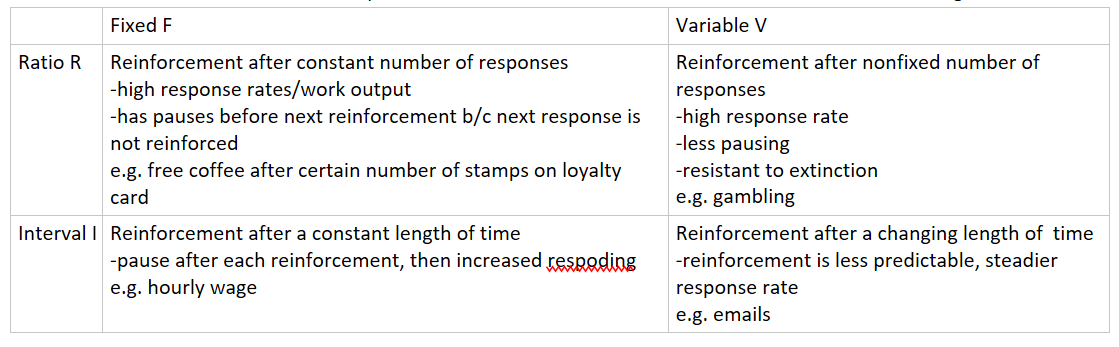
- 61ratio schedulecertain percentage of responses are reinforced
- 62Interval schedulecertain amount of time must elapse between reinforcements
- 63fixed schedulereinforcement always occurs after a specific number of responses or time interval
- 64variable schedulenumber of responses needed or time interval varies at random around an average
- 65reinforcement schedules
- 66best reinforcement schedulereinforce on a continuous schedule until behaviour is established, shift to partial that is made more demanding
- 67escape conditioningorganisms learn a response to terminate an aversive stimulus
e.g. put on sweater when cold - 68avoidance conditioningorganism learns a response to completely avoid an aversive stimulus
e.g. put on sweater before you are cold - 69Two-factor theory of avoidance learningclassical AND operant conditioning
e.g. Warning light is paired with UCS shock, light becomes a CS causing fear, fleeing is negatively reinforced by termination of fear, strengthens avoidance response - 70Skinner: individual and societal problems are created by the haphazard use of ______ + reliance on ________reinforcement, punishment
- 71Token economicsdesirable behaviour are quickly reinforced with tokens that are later used for other reinforcers
- 72Applied behaviour analysisfield influence by Skinner's work, AKA behaviour modification
Usually uses a program developed that uses positive reinforcement - 73preparednessMartin Seligman: animals are prewired through evolution to easily learn behaviours related to species survival
- 74conditioned taste aversionpairing smell/taste (CS) with toxin/illness producing agent (UCS) produces repulsion (CR) by smell/taste
John Garcia: When rats were exposed to sweet water, bright light and buzzer simultaneously (along with x-rays that made them sick) they only developed an aversion to the sweet water
=biologically primed to form taste-illness associations - 75biological preparedness for fearArne Ohman-we tend to develop fear towards things that have evolutionary significance
Fear can be conditioned easily to some stimuli than others - 76Instinctive driftconditioned response "drifts" back toward instinctive behaviour (e.g. once stimulus is rewarded with food, some act like it is food)
- 77learning in the brainNucleus accumbens and neurotransmitters have roles in reward
Cerebellum-important in acquiring CC movements
Amygdala-involved in acquiring CC fears - 78SR (stimulus response) psychologylearning involves the relatively automatic formation of bonds between stimuli and responses (early behaviourists)
- 79SOR cognitive modellearning involving individual's mental representation of the world
- 80Wolfgang Kohler-learninggave chimpanzees learning tasks, found that they were able to learn by insight (perception of a useful relationship that helps to solve a problem)
Dr. Laura says this was not shaping, as behaviourists believed - 81Edward Tolman-learningfound that rats developed a cognitive map (mental representation of a maze)
Learning provides KNOWLEDGE, then organisms develop an EXPECTANCY (expectation that CS will be followed by UCS)
Behaviourists disagreed - 82most important factor in CCnot pairing frequency but how well CS predicts appearance of UCS
- 83place cellsdiscovered by O'Keefe
neurons that become active when an animal is in a specific location in the environment
(Become activated in temporal sequences=order in which animal visited location, BUT neighbouring place cells do not become active in neighbouring spatial locations) - 84Dabaghian studyrecorded activity of place cells in rats through a maze to get chocolate milk
Altered maze geometry but not topology
Rat behaviour didn’t change much, so sp place cells represent topological map (like subway map) - 85Numerosity and frequency discrimination (two principles)sensitivity to number of items
1. The larger the diff, the easier the comparison
2. Accuracy decreases as the number of items increases, even with same distance - 86Wilhelm von Ostenclaimed that his horse could count, do arithmetic, colours, etc.
-Could answer spoken and written questions
-Pfungst stated that Hans/horse had learned to interpret cues from body language - 87Latent learninglearning that occurs but is not demonstrated until there is an incentive to perform
- 88observational learninglearning that occurs by observing the behaviour of a model
- 89Bandura's social-cognitive theoryATTENTION
RETENTION
REPRODUCTION
MOTIVATION (to display behaviour)
(ARetRepMot)
Informationen
- Beschreibung
- Psych Karteikarten am Ch 7, erstellt von Icecream M am 13/12/2017.
- Erstellt von
- Icecream M
- Aufrufe
- 0
- Bewertung