
Karteikarten
Learning and Memory
Karten in diesem Stapel (83)
- 1What is neural plasticity?The ability of the brain structure to change from experience throughout life.
The more complex the experience, the more complex the change. - 2What parts of the brain have higher levels of plasticity?The sensory and motor cortex
- 3What is Synaptic Plasticity?The ability of the synapse to change over time due to the growth of new synaptic connections that strengthen the synapse or synaptic pruning brought on by lack of use of the synapse.
- 4What is Herbs rule?'Neurons that fire together, fire together'
- 5What is the difference between Long-term Potentiation and Long-term Depression?LTP is the strengthening of synaptic connections, resulting in enhance or more effective synaptic transmissions. LTD is a decrease in the strength of synaptic transmissions.
- 6What causes LTD?Lack of stimulation of pre-synaptic and post-synaptic neurons or prolonged low level stimulation.
- 7What are the similarities between Neurotransmitters and Neurohormones?- Both chemical substances
- Can dampen or enhance a response. - 8What are the differences between Neurotransmitters and Neurohormones?- Neurotransmitters are released at the synapse to interact with the post and pre synaptic neuron.
- Neurohormones are released by a neuron and secreted into circulation.
- Neurohormones can function as both hormone and neurotransmitter but neurotransmitter can't. - 9What does glutamate do in relation to plasticity?It binds neurons together through synaptic plasticity involved in LTP.
(Neurotransmitter) - 10What does Adrenaline do in relation to plasticity?It enhance long-term memory and is important for encoding emotional memories and ensures memory strength relates to memory.
(Neurohormone) - 11What is the process of an Emotional Arousing Experience?- Adrenaline is released
- Induces release of noradrenaline
- Activates the Amygdala
- Triggers the hippocampus
- Hippocampus encodes important details. - 12What is Learning?A relatively permanent change in behaviour that occurs as a result of experience and is ongoing.
- 13What is Classical conditioning?Is the repeated association of 2 or more different stimuli. Learning occurs when a particular stimulis consistently produces a response that it didn't produce before.
- 14What is conditioning?The process of learning associations between a stimulis in the environment (one event) and behavioural response (another event).
Eg. associating a smile with friendly behaviour. - 15What did Ivan Pavlov do?He discovered classical conditioning by measuring dogs salivation. He released that the dogs salivated when they saw the feeders and not just when they saw/tasted the food.
- 16What is the Three-Phase Model?The three phase model is the stages that occur during classical conditioning. Before conditioning, During conditioning and After conditioning.
- 17What is a Unconditioned Stimulus?Any stimulis that consistently produces a naturally occurring automatic response. (Unconditioned Response)
- 18What is a Conditioned Stimulus?It is the stimulis that is neutral at the start of a process and doesn't normally produce the UCR. Through association with the UCS it produces a similar response to the UCR.
- 19What is an Unconditioned response?The response that occurs automatically when the UCS is presented. Reflexive, involuntary response and predictably caused by UCR.
- 20What is a conditioned response?It is the learned response produced by the CS. Similar to UCS, but triggered by CS.
- 21What is a neutral Stimulus?Produces no naturally occurring response.
- 22What is Stimulus generalisation?It is the tendency for another stimulus similar to the CS to produce a response that is similar to the CR.
- 23What is stimulus Discrimination?When the person responds to the CS only, but not similar stimuli.
- 24What is extinction?Extinction is the gradual decrease in strength of CR that occurs when UCS is no longer presented.
The disappearance of a CR following a lack of pairing of the UCS with the CS. - 25What is spontaneous recovery?It is when the CR reappears when CS is presented, following a rest period with no CS after extinction appears to have occurred.
- 26What is a conditioned emotional response?Is observed when the autonomic NS produces a reaction to a stimulus that did not previously cause that reaction.
- 27What is an example of a conditioned emotional response?Dentist drill - the association between pain & sound.
The sound of the drill - CS
Drilling of the tooth - UCS
Fear - Conditioned emotional response. - 28What is Acquisition in relation to classical conditioning?The development of a conditioned response through the repeated associations between UCS and CS.
- 29Who is B.F. Skinner?He discovered operant conditioning in the 1930's via his Skinner boxes.
- 30What is operant conditioning?It is a response that occurs and operates on the environment to produce some kind of effect.
- 31What does the ABC in the ABC model stand for?Antecedent - discriminative stimulus
Behaviour - operant response
Consequence - 32What is a consequence?It is a response to an action. It can be a positive or negative reinforcement. It can also be a punishment .
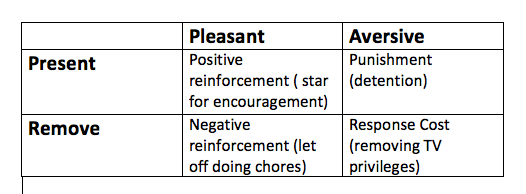
- 33What is a Reinforcement?A reinforcement is when a desirable behaviour is encouraged with the view to strengthen it. For example to give something desirable or takeaway something undesirable.
- 34What is a Punishment?When undesirable behaviour is discouraged with a view to weakening it. For example to give something undesirable or to takeaway something desirable.
- 35What types of consequences are there
- 36What is continuous reinforcement?Reinforcement is given after every correct response. This is essential in the acquisition stage but not effective for maintaining a maximal response.
- 37What is partial reinforcement?Reinforcing after same responses, but not after all of them. This is used after the acquisition stage and responses tend to be stronger and less easy to extinguish.
- 38What are the 3 factors that make reinforcement effective ?Order of presentation
Timing
Appropriateness - 39What does order of presentation mean?It means that a reinforcement or punishment should always occur after a desired response (should be consistent)
- 40What does appropriateness mean?It means that you need to take in account the personal characteristics of the individual and the individual situations when deciding whether the stimulus will act as a reinforcement or punishment.
- 41What are the factors involved in Operant conditioning?Stimulus generalisation
Stimulus discrimination
Acquisition
Extinction
Spontaneous Recovery - 42What is Stimulus generalisation in relation to Operant Conditioning?Occurs when the correct response is made to another stimulus that is similar to the stimulus that was present when the original behaviour was reinforced.
- 43What is stimulus discrimination in relation to Operant Conditioning?This is when an organism makes the correct response to a stimulus, and is reinforced, but does not respond to any other stimulus even when similar.
- 44What is acquisition in relation to operant conditioning?It is the establishment of a response through reinforcement.
- 45What is extinction in relation to operant conditioning?The gradual decrease in the strength or rate of a learned response following consistent non-reinforcement at the response.
- 46What is spontaneous recovery in relation to operant conditioning?Can occur after the apparent extinction and involves the organism once again showing the response in the absence of any reinforcement.
- 47Operant Vs Classical Conditioning
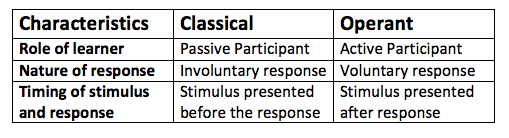
- 48Positive consequence Vs Aversive consquencePositive strengthens behaviour and the other weakens it.
- 49What is the social learning theory?Learning that occurs by watching another persons actions and their consequences to guide future behaviour.
- 50What is the process in Social Learning- Attention
- Retention
- Reproduction
- Motivation
- Reinforcement - 51What is attention in relation to observational learning?Learner actively watches model.
- 52What is retention in relation to observational learning?Learner stores mental representation of behaviour.
- 53What is reproduction in relation to observational learning?Learner has the mental and physical ability to perform the behaviour.
- 54What is Motivation in relation to observational learning?the learner mist want or desire to imitate the behaviour.
- 55What is reinforcement in relation to observational learning?A positive outcome means the learner is more likely to repeat the behaviour.
- 56Types of motivation includeIntrinsic and Extrinsic
- 57Types of reinforcement includeSelf reinforcement
External reinforcement
Vicarious reinforcement - 58What is Vicarious Conditioning?Watching a models behaviour being reinforced or punished = replicate or refrain from the behaviour
- 59What is Vicarious reinforcement?Increases the likelihood of the observer behaving in a similar way to a model whose behaviour is reinforced.
- 60What is Vicarious Punishment?Occurs when the likelihood of an observer performing a particular behaviour decreases after having seen a models behaviour being punished
- 61What is memory?Memory is the processing, storage and retrieval of information acquired through learning.
- 62What is memories information process?Encoding - converting the information to a useable form.
Storage - retention of the coded information.
Retrieval - information recovered from memory and brought into consciousness. - 63What is Atikins - Shiffrin Multi-store Model?It is three seperate components that differ in function capacity and duration.
- 64What are Atikins - Shiffrin Multi-store Model's three seperate components?-Sensory Memory
- Short-term Memory
-Long-term Memory - 65What is the duration and capacity for Sensory memory?It stores vast quantities of incoming sensory information for up to several seconds.
- 66What is the duration and capacity for Short-term memory?Information is processed, encoded and stored for up to 18 - 20 seconds. It has the capacity of 5 - 9 items.
- 67What is the duration and capacity for Long-term memory?It is stored up to a lifetime.
- 68What is a structural feature?A permanent built in fixed features of memory that
- 69What is a control process?selected and used by the individual may vary in different situations. They are under conscious control of the individual.
- 70What are sensory registers?It is where all the stimuli that bombard our senses are retained in their original form for a very brief time.
- 71What is iconic memory?- Visual sensory memory. Images only last in iconic memory for about 0.2 - 0.4 seconds.
- 72What is echoic memory?Auditory sensory memory. Stores sounds for 3 - 4 seconds.
- 73How do you improve the capacity of STM?You can improve STM capacity by chunking
- 74What is chunking?The grouping or packing of bits or units of information into larger bits or units that can be remembered as single units.
- 75How do you improve STM duration?Rehearsal
- Elaborative
- Maintenance
- Self reference effect - 76What is implicit memory?Memory without awareness.
- Procedural
- Classical Conditioned - 77What is procedural memory?Motor skills and actions
- 78What is classical conditioned memory?Conditioned response to a conditioned stimulus.
- 79What is explicit memory?Memory with awareness
- 80What is semantic memory?Facts and Knowledge
- 81What is episodic memory?Personal experience and events
- 82What is the serial effect?a finding that free recall of a list of items is better at the start and end of the list than for those in the middle.
- 83—
Informationen
- Beschreibung
- Year 12 Psychology Karteikarten am Learning and Memory, erstellt von Briana Mcnair am 24/10/2018.
- Erstellt von
- Briana Mcnair
- Aufrufe
- 0
- Bewertung