
Karteikarten
Ch.7 Attention
Karten in diesem Stapel (53)
- 1What is Attention?Concentration of mental activity that allows you to take in a limited portion of the incoming sensory world. (Attention is the process by which the mind chooses from among the various stimuli that strike the senses at any given moment)
Attention exists in order to allow stimuli with predicted or actual emotional or motivational significance to be selectively processed. - 2Does attention have limits?Yes, there is a limited amount of mental resources can be directed by top-down or bottom-up processing.
- 3Properties of attention-Limited amount/ capacity
-Voluntary/ top-down/ endogenous (selective, filter)
-Involuntary/ bottom-up/ exogenous (automatic, arousal)
-Vigilance
-Awareness (consciousness) - 4Issues in understanding attention1) Can you attend to all sensory/perceptual and mental activity?
2) How much can you take in?
3) What factors determine what draws you attention?
4) What factors determine what holds your attention?
5) What happens to information that is not attended to? - 51) Can you attend to all sensory/ perceptual mental activity? 2) How much can you take in?1) Yes
1) Attentional resources are not infinite and can be directed by top-down or bottom-up processing - 63) What factors determine what draw your attention? 4) What factors determine what holds your attention?Infants attend to changes in color, shape, movement, voice, phonemes, and novelty
Adults are sensitive to all these plus other types of arousing input (interest, excited, important, unexpected) - 75) What happens to information that is not attended to?Unattended information undergoes shallow processing and may not reach awareness
- 8Types of attentional mechanisms-Divided attention
-Selective attention
-Spatial attention (A type of selective attention which can be overt or covert) - 9—Frontal: maintaining vigilance
Parietal (posterior): orienting in space
Frontoparietal network: reorienting attention
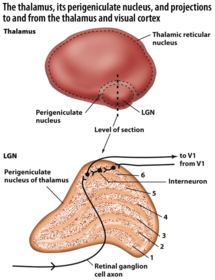
Thalamic: reflexive attention and attentional filtering
Superior Colliculi: saccadic eye movements - 10Attention PathwaysMain pathway: Retina--LGN--V1--V5 "where" or V4 "what"
Secondary pathway: Retina--SC--Amygdala--V4 or V5
V4-Color information
V5-Location information
*We don't need the primary pathway to see, other pathways can take over perception (Blindsight)* - 11Divided attention-Trying to pay attention to two or more simultaneous messages
-Trying to perform two tasks at the same time
-Strayer and colleagues (2003): simulated-driving studies - 12Selective attention-Respond selectively to certain kinds of information, while ignoring other information
-People notice little about the irrelevant tasks
-Selective nature of attention depends in part on task, arousal, interest, and importance - 13Dichotic listening-One message presented to one ear and another message presented to the other
-When asked to shadow one message people notice very little about the unattended message
-In general, we can only process one message at a time
-We may process the unattended message when both messages are presented slowly, the task is not challenging, the meaning of the unattended message is relevant
-N1 amplitude is higher (more responsive) to attended stimulus compared to the unattended stimulus - 14What is noticed from the unattended channel?-Change from English to German: No
-Same word repeated 40 times: No
-Voice change from man to woman: YES
-Both ears start playing the same message: YES
-Own name (Cocktail party effect): YES
-People follow meaning of attended channel to unattended channel
-Conditioned words in unattended channel elicit physiological response - 15Important properties of attention shown by dichotic listening tasks-Attention can be selective
-Attention has a limited capacity
-Focused attention comes with a cost
-Info not attended to is not blocked out entirely
-Unattended info is NOT extensively processed - 16Principles of divided attention-Divided attention is more challenging to maintain when tasks are difficult, require conscious attention, and are similar to other tasks
-Divided attention is easier to maintain when you engage in a well-practiced task that requires little conscious awareness, is not difficult, and is not similar to other tasks - 17The Stroop effect-Naming the colors of words
-Incongruent words vs. colored patches
-Practice
-Emotional Stroop task - 18AutomaticityAbility to perform task with little or no attentional involvement
- 19Bottleneck theoriesThe information processing system has a limited-capacity stage through which only a certain amount of information can pass
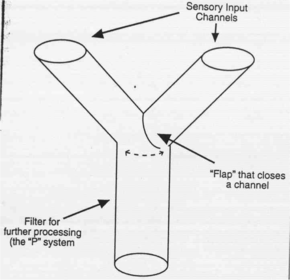
- 20Schneider & Shiffrin's ModelTwo types of processing:
-Automatic (parallel): for easy tasks with familiar items
-Controlled (serial): for difficult tasks or unfamiliar items - 21Early versus late selection modelsInformation to attend to is either selected early or late in the process of perceiving
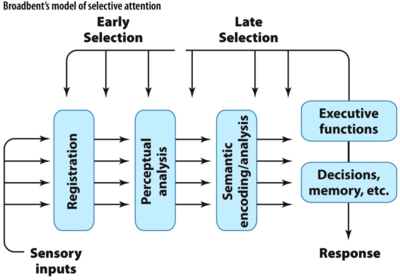
- 22Visual search tasksMore accurate if the target appears frequently
- 23The isolated-feature/ combined-feature effectTreisman and Gelade (1980)- searching for red X's
- 24The feature-present/ feature-absent effectTreisman and Souther (1985)- searching for "circle with the line" or "circle without the line?
Royden and colleagues (2001)- moving vs. stationary targets - 25Treisman's feature integration theory-Distributed attention (take in al parts simultaneously; automatic, parallel processing)
-Focused attention (serial; demanding)
-Feature detectors encoded by feature maps
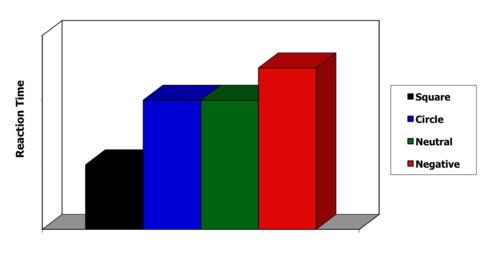
-With practice people are better at using distributed attention - 26Traditional oddball task (presenting squares frequently, and then adding a circle infrequently)-Targets produce greater activation than standards in regions of dorsolateral prefrontal and parietal cortices
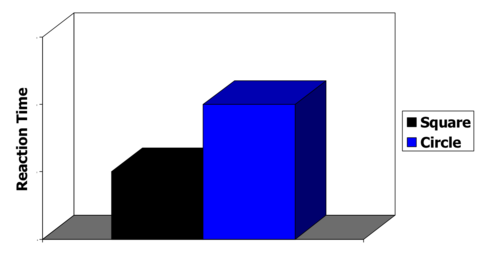
- 27Novelty oddball task (same as traditional one but adding new infrequent pictures of common scenes)The response to the new distractor stimulus is no different than the standards
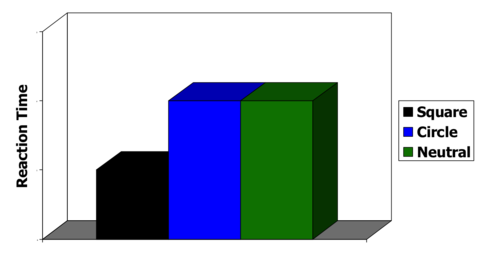
- 28Emotional oddball task (negative emotional pictures are added in with the neutral ones)
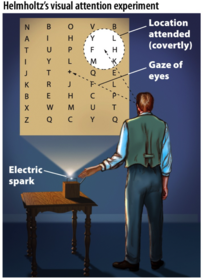
- 29Helmholtz and covert attentionIt is easier to perceive things within the focus of attention even when the eyes are physically focused somewhere else
- 30Naturalistic orienting-Emotional stimuli capture attention (initial movement toward negative scene and more time spent on it)
-So do tools (Increased P1 amplitude to targets overlaid upon the graspable objects) - 31Cues used to direct spatial attention-Centrally located (letters, arrows, and eye gaze change) can be either voluntary or reflexive
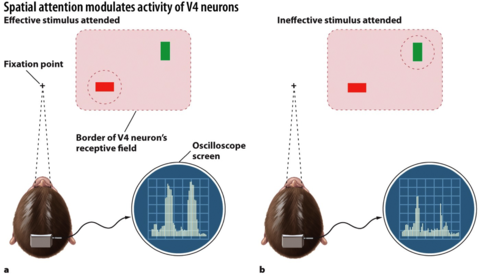
-Peripherally located (dots, bars, almost any change) always reflexive - 32—When monkey attended to red bar, the V4 neuron gave a good response but when it attended to the green bar it gave a poor response
- 33A network of regions in posterior parietal, frontal, and cingulate cortices responsible for domain-independent attentional manipulationsThis network responds to:
-Endogenous and exogenous shifts of attention
-Covert and overt shifts of attention
-Attending to periods of time
-Attention directed towards non-spatial features of objects - 34Inhibition of Return (IOR)-Occurs when orienting toward a previously viewed object or when the location is suppressed
-Impairment of IOR seen in individuals with variations of ADHD - 35—When attention is reflexively attracted to a location by an irrelevant abrupt onset of a visual stimulus, reaction times to subsequent targets presented to that same location are facilitated for short periods of time
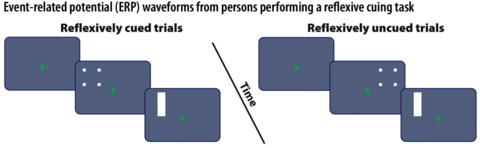
- 36—
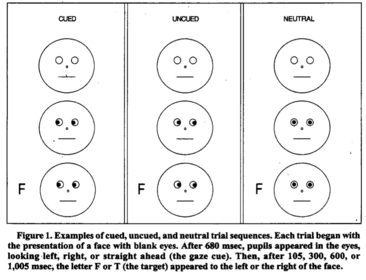
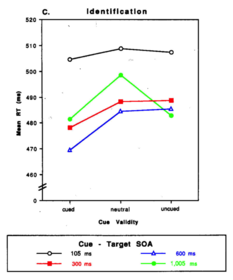
- 37Attentional bias to threat-Attending to threatening information leads to interpreting ambiguous information as threatening
-Attention bias towards threat is greater for anxious individuals
-Avoidance of threat during stress may be a risk factor for developing PTSD - 38Types of threatFear- Ambiguous threat: unknown location of threat, faster response away from gaze suggests broadening of attentional focus to search for threat
Anger- Direct threat: face is the source of threat, faster response towards gaze suggests attention to potential threat - 39Differential attention to stimulus features
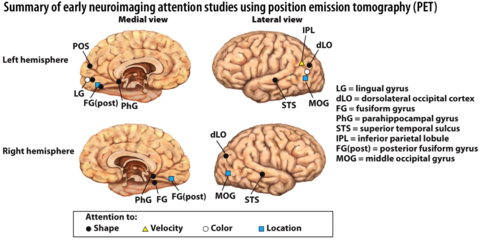
- 40Attention differs from fusiform face area (FF and the parahippocampal place area(PPA)Houses and faces were superimposed transparently to create stimuli that participants could not attend to using spatial mechanisms
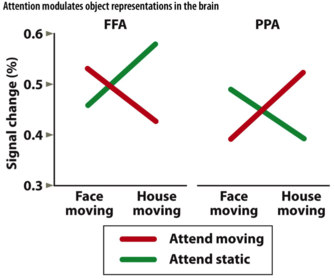
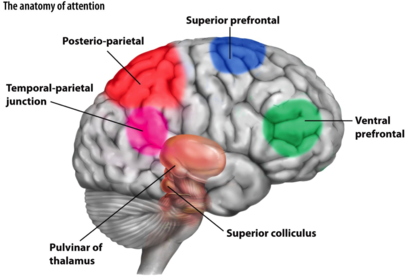
- 41Cortical regions involved in attentional controlDorsal attention network: Intraparietal sulcus (IPS), superior parietal lobule (SPL), and the frontal eye fields (FEF)
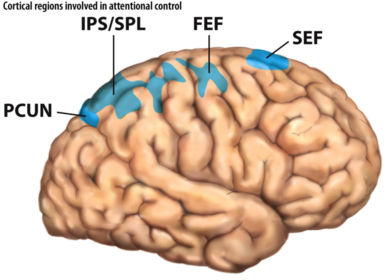
- 42Sources and sites of attention
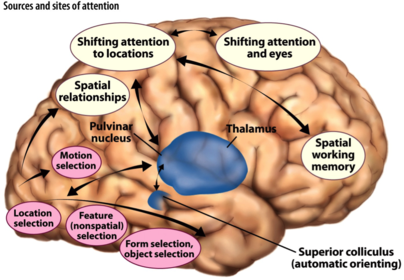
- 43Brain regions involved in detection of novelty and attentional reorientingThis view of the right hemisphere shows regions of temporoparietal junction (TPJ), middle temporal gyrus (MTG), middle frontal gyrus (MFG), and inferior frontal gyrus (IFG) that were activated when participants received an invalid trial in which a cue incorrectly predicted the target location.
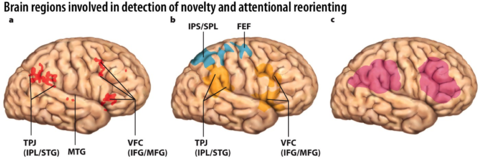
- 44Sub-cortical areas of attention
- 45Spatial neglectDamage to right parietal cortex leads to patients "ignoring" left side of space
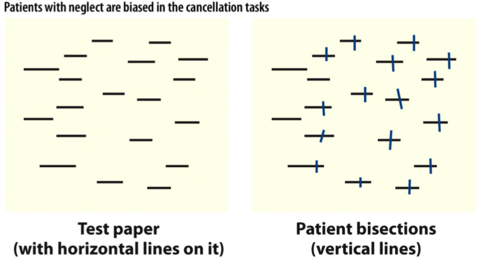
- 46Neuropsychological tests of attention: the cancellation taskPatients suffering from neglect are given a sheet of paper containing many horizontal lines and asked under free-viewing conditions to bisect the lines precisely in the middle with a vertical line. They tend to bisect the lines to the right (for a right-hemisphere lesion) of the midline of each page and/or each line, owing to neglect for contralesional space and the contralesional side of individual objects.
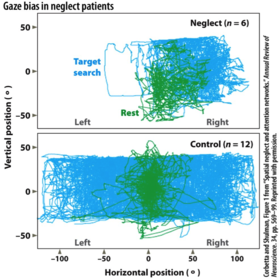
- 47Neuropsychological tests of attention: Gaze biasNeglect patients (top) show an ipsilesional gaze bias while searching for a target letter in a letter array (blue traces) and at rest (green traces). Non-neglect patients (bottom) showed no bias.
- 48Neuropsychological tests of attention: Test of extinctionResearcher wagged fingers in one or both visual fields. The patient correctly detected and responded (by pointing) to the stimuli if presented one at a time, demonstrating an ability to see both stimuli and therefore no major visual field defects. When the stimuli were presented simultaneously in the left and right visual fields, however, the patient reported seeing only the one in the right visual field. This effect is called extinction because the simultaneous presence of the stimulus in the patient’s right field leads to the stimulus on the left of the patient being extinguished from awareness.
- 49Bálint's syndrome-Occurs most often as consequence of two or more strokes at more or less the same place in each hemisphere (usually in parieto-occipital lobes)
-Symptoms include simultaneous agnosia, oculomotor apraxia, and optic ataxia - 50Simultaneous agnosiaThe inability to perceive simultaneous events or objects in one's visual field
- 51Oculomotor apraxiaThe inability to voluntarily guide eye movements
- 52Optic ataxiaThe inability to guide the hand toward an object using visual information
- 53Blindsight-Vision without awareness
-Damage to visual cortex
-Can still identify some visual attributes of stimulus reported as "not seen" (no conscious awareness)
-Why? A portion of the info from the retina travels to other locations outside of the visual cortex but the primary visual cortex is necessary for conscious awareness of visual stimuli
Informationen
- Beschreibung
- Cognitive Neuroscience (Midterm) Karteikarten am Ch.7 Attention, erstellt von Allison Sonia am 07/03/2017.
- Erstellt von
- Allison Sonia
- Aufrufe
- 188
- Bewertung