
Mindmap
personality basic
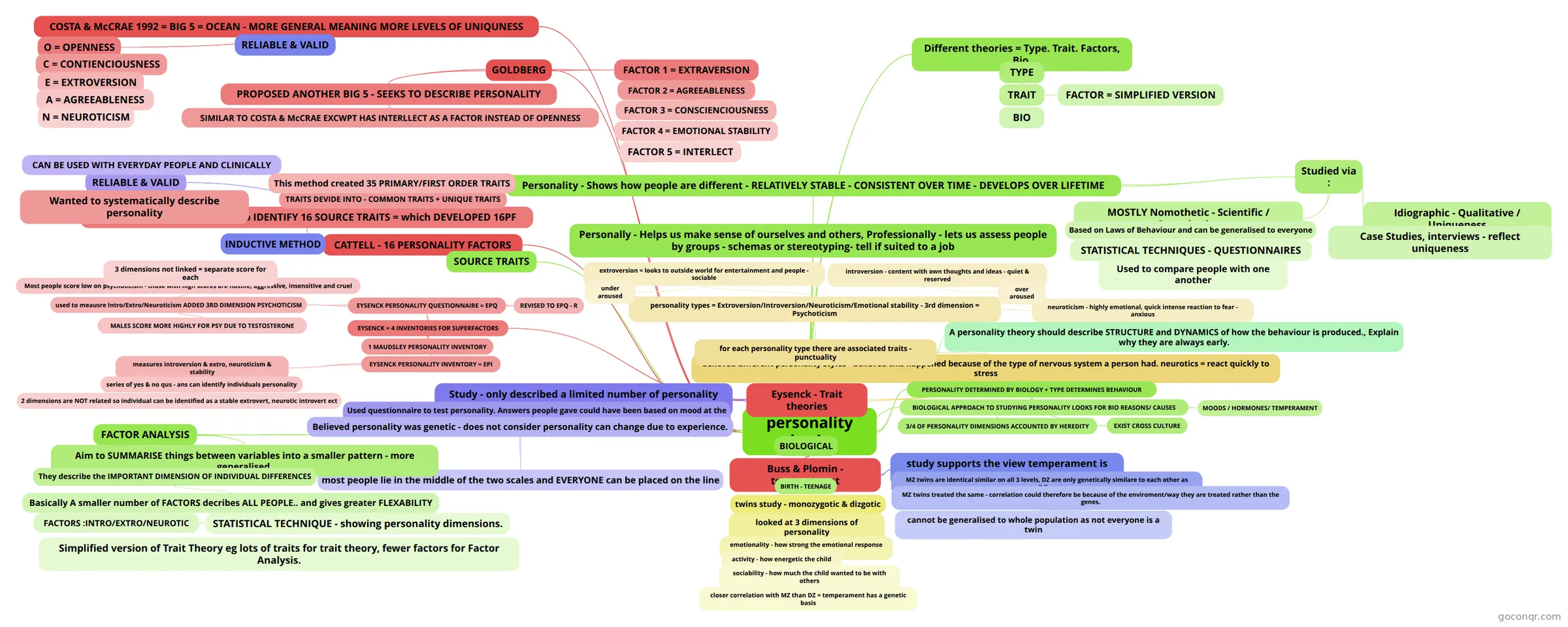
Mind map: personality psychology theories
Inhalt der Mindmap
personality basic
Buss & Plomin - temperament
- twins study - monozygotic & dizgotic
- looked at 3 dimensions of personality
- emotionality - how strong the emotional response was
- activity - how energetic the child was
- sociability - how much the child wanted to be with others
- closer correlation with MZ than DZ = temperament has a genetic basis
- sociability - how much the child wanted to be with others
- activity - how energetic the child was
- emotionality - how strong the emotional response was
- looked at 3 dimensions of personality
- study supports the view temperament is innate
- MZ twins are identical similar on all 3 levels, DZ are only genetically similare to each other as siblings
- MZ twins treated the same - correlation could therefore be because of the enviroment/way they are treated rather than the genes.
- cannot be generalised to whole population as not everyone is a twin
- MZ twins treated the same - correlation could therefore be because of the enviroment/way they are treated rather than the genes.
- MZ twins are identical similar on all 3 levels, DZ are only genetically similare to each other as siblings
- twins study - monozygotic & dizgotic
Eysenck - Trait theories
- believed different personality styles - believed this happened because of the type of nervous system a person had. neurotics = react quickly to stress
- for each personality type there are associated traits - punctuality
- personality types = Extroversion/Introversion/Neuroticism/Emotional stability - 3rd dimension = Psychoticism
- extroversion = looks to outside world for entertainment and people - sociable
- under aroused
- introversion - content with own thoughts and ideas - quiet & reserved
- over aroused
- neuroticism - highly emotional, quick intense reaction to fear - anxious
- extroversion = looks to outside world for entertainment and people - sociable
- A personality theory should describe STRUCTURE and DYNAMICS of how the behaviour is produced., Explain why they are always early.
- personality types = Extroversion/Introversion/Neuroticism/Emotional stability - 3rd dimension = Psychoticism
- for each personality type there are associated traits - punctuality
- Study - only described a limited number of personality types
- Used questionnaire to test personality. Answers people gave could have been based on mood at the time
- Believed personality was genetic - does not consider personality can change due to experience.
- most people lie in the middle of the two scales and EVERYONE can be placed on the line
- Believed personality was genetic - does not consider personality can change due to experience.
- Used questionnaire to test personality. Answers people gave could have been based on mood at the time
- EYSENCK = 4 INVENTORIES FOR SUPERFACTORS
- 1 MAUDSLEY PERSONALITY INVENTORY
- EYSENCK PERSONALITY QUESTIONNAIRE = EPQ
- REVISED TO EPQ - R
- used to meausre Intro/Extro/Neuroticism ADDED 3RD DIMENSION PSYCHOTICISM
- Most people score low on psychoticism - those with high scores are hostile, aggressive, insensitive and cruel
- 3 dimensions not linked = separate score for each
- MALES SCORE MORE HIGHLY FOR PSY DUE TO TESTOSTERONE
- Most people score low on psychoticism - those with high scores are hostile, aggressive, insensitive and cruel
- EYSENCK PERSONALITY INVENTORY = EPI
- measures introversion & extro, neuroticism & stability
- series of yes & no qus - ans can identify individuals personality
- 2 dimensions are NOT related so individual can be identified as a stable extrovert, neurotic introvert ect
- series of yes & no qus - ans can identify individuals personality
- measures introversion & extro, neuroticism & stability
- believed different personality styles - believed this happened because of the type of nervous system a person had. neurotics = react quickly to stress
BIOLOGICAL
- BIRTH - TEENAGE
- BIOLOGICAL APPROACH TO STUDYING PERSONALITY LOOKS FOR BIO REASONS/ CAUSES
- MOODS / HORMONES/ TEMPERAMENT
PERSONALITY DETERMINED BY BIOLOGY + TYPE DETERMINES BEHAVIOUR
- 3/4 OF PERSONALITY DIMENSIONS ACCOUNTED BY HEREDITY
- EXIST CROSS CULTURE
Personality - Shows how people are different - RELATIVELY STABLE - CONSISTENT OVER TIME - DEVELOPS OVER LIFETIME
- Studied via :
- MOSTLY Nomothetic - Scientific / Quantitative
- Based on Laws of Behaviour and can be generalised to everyone
- STATISTICAL TECHNIQUES - QUESTIONNAIRES
- Used to compare people with one another
- STATISTICAL TECHNIQUES - QUESTIONNAIRES
- Based on Laws of Behaviour and can be generalised to everyone
- Idiographic - Qualitative / Uniqueness
- Case Studies, interviews - reflect uniqueness
- MOSTLY Nomothetic - Scientific / Quantitative
- Studied via :
Different theories = Type. Trait. Factors, Bio.
- TYPE
- TRAIT
- BIO
- FACTOR = SIMPLIFIED VERSION
- TRAIT
- TYPE
Personally - Helps us make sense of ourselves and others, Professionally - lets us assess people by groups - schemas or stereotyping- tell if suited to a job
FACTOR ANALYSIS
- Aim to SUMMARISE things between variables into a smaller pattern - more generalised.
- They describe the IMPORTANT DIMENSION OF INDIVIDUAL DIFFERENCES
- Basically A smaller number of FACTORS decribes ALL PEOPLE.. and gives greater FLEXABILITY
- FACTORS :INTRO/EXTRO/NEUROTIC
- STATISTICAL TECHNIQUE - showing personality dimensions.
- Simplified version of Trait Theory eg lots of traits for trait theory, fewer factors for Factor Analysis.
- FACTORS :INTRO/EXTRO/NEUROTIC
- Basically A smaller number of FACTORS decribes ALL PEOPLE.. and gives greater FLEXABILITY
- They describe the IMPORTANT DIMENSION OF INDIVIDUAL DIFFERENCES
- Aim to SUMMARISE things between variables into a smaller pattern - more generalised.
CATTELL - 16 PERSONALITY FACTORS
- CATTELL = FACTOR ANALYSIS to IDENTIFY 16 SOURCE TRAITS = which DEVELOPED 16PF
- RELIABLE & VALID
- CAN BE USED WITH EVERYDAY PEOPLE AND CLINICALLY
- TRAITS DEVIDE INTO - COMMON TRAITS + UNIQUE TRAITS
- This method created 35 PRIMARY/FIRST ORDER TRAITS
- Wanted to systematically describe personality
- RELIABLE & VALID
- INDUCTIVE METHOD
- CATTELL = FACTOR ANALYSIS to IDENTIFY 16 SOURCE TRAITS = which DEVELOPED 16PF
SOURCE TRAITS
COSTA & McCRAE 1992 = BIG 5 = OCEAN - MORE GENERAL MEANING MORE LEVELS OF UNIQUNESS
- O = OPENNESS
- C = CONTIENCIOUSNESS
- E = EXTROVERSION
- A = AGREEABLENESS
- N = NEUROTICISM
- A = AGREEABLENESS
- E = EXTROVERSION
- C = CONTIENCIOUSNESS
- RELIABLE & VALID
- O = OPENNESS
GOLDBERG
- PROPOSED ANOTHER BIG 5 - SEEKS TO DESCRIBE PERSONALITY
- SIMILAR TO COSTA & McCRAE EXCWPT HAS INTERLLECT AS A FACTOR INSTEAD OF OPENNESS
- FACTOR 1 = EXTRAVERSION
- FACTOR 2 = AGREEABLENESS
- FACTOR 3 = CONSCIENCIOUSNESS
- FACTOR 4 = EMOTIONAL STABILITY
- FACTOR 5 = INTERLECT
- FACTOR 4 = EMOTIONAL STABILITY
- FACTOR 3 = CONSCIENCIOUSNESS
- FACTOR 2 = AGREEABLENESS
- PROPOSED ANOTHER BIG 5 - SEEKS TO DESCRIBE PERSONALITY
Informationen
- Beschreibung
- Degree with Hons Personality - DSE 212 Mindmap am personality basic, erstellt von cutiemcpouty am 28/05/2013.
- Erstellt von
- cutiemcpouty
- Aufrufe
- 129
- Tags
- Bewertung