
Mindmap
Behaviorism
Inhalt der Mindmap
Behaviorism
Assumptions
- Observable behavior
- Animals and humans learn in the same ways so behaviorists carry out experiments on animals and generalise results to humans.
- Lab experiment based
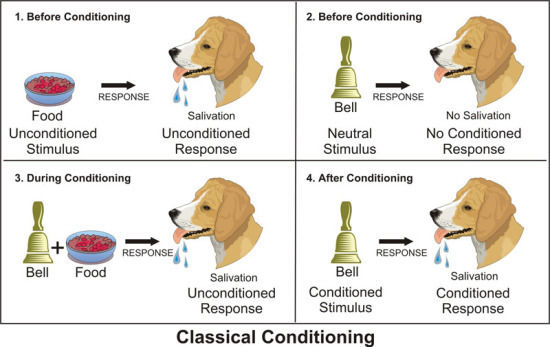
Classical conditioning
- An existing involuntary reflex response is associated with a new stimulus (learning by association)
- Pavlov's dogs
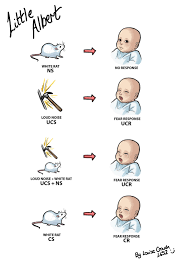
- Watson and Rayner - Little Albert
Operant conditioning
- new voluntary behaviour is associated with a consequence (learning by consequences)
- Skinners box
- Positive reinforcement - Rat rewarded with food when it pressed the lever
- Negative reinforcement - rat was able to turn off electric shock by pressing lever
- Positive reinforcement
- Receiving a reward based on an action. Increases the likelihood of the behavior being repeated.
- Negative reinforcement
- A behavior strengthened by avoiding a negative outcome. Increases the likelihood of the behavior being repeated.
- Punishment
- A consequence that makes a behaviour less likely to occur
Application
- Behaviorism has increased our understanding of the causes of phobias and attachment.
- Given rise to therapies such as systematic desensitisation and token economy e.g. in prisons.
Scientific (lab experiments) - Control of extraneous and independent variables. This allows a cause and effect relationship to be established.
Strong nurture side - Better decisions with regard to education and child-rearing.
Deterministic - Ignores the role of free will e.g. Little Albert's fear response was created through conditioning.
- Lacks ecological validity which means that results may not be a true reflection of real life behaviour.
Bilder und Dateien der Mindmap
Informationen
- Beschreibung
- A level Psychology Mindmap am Behaviorism, erstellt von neeka patt am 11/10/2018.
- Erstellt von
- neeka patt
- Aufrufe
- 0
- Bewertung