
Mindmap
Multi-Store Model
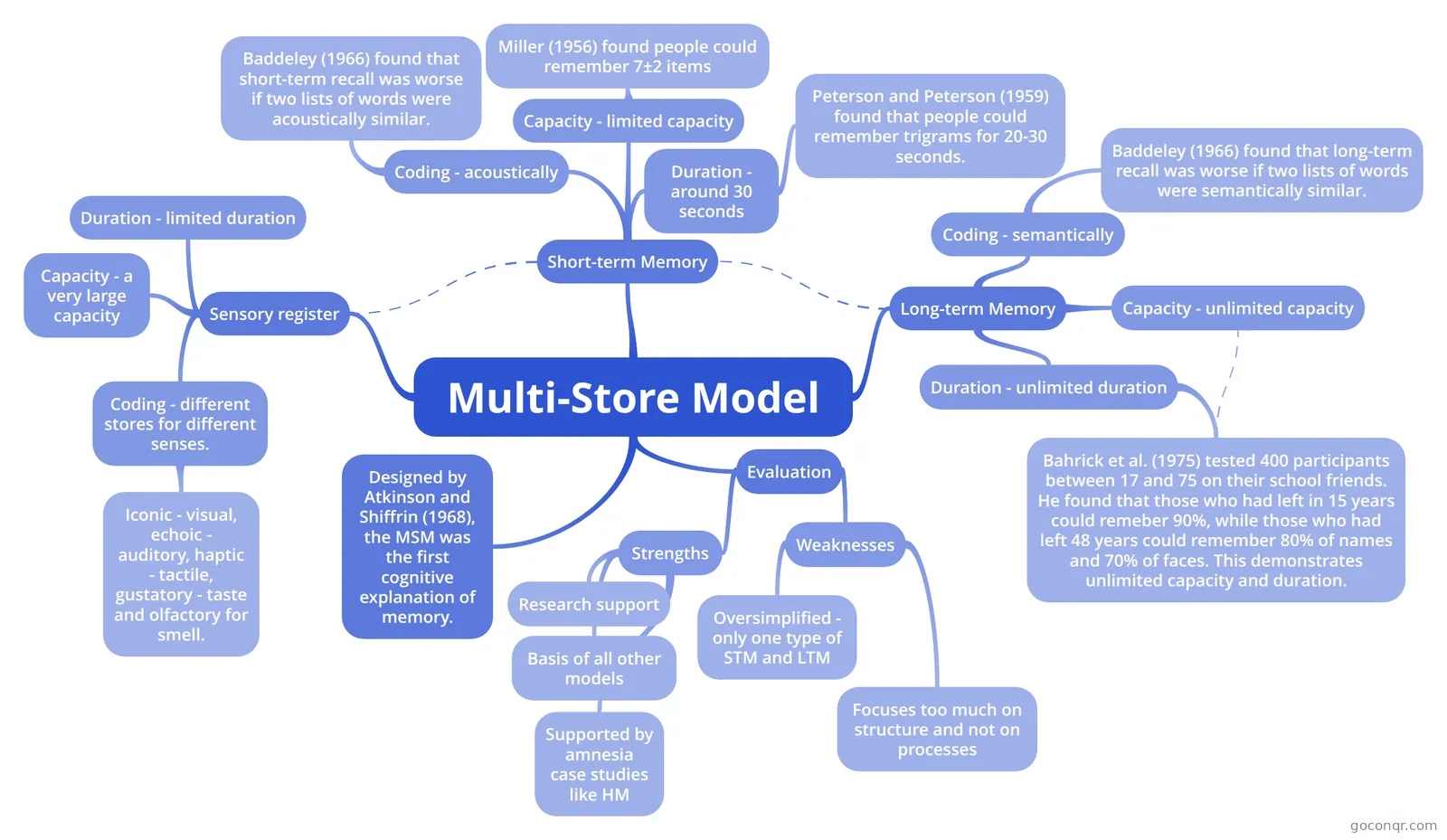
Mind map: Multi-Store Model
Inhalt der Mindmap
Multi-Store Model
Designed by Atkinson and Shiffrin (1968), the MSM was the first cognitive explanation of memory.
Sensory register
- Coding - different stores for different senses.
- Iconic - visual, echoic - auditory, haptic - tactile, gustatory - taste and olfactory for smell.
- Capacity - a very large capacity
- Duration - limited duration
- Coding - different stores for different senses.
Short-term Memory
- Coding - acoustically
- Baddeley (1966) found that short-term recall was worse if two lists of words were acoustically similar.
- Capacity - limited capacity
- Miller (1956) found people could remember 7±2 items
- Duration - around 30 seconds
- Peterson and Peterson (1959) found that people could remember trigrams for 20-30 seconds.
- Coding - acoustically
Long-term Memory
- Coding - semantically
- Baddeley (1966) found that long-term recall was worse if two lists of words were semantically similar.
- Capacity - unlimited capacity
- Duration - unlimited duration
- Bahrick et al. (1975) tested 400 participants between 17 and 75 on their school friends. He found that those who had left in 15 years could remeber 90%, while those who had left 48 years could remember 80% of names and 70% of faces. This demonstrates unlimited capacity and duration.
- Coding - semantically
Evaluation
- Strengths
- Basis of all other models
- Research support
- Supported by amnesia case studies like HM
- Weaknesses
- Oversimplified - only one type of STM and LTM
- Focuses too much on structure and not on processes
- Strengths
Informationen
- Beschreibung
- A level Psychology (Memory) Mindmap am Multi-Store Model, erstellt von Bethany Barnes am 03/06/2019.
- Erstellt von
- Bethany Barnes
- Aufrufe
- 0
- Bewertung