
Mindmap
Working Memory Model
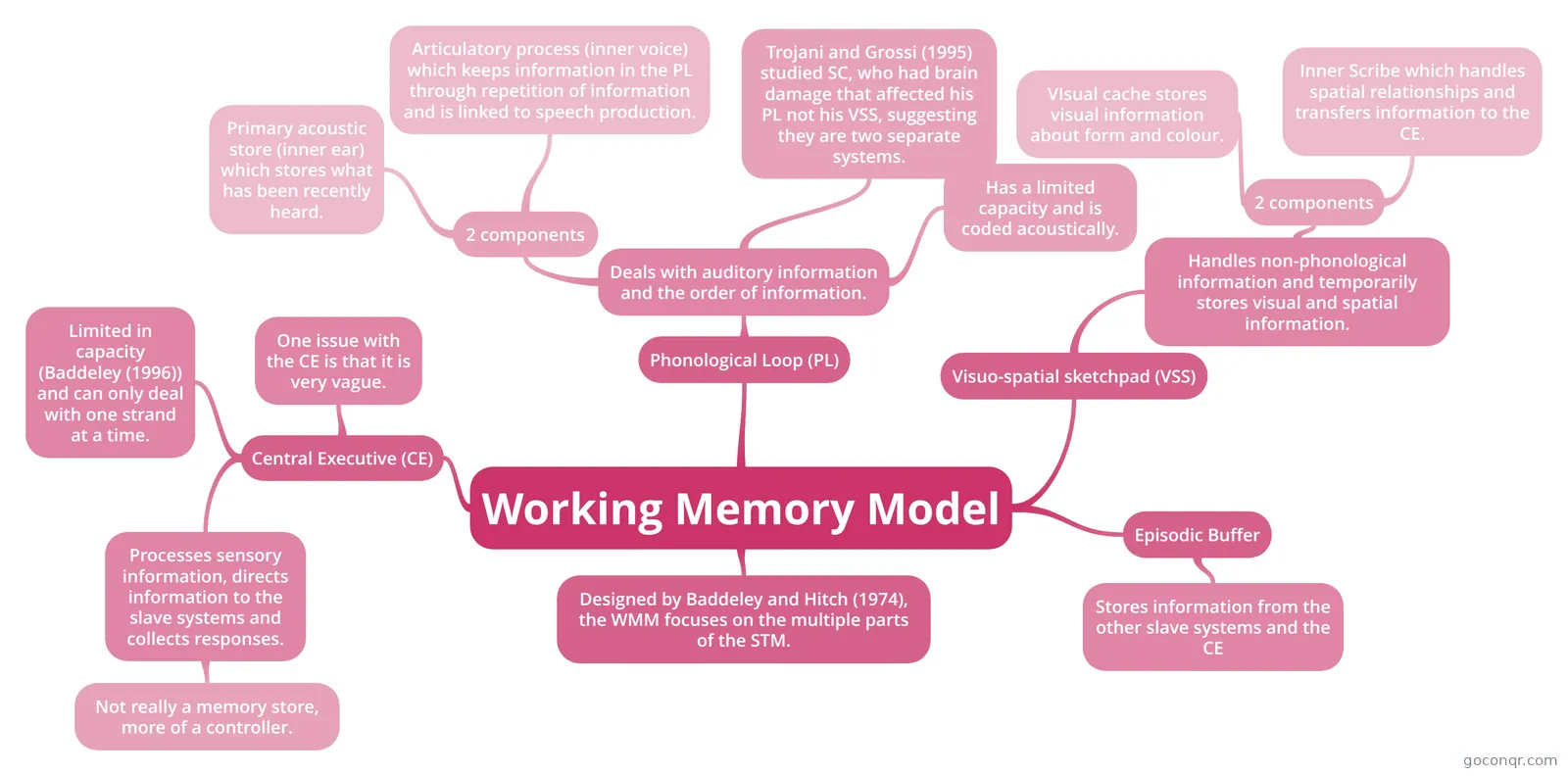
Mind map: Working Memory Model
Inhalt der Mindmap
Working Memory Model
Designed by Baddeley and Hitch (1974), the WMM focuses on the multiple parts of the STM.
Central Executive (CE)
- Processes sensory information, directs information to the slave systems and collects responses.
- Not really a memory store, more of a controller.
- Limited in capacity (Baddeley (1996)) and can only deal with one strand at a time.
- One issue with the CE is that it is very vague.
- Processes sensory information, directs information to the slave systems and collects responses.
Phonological Loop (PL)
- Deals with auditory information and the order of information.
- 2 components
- Primary acoustic store (inner ear) which stores what has been recently heard.
- Articulatory process (inner voice) which keeps information in the PL through repetition of information and is linked to speech production.
- Has a limited capacity and is coded acoustically.
- Trojani and Grossi (1995) studied SC, who had brain damage that affected his PL not his VSS, suggesting they are two separate systems.
- 2 components
- Deals with auditory information and the order of information.
Visuo-spatial sketchpad (VSS)
- Handles non-phonological information and temporarily stores visual and spatial information.
- 2 components
- VIsual cache stores visual information about form and colour.
- Inner Scribe which handles spatial relationships and transfers information to the CE.
- 2 components
- Handles non-phonological information and temporarily stores visual and spatial information.
Episodic Buffer
- Stores information from the other slave systems and the CE
Informationen
- Beschreibung
- A level Psychology (Memory) Mindmap am Working Memory Model, erstellt von Bethany Barnes am 03/06/2019.
- Erstellt von
- Bethany Barnes
- Aufrufe
- 0
- Bewertung