
Mindmap
Memory
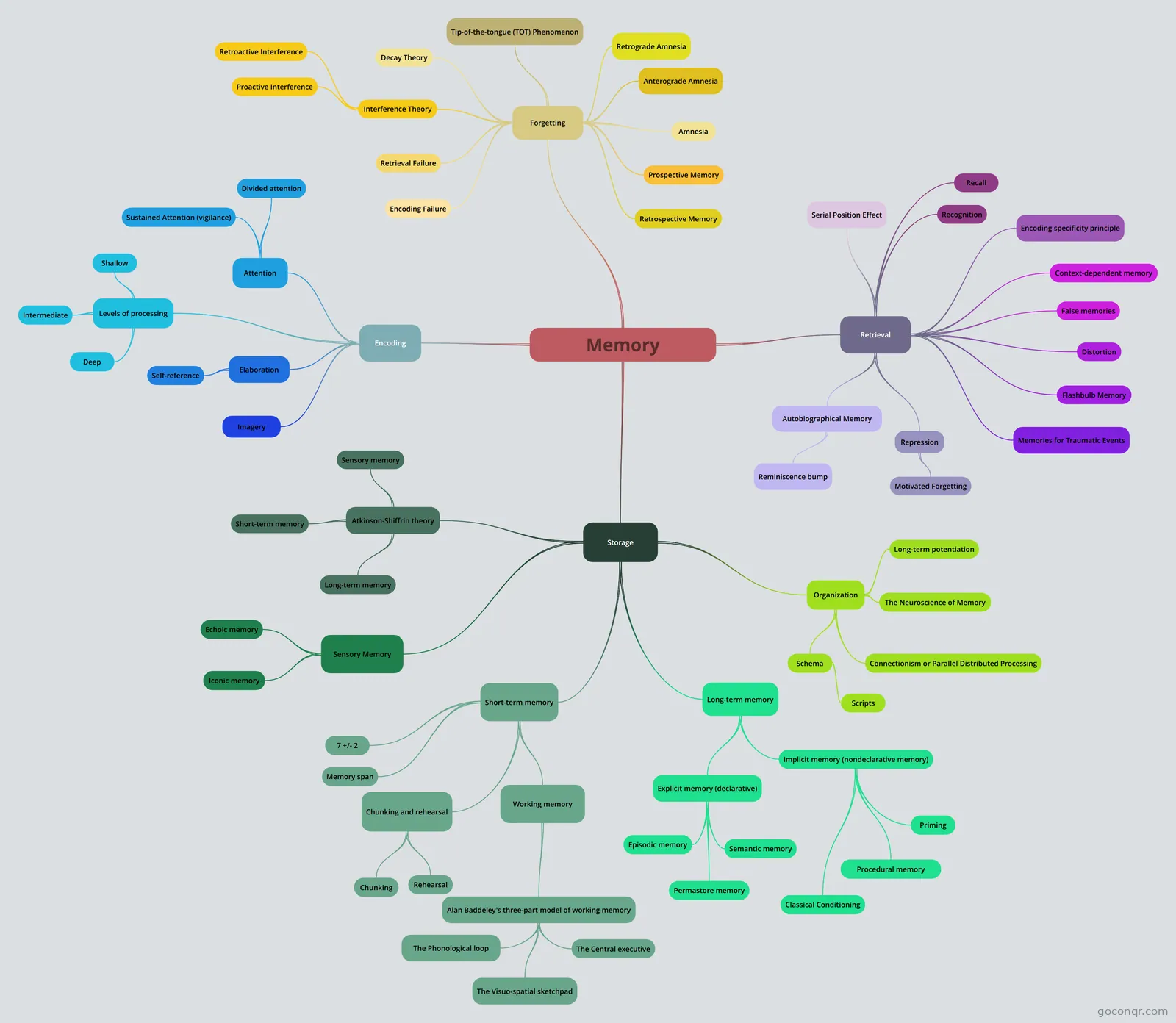
Mind map: Memory psychology
Inhalt der Mindmap
Memory
- the retention of information or experience over time. memory has three key processes; encoding, storage, retrieval.
Encoding
- The process by which information gets into memory storage.
- Attention
- Divided attention
- Involves concentrating on more than one activity at the same time.
- multitasking is working on three or more activities at once which has negative consequences for memory.
- Sustained Attention (vigilance)
- the ability to maintain attention to a selected stimulus for a prolonged period of time.
- Divided attention
- Levels of processing
- refers to the continuum from shallow to intermediate to deep.
- Shallow
- noting and analyzing the physical features of a stimulus
- Intermediate
- recognizing the stimulus giving the stimulus a label
- Deep
- entails thinking about the meaning of a stimulus
- Elaboration
- refers to the formation of a number of different connections around a stimulus at any given level of memory encoding
- when we elaborate during encoding we develop many mental connections between new information and information we already know.
- Self-reference
- relating given material to your own experiences
- Imagery
- the use of imagery means that a person conjures up pictures that are associated with each thing that needs to be remembered
Storage
- the retention of information over time and how this information is represented in memory
- Atkinson-Shiffrin theory
- theory stating that memory storage involves three separate systems: sensory memory, short-term memory, and long-term memory
- Sensory memory
- time frames of a fraction of a second to several seconds
- Short-term memory
- time frames up to 30 seconds
- Long-term memory
- time frames up to a lifetime
- Sensory Memory
- holds information from the world in its original sensory form for only an instant, not much longer than the brief time it is exposed to the visual, auditory, and other senses
- Echoic memory
- refers to auditory sensory memory, retained for several seconds
- Iconic memory
- refers to visual sensory memory, retained for only about 1/4 second
- Short-term memory
- limited-capacity memory system in which information is usually retained for only as long as 30 seconds unless the individual uses strategies to retain it longer.
- 7 +/- 2
- Memory span
- refers to the number of digits an individual can report back in order after a single presentation of them
- Chunking and rehearsal
- Chunking
- involves grouping or "packing" information that exceeds the 7+/- 2 memory span into higher-order units that can be remembered as single units, helps to make large amounts of information more manageable.
- Rehearsal
- repeating the information over and over in your head to keep it in memory. if rehearsal is uninterrupted, information can be retained indefinitely. often verbal, but can be visual or spatial.
- Chunking
- Working memory
- a combination of components, including short-term memory and attention, that allows individuals to hold information temporarily as they perform cognitive tasks; a kind of mental workbench on which the brain manipulates and assembles information to guide understanding, decision making, and problem solving.
- Alan Baddeley's three-part model of working memory
- The Phonological loop
- specialized to briefly store speech-based information about the sounds of language. two separate components: the sounds we hear and rehearsal
- The Visuo-spatial sketchpad
- stores visual and spatial information, including visual imagery, space is limited
- The Central executive
- integrates information not only from the phonological loop and the visuo-spatial sketchpad but also from long-term memory. the central executive acts like a supervisor who monitors which information deserves our attention and which we should ignore.
- The Phonological loop
- Long-term memory
- relatively permanent type of memory that stores huge amounts of information for a long time, our storage capacity is virtually unlimited
- Explicit memory (declarative)
- remembering who, what, when, where, why; conscious recollection of information that can be verbally communicated
- Episodic memory
- the retention of information about where, when, and what of life's happenings- how individuals remember life's episodes. it is autobiographical
- Semantic memory
- person's knowledge about the world, including one's areas of expertise; general knowledge, such as things learned in school, and everyday knowledge
- Permastore memory
- represents the portion of original learning that appears destines to stay with the person virtually forever, even without rehearsal
- Implicit memory (nondeclarative memory)
- remembering how; memory in which behavior is affected by prior experience without a conscious recollection of that experience
- Procedural memory
- memory for skills
- Priming
- the activation of information that people already have in storage to help them remember new information better and faster; occurs when something in the environment evokes a response in memory
- Classical Conditioning
- a learning process that occurs when two stimuli are repeatedly paired: a response which is at first elicited by the second stimulus is eventually elicited by the first stimulus alone
- Organization
- Schema
- a preexisting mental concept or framework that helps people to organize and interpret information; prior encounters with a specific environment influence the way we handle information; support the reconstruction process of memories
- Scripts
- a schema for an event, often containing information about physical features, people, and typical occurrences
- Connectionism or Parallel Distributed Processing
- The theory that memory is stored throughout the brain in connections among neurons, several of which may work together to process a single memory.
- The Neuroscience of Memory
- rather than being stored in one place in the brain, memories are processes: represented as connections throughout the brain and states of brain activity, recreating the brain's function when experiences first occur
- Long-term potentiation
- used to explain how memory functions at the neuron level
- Schema
Retrieval
- the memory process that occurs when information that was retained in memory out of storage
- Serial Position Effect
- the tendency to recall the items at the beginning and the end of a lost more readily than those in the middle
- Recall
- memory task in which the individual has to retrieve previously learned information
- Recognition
- a memory task in which the individual only has to identify learned items
- Encoding specificity principle
- states that information present at the time of encoding or learning tends to be effective as a retrieval cue
- Context-dependent memory
- people remember better when they try to recall information in the same context in which they learned it
- False memories
- occur when people remember something that never actually happened
- Autobiographical Memory
- a special form of episodic memory, is a person's recollections of their life experiences
- Reminiscence bump
- the effect that adults remember more events from the second and third decades of life than from other decades
- Flashbulb Memory
- the memory of emotionally significant events that people often recall with more accuracy and vivid imagery than everyday events; ex 9/11; the right amygdala
- Memories for Traumatic Events
- an experience that is so emotionally arousing that it leaves a kind of scar on the brain; memory for traumatic events is more accurate than memory for ordinary
- Repression
- defense mechanism in which a person is so traumatized by an event that the person forgets it and then forgets the act of forgetting
- Motivated Forgetting
- forgetting that occurs when something is so painful or anxiety-laden that remembering it is intolerable
- Distortion
- memory fades with time; memory can be altered by new information
Forgetting
- Encoding Failure
- occurs when the information was never entered into long-term memory
- Retrieval Failure
- problems with the information in storage, the effects of time, personal reasons for remembering or forgetting, and the brain's condition
- Interference Theory
- the theory that people forget not because memories are lost from storage but because other information gets in the way of what they want to remember
- Proactive Interference
- situation in which material that was learned earlier disrupts the recall of material that was learned later
- Retroactive Interference
- situation in which material that was learned later disrupts the retrieval of information that was learned earlier
- Decay Theory
- theory stating that when an individual learns something new, a neurochemical memory trace forms but then disintegrates over time, suggesting that the passage of time always increases forgetting
- Tip-of-the-tongue (TOT) Phenomenon
- a type of effortful retrieval that occurs when we are confident that we know something but cannot quite pull it out of memory
- Retrospective Memory
- remembering the past
- Prospective Memory
- remembering information about doing something later (in the future); includes timing and content
- Amnesia
- the loss of memory
- Anterograde Amnesia
- a memory disorder that affects the retention of new information and events; what you learn before the incident is not affected
- Retrograde Amnesia
- involves memory loss for a segment of past events; forgotten information is old
- Encoding Failure
Informationen
- Beschreibung
- Psychology (Memory) Mindmap am Memory, erstellt von Emily DeMinico am 02/11/2020.
- Erstellt von
- Emily DeMinico
- Aufrufe
- 1
- Bewertung