
Mindmap
Attachment:
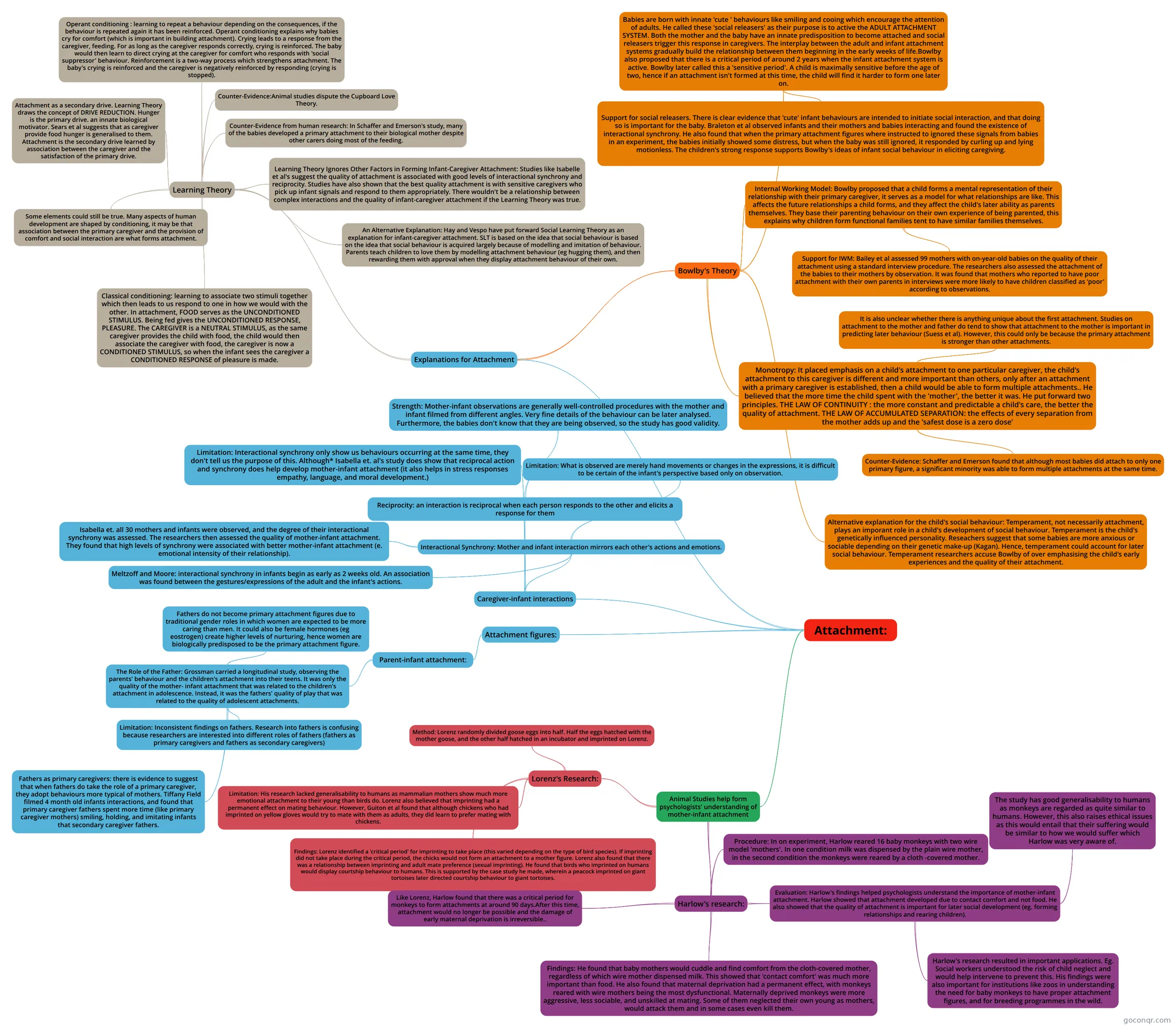
Mind map: Attachment psychology
Inhalt der Mindmap
Attachment:
Caregiver-infant interactions
- Babies and their mothers spend a lot of time interacting. The babies have periodic 'alert phases' and they signal when they're ready for interaction. Mothers respond to infant-alertness around two-thirds of the time. From around 3 months the interaction becomes more frequent, involving close attention to each other's verbal signals and facial expressions.
- Interactional Synchrony: Mother and infant interaction mirrors each other's actions and emotions.
- Limitation: What is observed are merely hand movements or changes in the expressions, it is difficult to be certain of the infant's perspective based only on observation.
- Isabella et. all 30 mothers and infants were observed, and the degree of their interactional synchrony was assessed. The researchers then assessed the quality of mother-infant attachment. They found that high levels of synchrony were associated with better mother-infant attachment (e. emotional intensity of their relationship).
- Research into mother-infant attachment such as Isabella's research is socially sensitive. It suggests that certain child rearing practices may have negative effects on children. Isabella's research demonstrates the importance of interactional synchrony in the early stages of the infant's development in the formation of infant-caregiver attachment, so mothers should not return to work so soon.
- Meltzoff and Moore: interactional synchrony in infants begin as early as 2 weeks old. An association was found between the gestures/expressions of the adult and the infant's actions.
- Reciprocity: an interaction is reciprocal when each person responds to the other and elicits a response for them
- Strength: Mother-infant observations are generally well-controlled procedures with the mother and infant filmed from different angles. Very fine details of the behaviour can be later analysed. Furthermore, the babies don't know that they are being observed, so the study has good validity.
- Limitation: Interactional synchrony only show us behaviours occurring at the same time, they don't tell us the purpose of this. Although* Isabella et. al's study does show that reciprocal action and synchrony does help develop mother-infant attachment (it also helps in stress responses empathy, language, and moral development.)
Attachment figures:
- Parent-infant attachment:
- Schaffer and Emerson found that a majority of infants did attach to their mother first (at 7 months), and within a few weeks or months they would form secondary attachments. In 75% of the infants, attachment formed by the age of 18 months.
- The Role of the Father: Grossman carried a longitudinal study, observing the parents' behaviour and the children's attachment into their teens. It was only the quality of the mother- infant attachment that was related to the children's attachment in adolescence. Instead, it was the fathers' quality of play that was related to the quality of adolescent attachments.
- Grossman's findings of fathers having an important role in adolescent attachment is contradicted by other studies. MacCallum and Golombok found that children growing up in single or same-sex families do not develop differently from two-parent heterosexual families.
- Fathers as primary caregivers: there is evidence to suggest that when fathers do take the role of a primary caregiver, they adopt behaviours more typical of mothers. Tiffany Field filmed 4 month old infants interactions, and found that primary caregiver fathers spent more time (like primary caregiver mothers) smiling, holding, and imitating infants that secondary caregiver fathers.
- Limitation: Inconsistent findings on fathers. Research into fathers is confusing because researchers are interested into different roles of fathers (fathers as primary caregivers and fathers as secondary caregivers)
- Fathers do not become primary attachment figures due to traditional gender roles in which women are expected to be more caring than men. It could also be female hormones (eg eostrogen) create higher levels of nurturing, hence women are biologically predisposed to be the primary attachment figure.
- Parent-infant attachment:
Animal Studies help form psychologists' understanding of mother-infant attachment
- Lorenz's Research:
- Method: Lorenz randomly divided goose eggs into half. Half the eggs hatched with the mother goose, and the other half hatched in an incubator and imprinted on Lorenz.
- Findings: Lorenz identified a 'critical period' for imprinting to take place (this varied depending on the type of bird species). If imprinting did not take place during the critical period, the chicks would not form an attachment to a mother figure. Lorenz also found that there was a relationship between imprinting and adult mate preference (sexual imprinting). He found that birds who imprinted on humans would display courtship behaviour to humans. This is supported by the case study he made, wherein a peacock imprinted on giant tortoises later directed courtship behaviour to giant tortoises.
- Limitation: His research lacked generalisability to humans as mammalian mothers show much more emotional attachment to their young than birds do. Lorenz also believed that imprinting had a permanent effect on mating behaviour. However, Guiton et al found that although chickens who had imprinted on yellow gloves would try to mate with them as adults, they did learn to prefer mating with chickens.
- Harlow's research:
- Procedure: In on experiment, Harlow reared 16 baby monkeys with two wire model 'mothers'. In one condition milk was dispensed by the plain wire mother, in the second condition the monkeys were reared by a cloth -covered mother.
- Findings: He found that baby mothers would cuddle and find comfort from the cloth-covered mother, regardless of which wire mother dispensed milk. This showed that 'contact comfort' was much more important than food. He also found that maternal deprivation had a permanent effect, with monkeys reared with wire mothers being the most dysfunctional. Maternally deprived monkeys were more aggressive, less sociable, and unskilled at mating. Some of them neglected their own young as mothers, would attack them and in some cases even kill them.
- Like Lorenz, Harlow found that there was a critical period for monkeys to form attachments at around 90 days.After this time, attachment would no longer be possible and the damage of early maternal deprivation is irreversible..
- Evaluation: Harlow's findings helped psychologists understand the importance of mother-infant attachment. Harlow showed that attachment developed due to contact comfort and not food. He also showed that the quality of attachment is important for later social development (eg. forming relationships and rearing children).
- Harlow's research resulted in important applications. Eg. Social workers understood the risk of child neglect and would help intervene to prevent this. His findings were also important for institutions like zoos in understanding the need for baby monkeys to have proper attachment figures, and for breeding programmes in the wild.
- The study has good generalisability to humans as monkeys are regarded as quite similar to humans. However, this also raises ethical issues as this would entail that their suffering would be similar to how we would suffer which Harlow was very aware of.
- Lorenz's Research:
Explanations for Attachment
- Learning Theory
- Dollard and Miller proposed that caregiver-infant attachment can be explained by this. This approach is also known as the 'cupboard love theory'.
- Classical conditioning: learning to associate two stimuli together which then leads to us respond to one in how we would with the other. In attachment, FOOD serves as the UNCONDITIONED STIMULUS. Being fed gives the UNCONDITIONED RESPONSE, PLEASURE. The CAREGIVER is a NEUTRAL STIMULUS, as the same caregiver provides the child with food, the child would then associate the caregiver with food, the caregiver is now a CONDITIONED STIMULUS, so when the infant sees the caregiver a CONDITIONED RESPONSE of pleasure is made.
- Operant conditioning : learning to repeat a behaviour depending on the consequences, if the behaviour is repeated again it has been reinforced. Operant conditioning explains why babies cry for comfort (which is important in building attachment). Crying leads to a response from the caregiver, feeding. For as long as the caregiver responds correctly, crying is reinforced. The baby would then learn to direct crying at the caregiver for comfort who responds with 'social suppressor' behaviour. Reinforcement is a two-way process which strengthens attachment. The baby's crying is reinforced and the caregiver is negatively reinforced by responding (crying is stopped).
- Attachment as a secondary drive. Learning Theory draws the concept of DRIVE REDUCTION. Hunger is the primary drive. an innate biological motivator. Sears et al suggests that as caregiver provide food hunger is generalised to them. Attachment is the secondary drive learned by association between the caregiver and the satisfaction of the primary drive.
- Counter-Evidence:Animal studies dispute the Cupboard Love Theory.
- Counter-Evidence from human research: In Schaffer and Emerson's study, many of the babies developed a primary attachment to their biological mother despite other carers doing most of the feeding.
- Learning Theory Ignores Other Factors in Forming Infant-Caregiver Attachment: Studies like Isabelle et al's suggest the quality of attachment is associated with good levels of interactional synchrony and reciprocity. Studies have also shown that the best quality attachment is with sensitive caregivers who pick up infant signals and respond to them appropriately. There wouldn't be a relationship between complex interactions and the quality of infant-caregiver attachment if the Learning Theory was true.
- Some elements could still be true. Many aspects of human development are shaped by conditioning, it may be that association between the primary caregiver and the provision of comfort and social interaction are what forms attachment.
- An Alternative Explanation: Hay and Vespo have put forward Social Learning Theory as an explanation for infant-caregiver attachment. SLT is based on the idea that social behaviour is based on the idea that social behaviour is acquired largely because of modelling and imitation of behaviour. Parents teach children to love them by modelling attachment behaviour (eg hugging them), and then rewarding them with approval when they display attachment behaviour of their own.
- Bowlby's Theory
- He proposed an evolutionary explanation: that attachment was an innate system that gave a survival advantage. Imprinting and attachment evolved because they ensured that your animals stayed close to their caregivers, which protected them from danger.
- Babies are born with innate 'cute ' behaviours like smiling and cooing which encourage the attention of adults. He called these 'social releasers' as their purpose is to active the ADULT ATTACHMENT SYSTEM. Both the mother and the baby have an innate predisposition to become attached and social releasers trigger this response in caregivers. The interplay between the adult and infant attachment systems gradually build the relationship between them beginning in the early weeks of life.Bowlby also proposed that there is a critical period of around 2 years when the infant attachment system is active. Bowlby later called this a 'sensitive period'. A child is maximally sensitive before the age of two, hence if an attachment isn't formed at this time, the child will find it harder to form one later on.
- Support for social releasers. There is clear evidence that 'cute' infant behaviours are intended to initiate social interaction, and that doing so is important for the baby. Braleton et al observed infants and their mothers and babies interacting and found the existence of interactional synchrony. He also found that when the primary attachment figures where instructed to ignored these signals from babies in an experiment, the babies initially showed some distress, but when the baby was still ignored, it responded by curling up and lying motionless. The children's strong response supports Bowlby's ideas of infant social behaviour in eliciting caregiving.
- Internal Working Model: Bowlby proposed that a child forms a mental representation of their relationship with their primary caregiver, it serves as a model for what relationships are like. This affects the future relationships a child forms, and they affect the child's later ability as parents themselves. They base their parenting behaviour on their own experience of being parented, this explains why children form functional families tent to have similar families themselves.
- Support for IWM: Bailey et al assessed 99 mothers with on-year-old babies on the quality of their attachment using a standard interview procedure. The researchers also assessed the attachment of the babies to their mothers by observation. It was found that mothers who reported to have poor attachment with their own parents in interviews were more likely to have children classified as 'poor' according to observations.
- Monotropy: It placed emphasis on a child's attachment to one particular caregiver, the child's attachment to this caregiver is different and more important than others, only after an attachment with a primary caregiver is established, then a child would be able to form multiple attachments.. He believed that the more time the child spent with the 'mother', the better it was. He put forward two principles. THE LAW OF CONTINUITY : the more constant and predictable a child's care, the better the quality of attachment. THE LAW OF ACCUMULATED SEPARATION: the effects of every separation from the mother adds up and the 'safest dose is a zero dose'
- It is a controversial idea as it has major implications for the lifestyle choices mothers make for their children when they're young. The law of accumulated separation states that substantial time apart between the mother and the child risks a poor quality attachment which would disadvantage the child and in the future. Feminists like Burman have pointed out that this places a burden of responsibility to mothers, blaming them for what happens wrong in their child's life. It would also force mothers to have certain lifestyle choices (not being able to return to work whent heir child is born).
- Counter-Evidence: Schaffer and Emerson found that although most babies did attach to only one primary figure, a significant minority was able to form multiple attachments at the same time.
- It is also unclear whether there is anything unique about the first attachment. Studies on attachment to the mother and father do tend to show that attachment to the mother is important in predicting later behaviour (Suess et al). However, this could only be because the primary attachment is stronger than other attachments.
- Alternative explanation for the child's social behaviour: Temperament, not necessarily attachment, plays an imporant role in a child's development of social behaviour. Temperament is the child's genetically influenced personality. Reseachers suggest that some babies are more anxious or sociable depending on their genetic make-up (Kagan). Hence, temperament could account for later social behaviour. Temperament researchers accuse Bowlby of over emphasising the child's early experiences and the quality of their attachment.
- Learning Theory
Informationen
- Beschreibung
- AQA Psychology Mindmap am Attachment:, erstellt von Movie burr am 19/03/2016.
- Erstellt von
- Movie burr
- Aufrufe
- 0
- Bewertung