
Mindmap
Psychodynamic
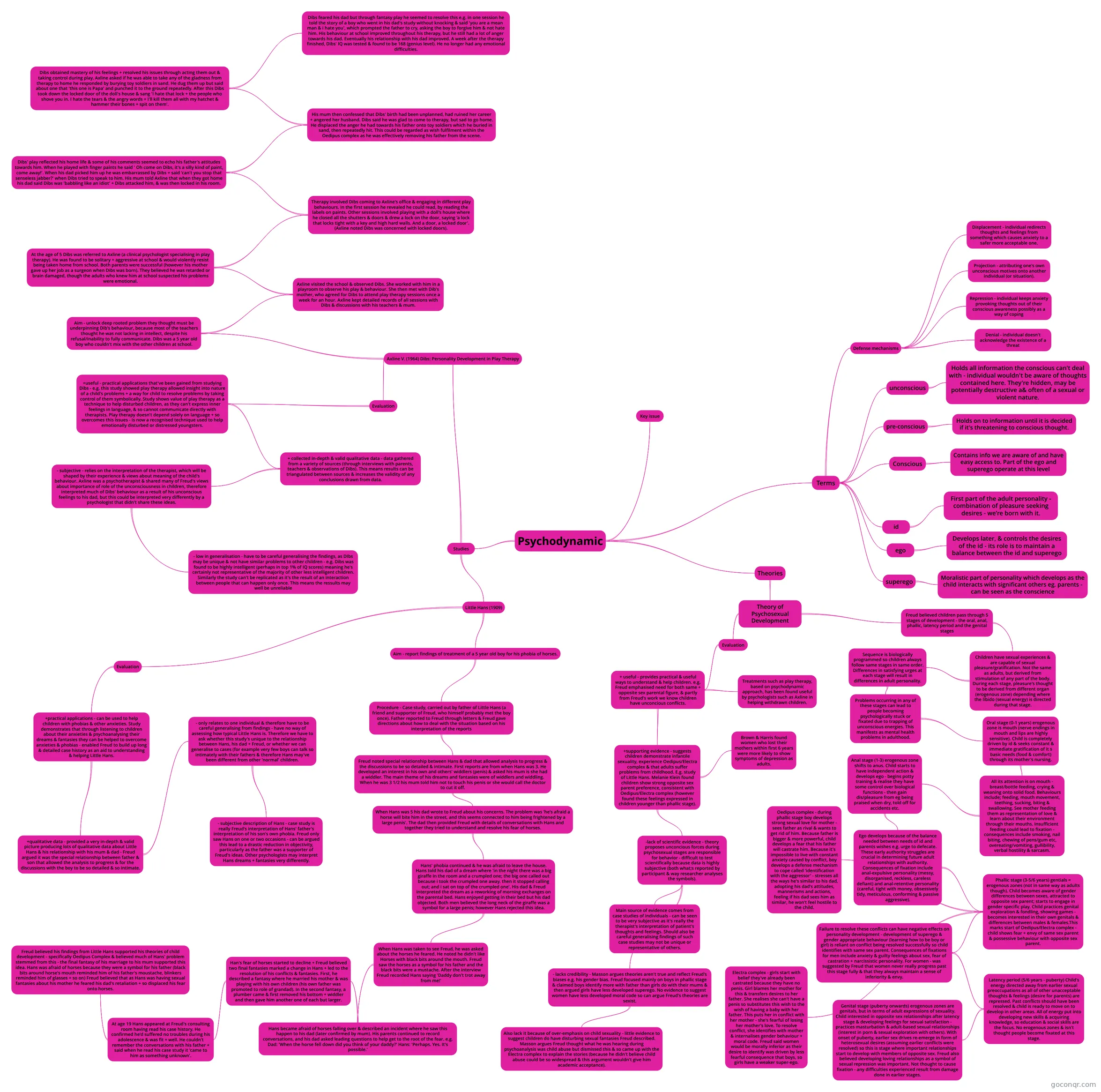
Mind map: Psychodynamic
Inhalt der Mindmap
Psychodynamic
Terms
- id
- First part of the adult personality - combination of pleasure seeking desires - we're born with it.
- ego
- Develops later, & controls the desires of the id - its role is to maintain a balance between the id and superego
- superego
- Moralistic part of personality which develops as the child interacts with significant others eg. parents - can be seen as the conscience
- Conscious
- Contains info we are aware of and have easy access to. Part of the ego and superego operate at this level
- pre-conscious
- Holds on to information until it is decided if it's threatening to conscious thought.
- unconscious
- Holds all information the conscious can't deal with - individual wouldn't be aware of thoughts contained here. They're hidden, may be potentially destructive a& often of a sexual or violent nature.
- Defense mechanisms
- Repression - individual keeps anxiety provoking thoughts out of their conscious awareness possibly as a way of coping
- Projection - attributing one's own unconscious motives onto another individual (or situation).
- Denial - individual doesn't acknowledge the existence of a threat
- Displacement - individual redirects thoughts and feelings from something which causes anxiety to a safer more acceptable one.
- id
Theories
- Theory of Psychosexual Development
- Freud believed children pass through 5 stages of development - the oral, anal, phallic, latency period and the genital stages
- Children have sexual experiences & are capable of sexual pleasure/gratification. Not the same as adults, but derived from stimulation of any part of the body. During each stage, pleasure's thought to be derived from different organ (erogenous zone) depending where the libido (sexual energy) is directed during that stage.
- Sequence is biologically programmed so children always follow same stages in same order. Differences in satisfying urges at each stage will result in differences in adult personality.
- Problems occurring in any of these stages can lead to people becoming psychologically stuck or fixated due to trapping of unconscious energies. This manifests as mental health problems in adulthood.
- Oral stage (0-1 years) erogenous zone is mouth (nerve endings in mouth and lips are highly sensitive). Child is completely driven by id & seeks constant & immediate gratification of it s basic needs (food & comfort) through its mother's nursing.
- All its attention is on mouth - breast/bottle feeding, crying & weaning onto solid food. Behaviours include; feeding, mouth movement, teething, sucking, biting & swallowing. See mother feeding them as representation of love & learn about their environment through their mouths. Insufficient feeding could lead to fixation - consequences include smoking, nail biting, chewing of pens/gum etc, overeating/vomiting, gullibility, verbal hostility & sarcasm.
- Anal stage (1-3) erogenous zone shifts to anus. Child starts to have independent action & develops ego - begins potty training & realise they have some control over biological functions - then gain dis/pleasure from eg being praised when dry, told off for accidents etc.
- Ego develops because of the balance needed between needs of id and parents wishes e.g. urge to defecate. These early authority struggles are crucial in determining future adult relationships with authority. Consequences of fixation include anal-expulsive personality (messy, disorganised, reckless, careless defiant) and anal-retentive personality (careful, tight with money, obsessively tidy, meticulous, conforming & passive aggressive).
- Phallic stage (3-5/6 years) gentials = erogenous zones (not in same way as adults though). Child becomes aware of gender differences between sexes, attracted to opposite sex parent; starts to engage in gender specific play. Child practices genital exploration & fondling, showing games - becomes interested in their own genitals & differences between males & females.This marks start of Oedipus/Electra complex - child shows fear + envy of same sex parent & possessive behaviour with opposite sex parent.
- Failure to resolve these conflicts can have negative effects on personality development - development of superego & gender appropriate behaviour (learning how to be boy or girl) is reliant on conflict being resolved successfully so child identifies with same sex parent. Consequences of fixations for men include anxiety & guilty feelings about sex, fear of castration + narcissistic personality. For women - was suggested by Freud that women never really progress past this stage fully & that they always maintain a sense of inferiority & envy.
- Latency period (5/6 years - puberty) Child's energy directed away from earlier sexual preoccupations as all of other unacceptable thoughts & feelings (desire for parents) are repressed. Past conflicts should have been resolved & child is ready to move on to develop in other areas. All of energy put into developing new skills & acquiring knowledge, so education & social skills are the focus. No erogenous zones & isn't thought people become fixated at this stage.
- Genital stage (puberty onwards) erogenous zones are genitals, but in terms of adult expressions of sexuality. Child interested in opposite sex relationships after latency stage & developing feelings for sexual satisfaction - practices masturbation & adult-based sexual relationships (interest in porn & sexual exploration with others). With onset of puberty, earlier sex drives re-emerge in form of heterosexual desires (assuming earlier conflicts were resolved) so this is stage where important relationships start to develop with members of opposite sex. Freud also believed developing loving relationships as a symbol of sexual repression was important. Not thought to cause fixation - any difficulties experienced result from damage done in earlier stages.
- Latency period (5/6 years - puberty) Child's energy directed away from earlier sexual preoccupations as all of other unacceptable thoughts & feelings (desire for parents) are repressed. Past conflicts should have been resolved & child is ready to move on to develop in other areas. All of energy put into developing new skills & acquiring knowledge, so education & social skills are the focus. No erogenous zones & isn't thought people become fixated at this stage.
- Oedipus complex - during phallic stage boy develops strong sexual love for mother - sees father as rival & wants to get rid of him. Because father is bigger & more powerful, child develops a fear that his father will castrate him. Because it's impossible to live with constant anxiety caused by conflict, boy develops a defense mechanism to cope called 'identification with the aggressor' - stresses all the ways he's similar to his dad, adopting his dad's attitudes, mannerisms and actions, feeling if his dad sees him as similar, he won't feel hostile to the child.
- Electra complex - girls start with belief they've already been castrated because they have no penis. Girl blames her mother for this & transfers desires to her father. She realises she can't have a penis so substitutes this wish to the wish of having a baby with her father. This puts her in conflict with her mother - she's fearful of losing her mother's love. To resolve conflict, she identifies with mother & internalises gender behaviour + moral code. Freud said women would be morally inferior as their desire to identify was driven by less fearful consequence that boys, so girls have a weaker super-ego.
- Failure to resolve these conflicts can have negative effects on personality development - development of superego & gender appropriate behaviour (learning how to be boy or girl) is reliant on conflict being resolved successfully so child identifies with same sex parent. Consequences of fixations for men include anxiety & guilty feelings about sex, fear of castration + narcissistic personality. For women - was suggested by Freud that women never really progress past this stage fully & that they always maintain a sense of inferiority & envy.
- Phallic stage (3-5/6 years) gentials = erogenous zones (not in same way as adults though). Child becomes aware of gender differences between sexes, attracted to opposite sex parent; starts to engage in gender specific play. Child practices genital exploration & fondling, showing games - becomes interested in their own genitals & differences between males & females.This marks start of Oedipus/Electra complex - child shows fear + envy of same sex parent & possessive behaviour with opposite sex parent.
- Ego develops because of the balance needed between needs of id and parents wishes e.g. urge to defecate. These early authority struggles are crucial in determining future adult relationships with authority. Consequences of fixation include anal-expulsive personality (messy, disorganised, reckless, careless defiant) and anal-retentive personality (careful, tight with money, obsessively tidy, meticulous, conforming & passive aggressive).
- Anal stage (1-3) erogenous zone shifts to anus. Child starts to have independent action & develops ego - begins potty training & realise they have some control over biological functions - then gain dis/pleasure from eg being praised when dry, told off for accidents etc.
- All its attention is on mouth - breast/bottle feeding, crying & weaning onto solid food. Behaviours include; feeding, mouth movement, teething, sucking, biting & swallowing. See mother feeding them as representation of love & learn about their environment through their mouths. Insufficient feeding could lead to fixation - consequences include smoking, nail biting, chewing of pens/gum etc, overeating/vomiting, gullibility, verbal hostility & sarcasm.
- Oral stage (0-1 years) erogenous zone is mouth (nerve endings in mouth and lips are highly sensitive). Child is completely driven by id & seeks constant & immediate gratification of it s basic needs (food & comfort) through its mother's nursing.
- Problems occurring in any of these stages can lead to people becoming psychologically stuck or fixated due to trapping of unconscious energies. This manifests as mental health problems in adulthood.
- Sequence is biologically programmed so children always follow same stages in same order. Differences in satisfying urges at each stage will result in differences in adult personality.
- Children have sexual experiences & are capable of sexual pleasure/gratification. Not the same as adults, but derived from stimulation of any part of the body. During each stage, pleasure's thought to be derived from different organ (erogenous zone) depending where the libido (sexual energy) is directed during that stage.
- Evaluation
- + useful - provides practical & useful ways to understand & help children. e.g. Freud emphasised need for both same + opposite sex parental figure, & partly from Freud's work we know children have unconcious conflicts.
- Treatments such as play therapy, based on psychodynamic approach, has been found useful by psychologists such as Axline in helping withdrawn children.
- +supporting evidence - suggests children demonstrate infantile sexuality, experience Oedipus/Electra complex & that adults suffer problems from childhood. E.g. study of Little Hans. Melanie Klein found children show strong opposite sex parent preference, consistent with Oedipus/Electra complex (however found these feelings expressed in children younger than phallic stage).
- Brown & Harris found women who lost their mothers within first 6 years were more likely to show symptoms of depression as adults.
- -lack of scientific evidence - theory proposes unconcious forces during psychosexual stages are responsible for behavior - difficult to test scientifically because data is highly subjective (both what;s reported by participant & way researcher analyses the symbols).
- Main source of evidence comes from case studies of individuals - can be seen to be very subjective as it's really the therapist's interpretation of patient's thoughts and feelings. Should also be careful generalising findings of such case studies may not be unique or representative of others.
- - lacks credibility - Masson argues theories aren't true and reflect Freud's biases e.g. his gender bias. Freud focused mainly on boys in phallic stage & claimed boys identify more with father than girls do with their mums & then argued girls have less developed superego. No evidence to suggest women have less developed moral code so can argue Freud's theories are sexist.
- Also lack it because of over-emphasis on child sexuality - little evidence to suggest children do have disturbing sexual fantasies Freud described. Masson argues Freud thought what he was hearing during psychoanalysis was child abuse but dismissed this & so came up with the Electra complex to explain the stories (because he didn't believe child abuse could be so widespread & this argument wouldn't give him academic acceptance).
- + useful - provides practical & useful ways to understand & help children. e.g. Freud emphasised need for both same + opposite sex parental figure, & partly from Freud's work we know children have unconcious conflicts.
- Freud believed children pass through 5 stages of development - the oral, anal, phallic, latency period and the genital stages
- Theory of Psychosexual Development
Studies
- Little Hans (1909)
- Aim - report findings of treatment of a 5 year old boy for his phobia of horses.
- Procedure - Case study, carried out by father of Little Hans (a friend and supporter of Freud, who himself probably met the boy once). Father reported to Freud through letters & Freud gave directions about how to deal with the situation based on his interpretation of the reports
- Freud noted special relationship between Hans & dad that allowed analysis to progress & the discussions to be so detailed & intimate. First reports are from when Hans was 3. He developed an interest in his own and others' widdlers (penis) & asked his mum is she had a widdler. The main theme of his dreams and fantasies were of widdlers and widdling. When he was 3 1/2 his mum told him not to touch his penis or she would call the doctor to cut it off.
- When Hans was 5 his dad wrote to Freud about his concerns. The problem was 'he's afraid a horse will bite him in the street, and this seems connected to him being frightened by a large penis'. The dad then provided Freud with details of conversations with Hans and together they tried to understand and resolve his fear of horses.
- Hans' phobia continued & he was afraid to leave the house. Hans told his dad of a dream where 'in the night there was a big giraffe in the room and a crumpled one; the big one called out because i took the crumpled one away. then it stopped calling out; and i sat on top of the crumpled one'. His dad & Freud interpreted the dream as a reworking of morning exchanges on the parental bed. Hans enjoyed getting in their bed but his dad objected. Both men believed the long neck of the giraffe was a symbol for a large penis; however Hans rejected this idea.
- When Hans was taken to see Freud, he was asked about the horses he feared. He noted he didn't like Horses with black bits around the mouth. Freud saw the horses as a symbol for his father and the black bits were a mustache. After the interview Freud recorded Hans saying 'Daddy don't trot away from me!'
- Hans became afraid of horses falling over & described an incident where he saw this happen to his dad (later confirmed by mum). His parents continued to record conversations, and his dad asked leading questions to help get to the root of the fear. e.g. Dad: 'When the horse fell down did you think of your daddy?' Hans: 'Perhaps. Yes. It's possible.'
- Han's fear of horses started to decline + Freud believed two final fantasies marked a change in Hans + led to the resolution of his conflicts & fantasies. First, he described a fantasy where he married his mother & was playing with his own children (his own father was promoted to role of grandad). In the second fantasy, a plumber came & first removed his bottom + widdler and then gave him another one of each but larger.
- At age 19 Hans appeared at Freud's consulting room having read his case history. He confirmed he'd suffered no troubles during his adolescence & was fit + well. He couldn't remember the conversations with his father + said when he read his case study it 'came to him as something unknown'.
- Freud believed his findings from Little Hans supported his theories of child development - specifically Oedipus Complex & believed much of Hans' problem stemmed from this - the final fantasy of his marriage to his mum supported this idea. Hans was afraid of horses because they were a symbol for his father (black bits around horse's mouth reminded him of his father's moustache, blinkers reminded him of glasses + so on) Freud believed that as Hans was having sexual fantasies about his mother he feared his dad's retaliation + so displaced his fear onto horses.
- At age 19 Hans appeared at Freud's consulting room having read his case history. He confirmed he'd suffered no troubles during his adolescence & was fit + well. He couldn't remember the conversations with his father + said when he read his case study it 'came to him as something unknown'.
- Han's fear of horses started to decline + Freud believed two final fantasies marked a change in Hans + led to the resolution of his conflicts & fantasies. First, he described a fantasy where he married his mother & was playing with his own children (his own father was promoted to role of grandad). In the second fantasy, a plumber came & first removed his bottom + widdler and then gave him another one of each but larger.
- Hans became afraid of horses falling over & described an incident where he saw this happen to his dad (later confirmed by mum). His parents continued to record conversations, and his dad asked leading questions to help get to the root of the fear. e.g. Dad: 'When the horse fell down did you think of your daddy?' Hans: 'Perhaps. Yes. It's possible.'
- When Hans was taken to see Freud, he was asked about the horses he feared. He noted he didn't like Horses with black bits around the mouth. Freud saw the horses as a symbol for his father and the black bits were a mustache. After the interview Freud recorded Hans saying 'Daddy don't trot away from me!'
- Hans' phobia continued & he was afraid to leave the house. Hans told his dad of a dream where 'in the night there was a big giraffe in the room and a crumpled one; the big one called out because i took the crumpled one away. then it stopped calling out; and i sat on top of the crumpled one'. His dad & Freud interpreted the dream as a reworking of morning exchanges on the parental bed. Hans enjoyed getting in their bed but his dad objected. Both men believed the long neck of the giraffe was a symbol for a large penis; however Hans rejected this idea.
- When Hans was 5 his dad wrote to Freud about his concerns. The problem was 'he's afraid a horse will bite him in the street, and this seems connected to him being frightened by a large penis'. The dad then provided Freud with details of conversations with Hans and together they tried to understand and resolve his fear of horses.
- Freud noted special relationship between Hans & dad that allowed analysis to progress & the discussions to be so detailed & intimate. First reports are from when Hans was 3. He developed an interest in his own and others' widdlers (penis) & asked his mum is she had a widdler. The main theme of his dreams and fantasies were of widdlers and widdling. When he was 3 1/2 his mum told him not to touch his penis or she would call the doctor to cut it off.
- Procedure - Case study, carried out by father of Little Hans (a friend and supporter of Freud, who himself probably met the boy once). Father reported to Freud through letters & Freud gave directions about how to deal with the situation based on his interpretation of the reports
- Evaluation
- +practical applications - can be used to help children with phobias & other anxieties. Study demonstrates that through listening to children about their anxieties & psychoanalysing their dreams & fantasies they can be helped to overcome anxieties & phobias - enabled Freud to build up long & detailed case history as an aid to understanding & helping Little Hans.
- +qualitative data - provided a very in-depth & valid picture producing lots of qualitative data about Little Hans & his relationship with his mum & dad - Freud argued it was the special relationship between father & son that allowed the analysis to progress & for the discussions with the boy to be so detailed & so intimate.
- - only relates to one individual & therefore have to be careful generalising from findings - have no way of assessing how typical Little Hans is. Therefore we have to ask whether this study's unique to the relationship between Hans, his dad + Freud, or whether we can generalise to cases (for example very few boys can talk so intimately with their fathers & therefore Hans may've been different from other 'normal' children.
- - subjective description of Hans - case study is really Freud's interpretation of Hans' father's interpretation of his son's own phobia. Freud only saw Hans on one or two occasions - can be argued this lead to a drastic reduction in objectivity, particularly as the father was a supporter of Freud's ideas. Other psychologists may interpret Hans dreams + fantasies very differently.
- - only relates to one individual & therefore have to be careful generalising from findings - have no way of assessing how typical Little Hans is. Therefore we have to ask whether this study's unique to the relationship between Hans, his dad + Freud, or whether we can generalise to cases (for example very few boys can talk so intimately with their fathers & therefore Hans may've been different from other 'normal' children.
- +qualitative data - provided a very in-depth & valid picture producing lots of qualitative data about Little Hans & his relationship with his mum & dad - Freud argued it was the special relationship between father & son that allowed the analysis to progress & for the discussions with the boy to be so detailed & so intimate.
- +practical applications - can be used to help children with phobias & other anxieties. Study demonstrates that through listening to children about their anxieties & psychoanalysing their dreams & fantasies they can be helped to overcome anxieties & phobias - enabled Freud to build up long & detailed case history as an aid to understanding & helping Little Hans.
- Aim - report findings of treatment of a 5 year old boy for his phobia of horses.
- Axline V. (1964) Dibs: Personality Development in Play Therapy
- Aim - unlock deep rooted problem they thought must be underpinning Dib's behaviour, because most of the teachers thought he was not lacking in intellect, despite his refusal/inability to fully communicate. Dibs was a 5 year old boy who couldn't mix with the other children at school.
- Axline visited the school & observed Dibs. She worked with him in a playroom to observe his play & behaviour. She then met with Dib's mother, who agreed for Dibs to attend play therapy sessions once a week for an hour. Axline kept detailed records of all sessions with Dibs & discussions with his teachers & mum.
- At the age of 5 Dibs was referred to Axline (a clinical psychologist specialising in play therapy). He was found to be solitary + aggressive at school & would violently resist being taken home from school. Both parents were successful (however his mother gave up her job as a surgeon when Dibs was born). They believed he was retarded or brain damaged, though the adults who knew him at school suspected his problems were emotional.
- Therapy involved Dibs coming to Axline's office & engaging in different play behaviours. In the first session he revealed he could read, by reading the labels on paints. Other sessions involved playing with a doll's house where he closed all the shutters & doors & drew a lock on the door, saying 'a lock that locks tight with a key and high hard walls. And a door, a locked door'. (Axline noted Dibs was concerned with locked doors).
- Dibs' play reflected his home life & some of his comments seemed to echo his father's attitudes towards him. When he played with finger paints he said ' Oh come on Dibs, it's a silly kind of paint, come away!'. When his dad picked him up he was embarrassed by Dibs + said 'can't you stop that senseless jabber?' when Dibs tried to speak to him. His mum told Axline that when they got home his dad said Dibs was 'babbling like an idiot' + Dibs attacked him, & was then locked in his room.
- His mum then confessed that Dibs' birth had been unplanned, had ruined her career + angered her husband. Dibs said he was glad to come to therapy, but sad to go home. He displaced the anger he had towards his father onto toy soldiers which he buried in sand, then repeatedly hit. This could be regarded as wish fulfilment within the Oedipus complex as he was effectively removing his father from the scene.
- Dibs obtained mastery of his feelings + resolved his issues through acting them out & taking control during play. Axline asked if he was able to take any of the gladness from therapy to home he responded by burying toy soldiers in sand. He dug them up but said about one that 'this one is Papa' and punched it to the ground repeatedly. After this Dibs took down the locked door of the doll's house & sang 'I hate that lock + the people who shove you in. I hate the tears & the angry words + I'll kill them all with my hatchet & hammer their bones + spit on them'.
- Dibs feared his dad but through fantasy play he seemed to resolve this e.g. in one session he told the story of a boy who went in his dad's study without knocking & said 'you are a mean man & i hate you', which prompted the father to cry, asking the boy to forgive him & not hate him. His behaviour at school improved throughout his therapy, but he still had a lot of anger towards his dad. Eventually his relationship with his dad improved. A week after the therapy finished, Dibs' IQ was tested & found to be 168 (genius level). He no longer had any emotional difficulties.
- Dibs obtained mastery of his feelings + resolved his issues through acting them out & taking control during play. Axline asked if he was able to take any of the gladness from therapy to home he responded by burying toy soldiers in sand. He dug them up but said about one that 'this one is Papa' and punched it to the ground repeatedly. After this Dibs took down the locked door of the doll's house & sang 'I hate that lock + the people who shove you in. I hate the tears & the angry words + I'll kill them all with my hatchet & hammer their bones + spit on them'.
- His mum then confessed that Dibs' birth had been unplanned, had ruined her career + angered her husband. Dibs said he was glad to come to therapy, but sad to go home. He displaced the anger he had towards his father onto toy soldiers which he buried in sand, then repeatedly hit. This could be regarded as wish fulfilment within the Oedipus complex as he was effectively removing his father from the scene.
- Dibs' play reflected his home life & some of his comments seemed to echo his father's attitudes towards him. When he played with finger paints he said ' Oh come on Dibs, it's a silly kind of paint, come away!'. When his dad picked him up he was embarrassed by Dibs + said 'can't you stop that senseless jabber?' when Dibs tried to speak to him. His mum told Axline that when they got home his dad said Dibs was 'babbling like an idiot' + Dibs attacked him, & was then locked in his room.
- Therapy involved Dibs coming to Axline's office & engaging in different play behaviours. In the first session he revealed he could read, by reading the labels on paints. Other sessions involved playing with a doll's house where he closed all the shutters & doors & drew a lock on the door, saying 'a lock that locks tight with a key and high hard walls. And a door, a locked door'. (Axline noted Dibs was concerned with locked doors).
- At the age of 5 Dibs was referred to Axline (a clinical psychologist specialising in play therapy). He was found to be solitary + aggressive at school & would violently resist being taken home from school. Both parents were successful (however his mother gave up her job as a surgeon when Dibs was born). They believed he was retarded or brain damaged, though the adults who knew him at school suspected his problems were emotional.
- Axline visited the school & observed Dibs. She worked with him in a playroom to observe his play & behaviour. She then met with Dib's mother, who agreed for Dibs to attend play therapy sessions once a week for an hour. Axline kept detailed records of all sessions with Dibs & discussions with his teachers & mum.
- Evaluation
- +useful - practical applications that've been gained from studying Dibs - e.g. this study showed play therapy allowed insight into nature of a child's problems + a way for child to resolve problems by taking control of them symbolically. Study shows value of play therapy as a technique to help disturbed children, as they can't express inner feelings in language, & so cannot communicate directly with therapists. Play therapy doesn't depend solely on language + so overcomes this issues - is now a recognised technique used to help emotionally disturbed or distressed youngsters.
- + collected in-depth & valid qualitative data - data gathered from a variety of sources (through interviews with parents, teachers & observations of Dibs). This means results can be triangulated between sources & increases the validity of any conclusions drawn from data.
- - subjective - relies on the interpretation of the therapist, which will be shaped by their experience & views about meaning of the child's behaviour. Axline was a psychotherapist & shared many of Freud's views about importance of role of the unconsciousness in children, therefore interpreted much of Dibs' behaviour as a result of his unconscious feelings to his dad, but this could be interpreted very differently by a psychologist that didn't share these ideas.
- - low in generalisation - have to be careful generalising the findings, as DIbs may be unique & not have similar problems to other children - e.g. Dibs was found to be highly intelligent (perhaps in top 1% of IQ scores) meaning he's certainly not representative of the majority of other less intelligent children. Similarly the study can't be replicated as it's the result of an interaction between people that can happen only once. This means the ressults may well be unreliable
- - subjective - relies on the interpretation of the therapist, which will be shaped by their experience & views about meaning of the child's behaviour. Axline was a psychotherapist & shared many of Freud's views about importance of role of the unconsciousness in children, therefore interpreted much of Dibs' behaviour as a result of his unconscious feelings to his dad, but this could be interpreted very differently by a psychologist that didn't share these ideas.
- + collected in-depth & valid qualitative data - data gathered from a variety of sources (through interviews with parents, teachers & observations of Dibs). This means results can be triangulated between sources & increases the validity of any conclusions drawn from data.
- +useful - practical applications that've been gained from studying Dibs - e.g. this study showed play therapy allowed insight into nature of a child's problems + a way for child to resolve problems by taking control of them symbolically. Study shows value of play therapy as a technique to help disturbed children, as they can't express inner feelings in language, & so cannot communicate directly with therapists. Play therapy doesn't depend solely on language + so overcomes this issues - is now a recognised technique used to help emotionally disturbed or distressed youngsters.
- Aim - unlock deep rooted problem they thought must be underpinning Dib's behaviour, because most of the teachers thought he was not lacking in intellect, despite his refusal/inability to fully communicate. Dibs was a 5 year old boy who couldn't mix with the other children at school.
- Little Hans (1909)
Key issue
Informationen
- Beschreibung
- A Level Psychology (Unit 2) Mindmap am Psychodynamic, erstellt von jamesrobertdowdle am 04/04/2016.
- Erstellt von
- jamesrobertdowdle
- Aufrufe
- 0
- Bewertung