
Mindmap
Culture
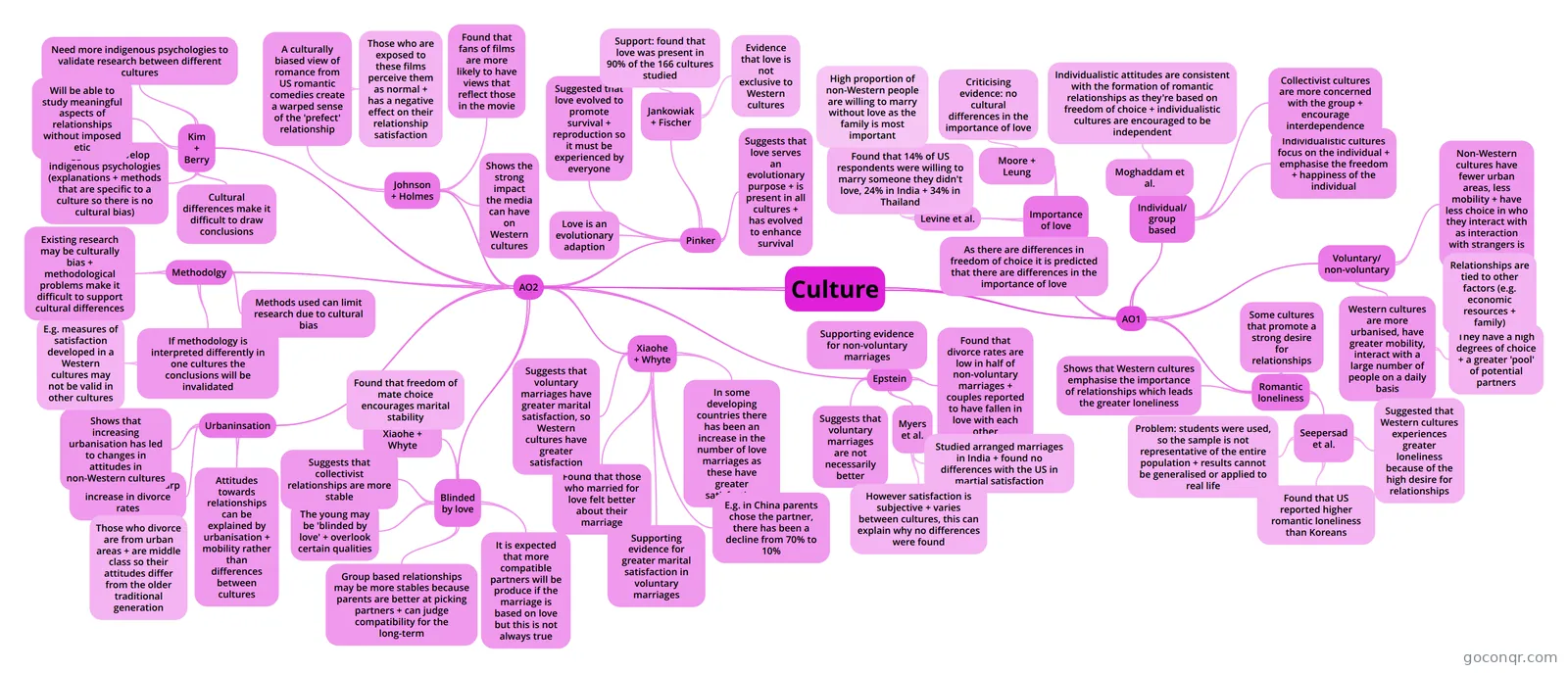
Mind map: Culture
Inhalt der Mindmap
Culture
AO1
- Voluntary/ non-voluntary
- Western cultures are more urbanised, have greater mobility, interact with a large number of people on a daily basis
- They have a high degrees of choice + a greater 'pool' of potential partners
- Non-Western cultures have fewer urban areas, less mobility + have less choice in who they interact with as interaction with strangers is rare
- Relationships are tied to other factors (e.g. economic resources + family)
- Western cultures are more urbanised, have greater mobility, interact with a large number of people on a daily basis
- Individual/ group based
- Individualistic cultures focus on the individual + emphasise the freedom + happiness of the individual
- Collectivist cultures are more concerned with the group + encourage interdependence
- Moghaddam et al.
- Individualistic attitudes are consistent with the formation of romantic relationships as they're based on freedom of choice + individualistic cultures are encouraged to be independent
- Importance of love
- As there are differences in freedom of choice it is predicted that there are differences in the importance of love
- Levine et al.
- Found that 14% of US respondents were willing to marry someone they didn't love, 24% in India + 34% in Thailand
- High proportion of non-Western people are willing to marry without love as the family is most important
- Found that 14% of US respondents were willing to marry someone they didn't love, 24% in India + 34% in Thailand
- Moore + Leung
- Criticising evidence: no cultural differences in the importance of love
- Romantic loneliness
- Some cultures that promote a strong desire for relationships
- Seepersad et al.
- Suggested that Western cultures experiences greater loneliness because of the high desire for relationships
- Found that US reported higher romantic loneliness than Koreans
- Problem: students were used, so the sample is not representative of the entire population + results cannot be generalised or applied to real life
- Shows that Western cultures emphasise the importance of relationships which leads the greater loneliness
- Voluntary/ non-voluntary
AO2
- Epstein
- Supporting evidence for non-voluntary marriages
- Found that divorce rates are low in half of non-voluntary marriages + couples reported to have fallen in love with each other
- Myers et al.
- Studied arranged marriages in India + found no differences with the US in martial satisfaction
- However satisfaction is subjective + varies between cultures, this can explain why no differences were found
- Suggests that voluntary marriages are not necessarily better
- Xiaohe + Whyte
- In some developing countries there has been an increase in the number of love marriages as these have greater satisfaction
- E.g. in China parents chose the partner, there has been a decline from 70% to 10%
- Supporting evidence for greater marital satisfaction in voluntary marriages
- Found that those who married for love felt better about their marriage
- Suggests that voluntary marriages have greater marital satisfaction, so Western cultures have greater satisfaction
- Pinker
- Love is an evolutionary adaption
- Suggested that love evolved to promote survival + reproduction so it must be experienced by everyone
- Jankowiak + Fischer
- Support: found that love was present in 90% of the 166 cultures studied
- Evidence that love is not exclusive to Western cultures
- Suggests that love serves an evolutionary purpose + is present in all cultures + has evolved to enhance survival
- Johnson + Holmes
- A culturally biased view of romance from US romantic comedies create a warped sense of the 'prefect' relationship
- Those who are exposed to these films perceive them as normal + has a negative effect on their relationship satisfaction
- Found that fans of films are more likely to have views that reflect those in the movie
- Shows the strong impact the media can have on Western cultures
- A culturally biased view of romance from US romantic comedies create a warped sense of the 'prefect' relationship
- Kim + Berry
- Cultural differences make it difficult to draw conclusions
- Suggest we develop indigenous psychologies (explanations + methods that are specific to a culture so there is no cultural bias)
- Will be able to study meaningful aspects of relationships without imposed etic
- Need more indigenous psychologies to validate research between different cultures
- Methodolgy
- Methods used can limit research due to cultural bias
- If methodology is interpreted differently in one cultures the conclusions will be invalidated
- E.g. measures of satisfaction developed in a Western cultures may not be valid in other cultures
- Existing research may be culturally bias + methodological problems make it difficult to support cultural differences
- Urbaninsation
- Attitudes towards relationships can be explained by urbanisation + mobility rather than differences between cultures
- India have had a sharp increase in divorce rates
- Those who divorce are from urban areas + are middle class so their attitudes differ from the older traditional generation
- Shows that increasing urbanisation has led to changes in attitudes in non-Western cultures
- Blinded by love
- It is expected that more compatible partners will be produce if the marriage is based on love but this is not always true
- Group based relationships may be more stables because parents are better at picking partners + can judge compatibility for the long-term
- The young may be 'blinded by love' + overlook certain qualities
- Suggests that collectivist relationships are more stable
- Xiaohe + Whyte
- Found that freedom of mate choice encourages marital stability
- Epstein
Informationen
- Beschreibung
- Psychology Mindmap am Culture, erstellt von Balinder am 10/04/2014.
- Erstellt von
- Balinder
- Aufrufe
- 5
- Tags
- Bewertung
Mehr zu Cultural influences on relationships