
Mindmap
AS: Developmental - Attachment
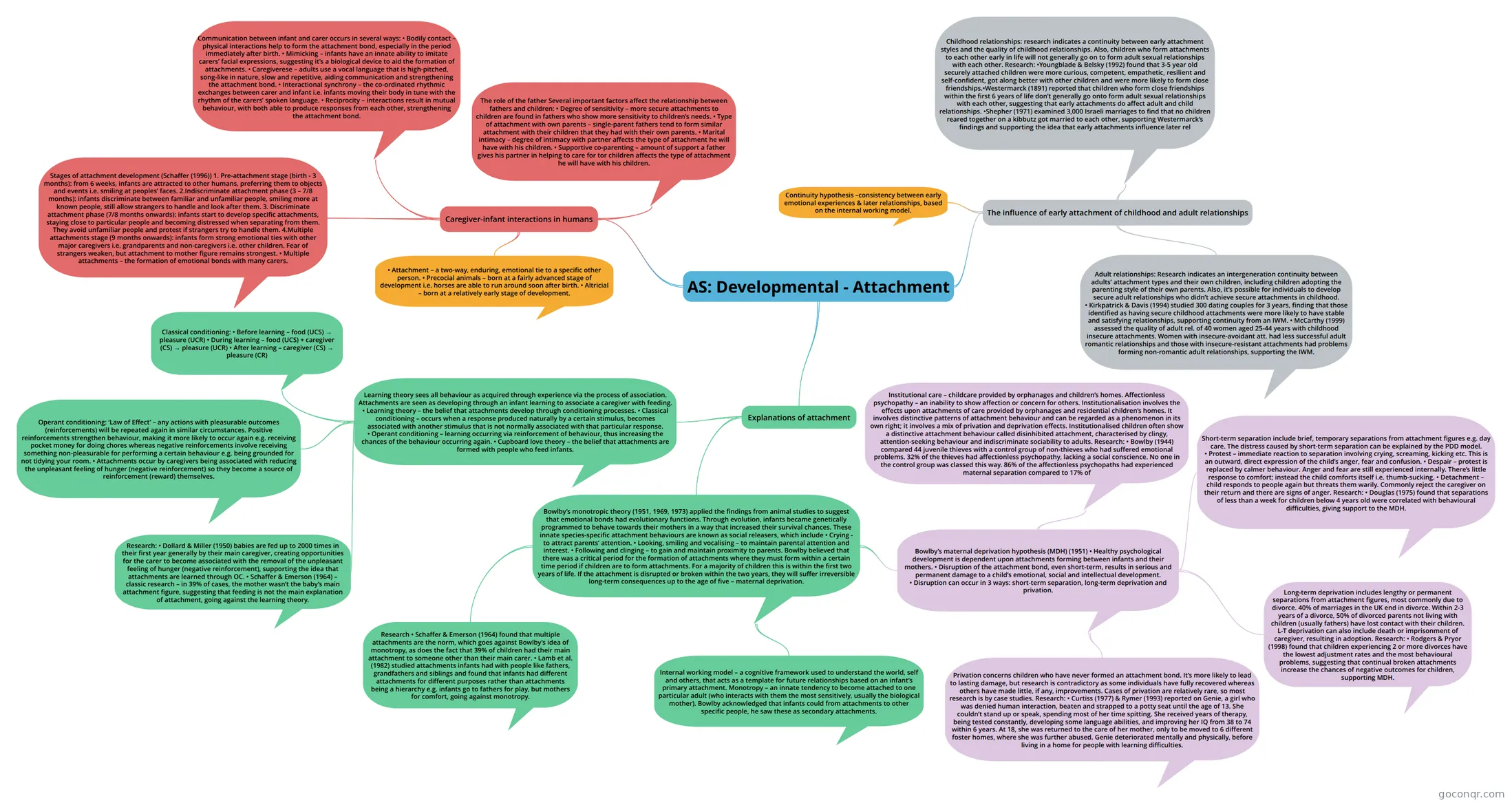
Mind map: AS developmental attachment
Inhalt der Mindmap
AS: Developmental - Attachment
Caregiver-infant interactions in humans
- Communication between infant and carer occurs in several ways: • Bodily contact – physical interactions help to form the attachment bond, especially in the period immediately after birth. • Mimicking – infants have an innate ability to imitate carers’ facial expressions, suggesting it’s a biological device to aid the formation of attachments. • Caregiverese – adults use a vocal language that is high-pitched, song-like in nature, slow and repetitive, aiding communication and strengthening the attachment bond. • Interactional synchrony – the co-ordinated rhythmic exchanges between carer and infant i.e. infants moving their body in tune with the rhythm of the carers’ spoken language. • Reciprocity – interactions result in mutual behaviour, with both able to produce responses from each other, strengthening the attachment bond.
- • Attachment – a two-way, enduring, emotional tie to a specific other person. • Precocial animals – born at a fairly advanced stage of development i.e. horses are able to run around soon after birth. • Altricial – born at a relatively early stage of development.
- Stages of attachment development (Schaffer (1996)) 1. Pre-attachment stage (birth - 3 months): from 6 weeks, infants are attracted to other humans, preferring them to objects and events i.e. smiling at peoples’ faces. 2.Indiscriminate attachment phase (3 – 7/8 months): infants discriminate between familiar and unfamiliar people, smiling more at known people, still allow strangers to handle and look after them. 3. Discriminate attachment phase (7/8 months onwards): infants start to develop specific attachments, staying close to particular people and becoming distressed when separating from them. They avoid unfamiliar people and protest if strangers try to handle them. 4.Multiple attachments stage (9 months onwards): infants form strong emotional ties with other major caregivers i.e. grandparents and non-caregivers i.e. other children. Fear of strangers weaken, but attachment to mother figure remains strongest. • Multiple attachments – the formation of emotional bonds with many carers.
- The role of the father Several important factors affect the relationship between fathers and children: • Degree of sensitivity – more secure attachments to children are found in fathers who show more sensitivity to children’s needs. • Type of attachment with own parents – single-parent fathers tend to form similar attachment with their children that they had with their own parents. • Marital intimacy – degree of intimacy with partner affects the type of attachment he will have with his children. • Supportive co-parenting – amount of support a father gives his partner in helping to care for tor children affects the type of attachment he will have with his children.
Explanations of attachment
- Learning theory sees all behaviour as acquired through experience via the process of association. Attachments are seen as developing through an infant learning to associate a caregiver with feeding. • Learning theory – the belief that attachments develop through conditioning processes. • Classical conditioning – occurs when a response produced naturally by a certain stimulus, becomes associated with another stimulus that is not normally associated with that particular response. • Operant conditioning – learning occurring via reinforcement of behaviour, thus increasing the chances of the behaviour occurring again. • Cupboard love theory – the belief that attachments are formed with people who feed infants.
- Classical conditioning: • Before learning – food (UCS) → pleasure (UCR) • During learning – food (UCS) + caregiver (CS) → pleasure (UCR) • After learning – caregiver (CS) → pleasure (CR)
- Operant conditioning: ‘Law of Effect’ – any actions with pleasurable outcomes (reinforcements) will be repeated again in similar circumstances. Positive reinforcements strengthen behaviour, making it more likely to occur again e.g. receiving pocket money for doing chores whereas negative reinforcements involve receiving something non-pleasurable for performing a certain behaviour e.g. being grounded for not tidying your room. • Attachments occur by caregivers being associated with reducing the unpleasant feeling of hunger (negative reinforcement) so they become a source of reinforcement (reward) themselves.
- Research: • Dollard & Miller (1950) babies are fed up to 2000 times in their first year generally by their main caregiver, creating opportunities for the carer to become associated with the removal of the unpleasant feeling of hunger (negative reinforcement), supporting the idea that attachments are learned through OC. • Schaffer & Emerson (1964) – classic research – in 39% of cases, the mother wasn’t the baby’s main attachment figure, suggesting that feeding is not the main explanation of attachment, going against the learning theory.
- Bowlby’s monotropic theory (1951, 1969, 1973) applied the findings from animal studies to suggest that emotional bonds had evolutionary functions. Through evolution, infants became genetically programmed to behave towards their mothers in a way that increased their survival chances. These innate species-specific attachment behaviours are known as social releasers, which include • Crying - to attract parents’ attention. • Looking, smiling and vocalising – to maintain parental attention and interest. • Following and clinging – to gain and maintain proximity to parents. Bowlby believed that there was a critical period for the formation of attachments where they must form within a certain time period if children are to form attachments. For a majority of children this is within the first two years of life. If the attachment is disrupted or broken within the two years, they will suffer irreversible long-term consequences up to the age of five – maternal deprivation.
- Research • Schaffer & Emerson (1964) found that multiple attachments are the norm, which goes against Bowlby’s idea of monotropy, as does the fact that 39% of children had their main attachment to someone other than their main carer. • Lamb et al. (1982) studied attachments infants had with people like fathers, grandfathers and siblings and found that infants had different attachments for different purposes rather than attachments being a hierarchy e.g. infants go to fathers for play, but mothers for comfort, going against monotropy.
- Internal working model – a cognitive framework used to understand the world, self and others, that acts as a template for future relationships based on an infant’s primary attachment. Monotropy – an innate tendency to become attached to one particular adult (who interacts with them the most sensitively, usually the biological mother). Bowlby acknowledged that infants could from attachments to other specific people, he saw these as secondary attachments.
- Bowlby’s maternal deprivation hypothesis (MDH) (1951) • Healthy psychological development is dependent upon attachments forming between infants and their mothers. • Disruption of the attachment bond, even short-term, results in serious and permanent damage to a child’s emotional, social and intellectual development. • Disruption can occur in 3 ways: short-term separation, long-term deprivation and privation.
- Short-term separation include brief, temporary separations from attachment figures e.g. day care. The distress caused by short-term separation can be explained by the PDD model. • Protest – immediate reaction to separation involving crying, screaming, kicking etc. This is an outward, direct expression of the child’s anger, fear and confusion. • Despair – protest is replaced by calmer behaviour. Anger and fear are still experienced internally. There’s little response to comfort; instead the child comforts itself i.e. thumb-sucking. • Detachment – child responds to people again but threats them warily. Commonly reject the caregiver on their return and there are signs of anger. Research: • Douglas (1975) found that separations of less than a week for children below 4 years old were correlated with behavioural difficulties, giving support to the MDH.
- Long-term deprivation includes lengthy or permanent separations from attachment figures, most commonly due to divorce. 40% of marriages in the UK end in divorce. Within 2-3 years of a divorce, 50% of divorced parents not living with children (usually fathers) have lost contact with their children. L-T deprivation can also include death or imprisonment of caregiver, resulting in adoption. Research: • Rodgers & Pryor (1998) found that children experiencing 2 or more divorces have the lowest adjustment rates and the most behavioural problems, suggesting that continual broken attachments increase the chances of negative outcomes for children, supporting MDH.
- Privation concerns children who have never formed an attachment bond. It’s more likely to lead to lasting damage, but research is contradictory as some individuals have fully recovered whereas others have made little, if any, improvements. Cases of privation are relatively rare, so most research is by case studies. Research: • Curtiss (1977) & Rymer (1993) reported on Genie, a girl who was denied human interaction, beaten and strapped to a potty seat until the age of 13. She couldn’t stand up or speak, spending most of her time spitting. She received years of therapy, being tested constantly, developing some language abilities, and improving her IQ from 38 to 74 within 6 years. At 18, she was returned to the care of her mother, only to be moved to 6 different foster homes, where she was further abused. Genie deteriorated mentally and physically, before living in a home for people with learning difficulties.
- Institutional care – childcare provided by orphanages and children’s homes. Affectionless psychopathy – an inability to show affection or concern for others. Institutionalisation involves the effects upon attachments of care provided by orphanages and residential children’s homes. It involves distinctive patterns of attachment behaviour and can be regarded as a phenomenon in its own right; it involves a mix of privation and deprivation effects. Institutionalised children often show a distinctive attachment behaviour called disinhibited attachment, characterised by clingy, attention-seeking behaviour and indiscriminate sociability to adults. Research: • Bowlby (1944) compared 44 juvenile thieves with a control group of non-thieves who had suffered emotional problems. 32% of the thieves had affectionless psychopathy, lacking a social conscience. No one in the control group was classed this way. 86% of the affectionless psychopaths had experienced maternal separation compared to 17% of
- Learning theory sees all behaviour as acquired through experience via the process of association. Attachments are seen as developing through an infant learning to associate a caregiver with feeding. • Learning theory – the belief that attachments develop through conditioning processes. • Classical conditioning – occurs when a response produced naturally by a certain stimulus, becomes associated with another stimulus that is not normally associated with that particular response. • Operant conditioning – learning occurring via reinforcement of behaviour, thus increasing the chances of the behaviour occurring again. • Cupboard love theory – the belief that attachments are formed with people who feed infants.
The influence of early attachment of childhood and adult relationships
- Childhood relationships: research indicates a continuity between early attachment styles and the quality of childhood relationships. Also, children who form attachments to each other early in life will not generally go on to form adult sexual relationships with each other. Research: •Youngblade & Belsky (1992) found that 3-5 year old securely attached children were more curious, competent, empathetic, resilient and self-confident, got along better with other children and were more likely to form close friendships.•Westermarck (1891) reported that children who form close friendships within the first 6 years of life don’t generally go onto form adult sexual relationships with each other, suggesting that early attachments do affect adult and child relationships. •Shepher (1971) examined 3,000 Israeli marriages to find that no children reared together on a kibbutz got married to each other, supporting Westermarck’s findings and supporting the idea that early attachments influence later rel
- Continuity hypothesis –consistency between early emotional experiences & later relationships, based on the internal working model.
- Adult relationships: Research indicates an intergeneration continuity between adults’ attachment types and their own children, including children adopting the parenting style of their own parents. Also, it’s possible for individuals to develop secure adult relationships who didn’t achieve secure attachments in childhood. • Kirkpatrick & Davis (1994) studied 300 dating couples for 3 years, finding that those identified as having secure childhood attachments were more likely to have stable and satisfying relationships, supporting continuity from an IWM. • McCarthy (1999) assessed the quality of adult rel. of 40 women aged 25-44 years with childhood insecure attachments. Women with insecure-avoidant att. had less successful adult romantic relationships and those with insecure-resistant attachments had problems forming non-romantic adult relationships, supporting the IWM.
Informationen
- Beschreibung
- A2 Psychology Mindmap am AS: Developmental - Attachment, erstellt von Jess M am 02/02/2017.
- Erstellt von
- Jess M
- Aufrufe
- 3
- Bewertung
Mehr zu Attachment and Parenting