
Mindmap
UNIT 3 RELATIONSHIPS (PART B)
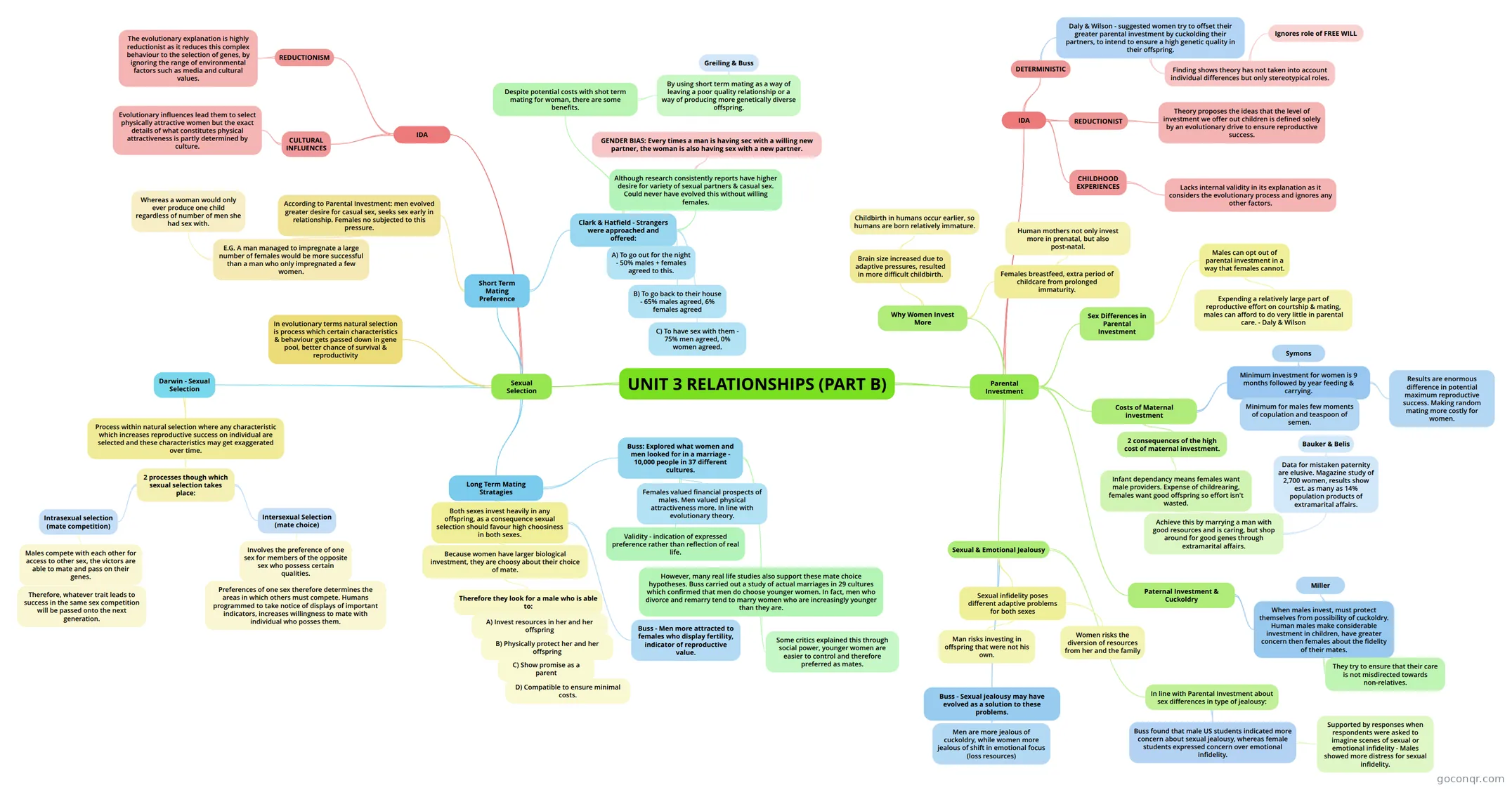
Mind map: Relationships (Unit 3, Part B)
Inhalt der Mindmap
UNIT 3 RELATIONSHIPS (PART B)
Sexual Selection
- In evolutionary terms natural selection is process which certain characteristics & behaviour gets passed down in gene pool, better chance of survival & reproductivity
- Darwin - Sexual Selection
- Process within natural selection where any characteristic which increases reproductive success on individual are selected and these characteristics may get exaggerated over time.
- 2 processes though which sexual selection takes place:
- Intrasexual selection (mate competition)
- Males compete with each other for access to other sex, the victors are able to mate and pass on their genes.
- Therefore, whatever trait leads to success in the same sex competition will be passed onto the next generation.
- Males compete with each other for access to other sex, the victors are able to mate and pass on their genes.
- Intersexual Selection (mate choice)
- Involves the preference of one sex for members of the opposite sex who possess certain qualities.
- Preferences of one sex therefore determines the areas in which others must compete. Humans programmed to take notice of displays of important indicators, increases willingness to mate with individual who posses them.
- Involves the preference of one sex for members of the opposite sex who possess certain qualities.
- Intrasexual selection (mate competition)
- 2 processes though which sexual selection takes place:
- Process within natural selection where any characteristic which increases reproductive success on individual are selected and these characteristics may get exaggerated over time.
- Short Term Mating Preference
- According to Parental Investment: men evolved greater desire for casual sex, seeks sex early in relationship. Females no subjected to this pressure.
- E.G. A man managed to impregnate a large number of females would be more successful than a man who only impregnated a few women.
- Whereas a woman would only ever produce one child regardless of number of men she had sex with.
- E.G. A man managed to impregnate a large number of females would be more successful than a man who only impregnated a few women.
- Clark & Hatfield - Strangers were approached and offered:
- A) To go out for the night - 50% males + females agreed to this.
- B) To go back to their house - 65% males agreed, 6% females agreed
- C) To have sex with them - 75% men agreed, 0% women agreed.
- Although research consistently reports have higher desire for variety of sexual partners & casual sex. Could never have evolved this without willing females.
- GENDER BIAS: Every times a man is having sec with a willing new partner, the woman is also having sex with a new partner.
- Despite potential costs with shot term mating for woman, there are some benefits.
- By using short term mating as a way of leaving a poor quality relationship or a way of producing more genetically diverse offspring.
- Greiling & Buss
- By using short term mating as a way of leaving a poor quality relationship or a way of producing more genetically diverse offspring.
- According to Parental Investment: men evolved greater desire for casual sex, seeks sex early in relationship. Females no subjected to this pressure.
- Long Term Mating Stratagies
- Both sexes invest heavily in any offspring, as a consequence sexual selection should favour high choosiness in both sexes.
- Because women have larger biological investment, they are choosy about their choice of mate.
- Therefore they look for a male who is able to:
- A) Invest resources in her and her offspring
- B) Physically protect her and her offspring
- C) Show promise as a parent
- D) Compatible to ensure minimal costs.
- C) Show promise as a parent
- B) Physically protect her and her offspring
- A) Invest resources in her and her offspring
- Therefore they look for a male who is able to:
- Buss - Men more attracted to females who display fertility, indicator of reproductive value.
- Because women have larger biological investment, they are choosy about their choice of mate.
- Buss: Explored what women and men looked for in a marriage - 10,000 people in 37 different cultures.
- Females valued financial prospects of males. Men valued physical attractiveness more. In line with evolutionary theory.
- Validity - indication of expressed preference rather than reflection of real life.
- However, many real life studies also support these mate choice hypotheses. Buss carried out a study of actual marriages in 29 cultures which confirmed that men do choose younger women. In fact, men who divorce and remarry tend to marry women who are increasingly younger than they are.
- Some critics explained this through social power, younger women are easier to control and therefore preferred as mates.
- Both sexes invest heavily in any offspring, as a consequence sexual selection should favour high choosiness in both sexes.
- IDA
- REDUCTIONISM
- The evolutionary explanation is highly reductionist as it reduces this complex behaviour to the selection of genes, by ignoring the range of environmental factors such as media and cultural values.
- CULTURAL INFLUENCES
- Evolutionary influences lead them to select physically attractive women but the exact details of what constitutes physical attractiveness is partly determined by culture.
- REDUCTIONISM
Parental Investment
- Sex Differences in Parental Investment
- Males can opt out of parental investment in a way that females cannot.
- Expending a relatively large part of reproductive effort on courtship & mating, males can afford to do very little in parental care. - Daly & Wilson
- Males can opt out of parental investment in a way that females cannot.
- Why Women Invest More
- Brain size increased due to adaptive pressures, resulted in more difficult childbirth.
- Childbirth in humans occur earlier, so humans are born relatively immature.
- Females breastfeed, extra period of childcare from prolonged immaturity.
- Human mothers not only invest more in prenatal, but also post-natal.
- Brain size increased due to adaptive pressures, resulted in more difficult childbirth.
- IDA
- DETERMINISTIC
- Daly & Wilson - suggested women try to offset their greater parental investment by cuckolding their partners, to intend to ensure a high genetic quality in their offspring.
- Finding shows theory has not taken into account individual differences but only stereotypical roles.
- Ignores role of FREE WILL
- Finding shows theory has not taken into account individual differences but only stereotypical roles.
- Daly & Wilson - suggested women try to offset their greater parental investment by cuckolding their partners, to intend to ensure a high genetic quality in their offspring.
- REDUCTIONIST
- Theory proposes the ideas that the level of investment we offer out children is defined solely by an evolutionary drive to ensure reproductive success.
- CHILDHOOD EXPERIENCES
- Lacks internal validity in its explanation as it considers the evolutionary process and ignores any other factors.
- DETERMINISTIC
- Costs of Maternal investment
- Minimum investment for women is 9 months followed by year feeding & carrying.
- Symons
- Minimum for males few moments of copulation and teaspoon of semen.
- Results are enormous difference in potential maximum reproductive success. Making random mating more costly for women.
- 2 consequences of the high cost of maternal investment.
- Infant dependancy means females want male providers. Expense of childrearing, females want good offspring so effort isn't wasted.
- Achieve this by marrying a man with good resources and is caring, but shop around for good genes through extramarital affairs.
- Data for mistaken paternity are elusive. Magazine study of 2,700 women, results show est. as many as 14% population products of extramarital affairs.
- Bauker & Belis
- Data for mistaken paternity are elusive. Magazine study of 2,700 women, results show est. as many as 14% population products of extramarital affairs.
- Achieve this by marrying a man with good resources and is caring, but shop around for good genes through extramarital affairs.
- Infant dependancy means females want male providers. Expense of childrearing, females want good offspring so effort isn't wasted.
- Minimum investment for women is 9 months followed by year feeding & carrying.
- Paternal Investment & Cuckoldry
- When males invest, must protect themselves from possibility of cuckoldry. Human males make considerable investment in children, have greater concern then females about the fidelity of their mates.
- Miller
- They try to ensure that their care is not misdirected towards non-relatives.
- When males invest, must protect themselves from possibility of cuckoldry. Human males make considerable investment in children, have greater concern then females about the fidelity of their mates.
- Sexual & Emotional Jealousy
- Sexual infidelity poses different adaptive problems for both sexes
- Man risks investing in offspring that were not his own.
- Women risks the diversion of resources from her and the family
- Buss - Sexual jealousy may have evolved as a solution to these problems.
- Men are more jealous of cuckoldry, while women more jealous of shift in emotional focus (loss resources)
- In line with Parental Investment about sex differences in type of jealousy:
- Buss found that male US students indicated more concern about sexual jealousy, whereas female students expressed concern over emotional infidelity.
- Supported by responses when respondents were asked to imagine scenes of sexual or emotional infidelity - Males showed more distress for sexual infidelity.
- Buss found that male US students indicated more concern about sexual jealousy, whereas female students expressed concern over emotional infidelity.
- Sexual infidelity poses different adaptive problems for both sexes
- Sex Differences in Parental Investment
Informationen
- Beschreibung
- A-Level Psychology Mindmap am UNIT 3 RELATIONSHIPS (PART B), erstellt von itsmenickylee am 27/05/2014.
- Erstellt von
- itsmenickylee
- Aufrufe
- 18
- Bewertung
Mehr zu Sexual selection and partner preferences