
Mindmap
Conceptual Development
Inhalt der Mindmap
Conceptual Development
CONCEPTION VERSUS PERCEPTION
- A concept is a MENTAL REPRESENTATION of an object, used for making inferences, categorising, memory etc. They are abstract, inferentially rich and non-modular
- The dominant theory of mind - thinking is a computation of representations
- PERCEPTUAL REPRESENTATIONS are sensory, concrete, modular, and have a limited inferential role.
- [Module = cognitive unit, associated with philosopher Fodor, are encapsulated, domain specific, and automatic - e.g. Muller Lyer illusion]
- NATIVISM VERSUS EMPIRICISM VERSUS PRAGMATISM
- NATIVISM: Born with innate knowledge about physical, linguistic, and social worlds (Chomsky, Fodor, Plato)
- 1.
- CONCEPTUAL REPRESENTATION: Core cognition - modular, innate, a result of specialised modules constructed by natural selection - supported by Carey and Spelke
- **However, does not imply present at birth - may require perceptual inputs or maturation of CNS to be activated - not a continuous process
- EMPIRICISM: Born with 'blank slate' mind, knowledge constructed from perceptual inputs (Locke, Berkeley, Hume)
- 2.
- CONCEPTUAL REPRESENTATION: central, linguistically encoded - overhauled through development
- E.g. perception of objects: concept of distal object built from primitive sensory representations, or proximal stimuli - shape, colour.
- PRAGMATISM: Development occurs through activity/interaction with environment - internalising results (James, Piaget)
- 3.
- NATIVISM: Born with innate knowledge about physical, linguistic, and social worlds (Chomsky, Fodor, Plato)
- A concept is a MENTAL REPRESENTATION of an object, used for making inferences, categorising, memory etc. They are abstract, inferentially rich and non-modular
OBJECT PERMANENCE: KNOWLEDGE THAT THE EXISTENCE OF THE EXTERNAL WORLD IS INDEPENDENT OF THE MIND.
- Rationalism: Innate, so should appear early.
- Empiricism: Develops through perceptual learning.
- Pragmatism: Development depends on development of action, so should be assessed in terms of actions.
- PIAGETIAN APPROACH:
- Infants have innate sensorimotor reflexes (0-18m) but cannot represent objects as objects - does not emerge until invisible displacement has passed.
- PIAGETIAN STUDIES OF OBJECT PERMANENCE:
- (1) Searching for occluded objects: pass typically at 8m - have developed motor skills to reach and remove occluders
- Thus, are infants representing hidden objects at 8m? Piaget argued that their performance is a result of learning an action procedure - as opposed to individuating a single persisting object - as shown by A not B. So only at 18m
- (2) A-not-B task: passed at around 12m. Two occluders - researcher moves object from under one to the other in full vision - both as easy to reach, but infant looks in original spot- perseveration error.
- (3) Invisible displacement: passed around 18m - displacing object by invisible means, do they look in correct location?
- (1) Searching for occluded objects: pass typically at 8m - have developed motor skills to reach and remove occluders
- PIAGETIAN STUDIES OF OBJECT PERMANENCE:
- OPPOSING PIAGETIAN APPROACH
- It is possible that the infant knows the object is occluded but CANNOT PUT THIS KNOWLEDGE INTO ACTION.
- If true, infants would be surprised at perceived outcomes that violate this knowledge.
- Bower -1970s, later - Baillargeon and Spelke
- VIOLATION OF EXPECTATION STUDIES
- Habituation (exposed, looking time halved)
- Dishabituation (new event shown - improbable - looking time increase? - surprise)
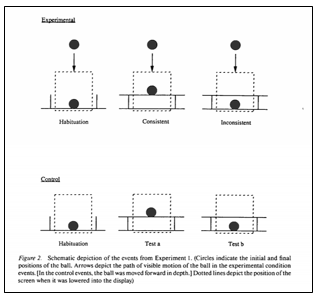
- Baillargeon, Spelke & Wasserman (1985): CONDITION 1: object is rotated, no obstacles. CONDITION 2: Object is rotated, box behind so that is appears to be obstacle, but still goes past - IMPOSSIBLE EVENT. CONDITION 3: Object rotates until the point of the obstacle (control - no obstacles but object still stops at same points).
- 5 month olds looked significantly longer at IMPOSSIBLE EVENT than the possible one
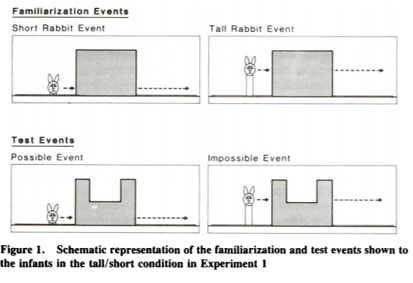
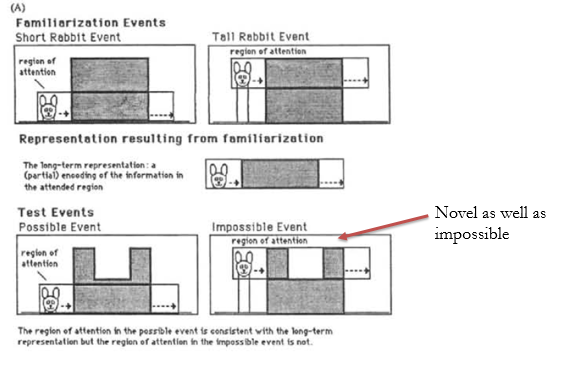
- Baillargeon & Graber (1987) Where is the Rabbit? Tall rabbits, short rabbits, and likewise occluders - 5m olds show surprise
- Explaining anomalies: adults do not show surprise, they assume a 2nd rabbit is waiting behind the occluder. 7m infants also don't show surprise - could the explanation be the same? When a second rabbit is initially shown, 5.5m show no dishabituation.
- Baillargeon, Spelke & Wasserman (1985): CONDITION 1: object is rotated, no obstacles. CONDITION 2: Object is rotated, box behind so that is appears to be obstacle, but still goes past - IMPOSSIBLE EVENT. CONDITION 3: Object rotates until the point of the obstacle (control - no obstacles but object still stops at same points).
- Dishabituation (new event shown - improbable - looking time increase? - surprise)
- Criticism of VOE Tasks
- What does dishabituation actually measure? There is contention as to whether it indicates surprise or a preference for novel stimuli.
- In fact, Bogartz et al. (1997) demonstrated that it takes no longer to habituate infants to impossible events than it does to possible events.
- Solidity: Hood, Carey & Prasada (2000). Infants familiarised to ball falling into a container. Then introduced to 2 shelves - inserted, ball dropped. Encouraged to search for ball, but did not seem to take into account the solidity of the shelves, even at 2y looked in incorrect locations. Yet VOE studies had indicated otherwise.
- Gravity: Hood et al. (2002). Infants overapply the gravity principle in ways that do not follow logic. Gravity tubes task. Until 2.5y. Shows a lack of full understanding of gravity.
- WHY IS THERE A GAP IN THESE FINDINGS BETWEEN VOE AND SEARCH?
- 1. Memory failure; 2. Executive error; 3. Problems with prediction; 4. Domain-general reps versus modular reps; 5. search tasks may be more difficult due to extraneous task demands (means end planning)
- 4. Looking time shows encapsulated system knowledge, but this may be separate from domain-general reps responsible for action.
- 2. Executive error: A-not-B tasks reflect this. Infant may experience difficulty inhibiting habit of reaching for side A, whilst at the same time holding the current location in WM. Thus, may know but cannot inhibit. Success = self-control?
- Maturational changes in the PFC underlies improvement in performance 7 to 12m (Diamond). Rhesus monkeys w/ lesions perform poorly on an analogue of the task. Infants with PKU perform much worse.
- Ahmed & Ruffman (1998) VOE version of the A-not-B task - infants looked longer at impossible event across all 3 conditions
- Maturational changes in the PFC underlies improvement in performance 7 to 12m (Diamond). Rhesus monkeys w/ lesions perform poorly on an analogue of the task. Infants with PKU perform much worse.
- 1. Memory failure; 2. Executive error; 3. Problems with prediction; 4. Domain-general reps versus modular reps; 5. search tasks may be more difficult due to extraneous task demands (means end planning)
- WHY IS THERE A GAP IN THESE FINDINGS BETWEEN VOE AND SEARCH?
- Gravity: Hood et al. (2002). Infants overapply the gravity principle in ways that do not follow logic. Gravity tubes task. Until 2.5y. Shows a lack of full understanding of gravity.
- Solidity: Hood, Carey & Prasada (2000). Infants familiarised to ball falling into a container. Then introduced to 2 shelves - inserted, ball dropped. Encouraged to search for ball, but did not seem to take into account the solidity of the shelves, even at 2y looked in incorrect locations. Yet VOE studies had indicated otherwise.
- Preference for Motion? Rivera et al. (1999). With no habituation period, infants were shown an impossible event (object rotating 180 degrees despite there appearing to be an obstructing object) and a possible event (stops at obstructing object). In the first condition, the rotation is 180 degrees whereas in the second condition, the rotation is 112 degrees. Shown these events without the objects (trial 2). In both trials, infants looked longer at the 180 degree condition.
- However, Wang, Baillargeon & Brueckner (2004) used the same degree of motion in their experimental conditions and still found a preference for the inappropriate events (narrow and wide occluders). However, the appearance of the displays in each condition were different.
- Spelke's work is less vulnerable to criticism as her designs are the same for the impossible and possible trials.
- However, Wang, Baillargeon & Brueckner (2004) used the same degree of motion in their experimental conditions and still found a preference for the inappropriate events (narrow and wide occluders). However, the appearance of the displays in each condition were different.
- In fact, Bogartz et al. (1997) demonstrated that it takes no longer to habituate infants to impossible events than it does to possible events.
- Haith (1998): nothing should be inferred from looking time studies. Is it possible that infants have a lingering sensory activation - cognition does not begin when the object disappears - where is the temporal breakpoint?
- However, this theory has trouble explaining studies with longer occlusion periods, when occluded objects MOVE, when the occluded object is only ever partially visible (Rochat & Hespos, 1996)
- What does dishabituation actually measure? There is contention as to whether it indicates surprise or a preference for novel stimuli.
- Habituation (exposed, looking time halved)
- If true, infants would be surprised at perceived outcomes that violate this knowledge.
- It is possible that the infant knows the object is occluded but CANNOT PUT THIS KNOWLEDGE INTO ACTION.
- Infants have innate sensorimotor reflexes (0-18m) but cannot represent objects as objects - does not emerge until invisible displacement has passed.
- PIAGETIAN APPROACH:
FOLK PHYSICS: continuity, solidity, gravity, inertia. Spelke.
- Spelke et al. (1992) continuity and soldiity -3-4m olds. Dishabituated to inconsistent event, suggesting understanding of the above concepts.
- SOLIDITY: Hespos & Baillargeon (2001) experiment. Infants shown two containers, one smaller than the other. In open-container condition, the smaller container fits into the bigger (the open top has been shown). In the second condition, the top is closed and this is shown. Yet, the container fits in.
- Looking time was much longer for the impossible event.
- SOLIDITY: Hespos & Baillargeon (2001) experiment. Infants shown two containers, one smaller than the other. In open-container condition, the smaller container fits into the bigger (the open top has been shown). In the second condition, the top is closed and this is shown. Yet, the container fits in.
- Gravity, on the other hand, was failed by 5m olds but passed by 7m olds in an experiment by Kim & Spelke (1992): object motion on an inclined plane. Viewed ball rolling either downward or upward, either accelerating or decelerating. Then tested on opposite, with appropriate or inappropriate acceleration. At 7m - looked longer at inappropriate event.
- Nativists conclude from this that from 1/2m, representations of objects are formed, and are NOT formed from perceptual primitives. These representations respect folk physics. They do acknowledge that reps undergo much more advancement over the years.
- Individuating Objects. This is the ability to track numerical identity across time.
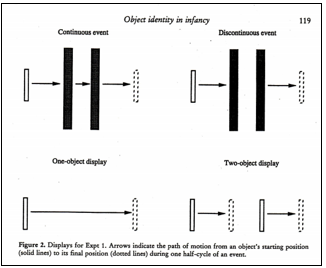
- Spelke, Kestenbaum, Simons & Wein (1995) tested the use of spatiotemporal (movement) info to individuate objects. Able to pass at 4m.
- Spelke et al. (1992) continuity and soldiity -3-4m olds. Dishabituated to inconsistent event, suggesting understanding of the above concepts.
Object Kinds: as shown, infants can use spatiotemporal info to individuate objects - but can they use perceptual info such as colour and shape or kind to individuate objects?
- Xu & Carey (1996): S-T CONDITION: Screen at start. Both a bear and a truck are shown. Then only truck is shown, then returned behind the screen. Then the bear is brought out, then returned. This repeated. Screen is then lift to show either 1) EXPECTED outcome or 2) UNEXPECTED outcome (just one toy). 10m olds showed more surprise at 2.
- KIND CONDITION: The objects are not shown together at the start, the rest of the pattern is the same. Screen removed - must use info on perceptual feature to individuate them. This condition is not passed until 12m
- Tested in OLDER INFANTS. Xu, Carey & Quint (2004) - suggested that not any kind of feature is used. In their experiment, 12m olds failed to use colour to distinguish objects.
- These experiments were then tried with SEARCH rather than LOOKING. Opposite to what was seen earlier, infants (12m) have done better in manual search versions than looking.
- Van de Walle, Prevor & Carey (2000): Opaque box, Toy A extracted. placed on top, then returned to box. Toy B then extracted, placed, then returned. 12m olds often searched more than once (indicating knowledge of two different kinds of toys in box), compared to 10m olds.
- LABELLING? Xu (2000): Similar to screen and toy experiment earlier, but names of toys announced. 9m olds surprised at one object when 2 distinct labels were used. Similar results have been found when nonsense words were used, BUT NOT the same word twice, " w/ different tones, " w/different emotional reactions.
- DEMONSTRATIONS OF FUNCTION? Futo. Teglas, Csibra & Gergely (2010) 10m found to be able to do this.
- These experiments were then tried with SEARCH rather than LOOKING. Opposite to what was seen earlier, infants (12m) have done better in manual search versions than looking.
- Tested in OLDER INFANTS. Xu, Carey & Quint (2004) - suggested that not any kind of feature is used. In their experiment, 12m olds failed to use colour to distinguish objects.
- KIND CONDITION: The objects are not shown together at the start, the rest of the pattern is the same. Screen removed - must use info on perceptual feature to individuate them. This condition is not passed until 12m
- Xu & Carey (1996): S-T CONDITION: Screen at start. Both a bear and a truck are shown. Then only truck is shown, then returned behind the screen. Then the bear is brought out, then returned. This repeated. Screen is then lift to show either 1) EXPECTED outcome or 2) UNEXPECTED outcome (just one toy). 10m olds showed more surprise at 2.
Bilder und Dateien der Mindmap
Informationen
- Beschreibung
- Psychology Mindmap am Conceptual Development, erstellt von Tara van Zyl am 22/03/2018.
- Erstellt von
- Tara van Zyl
- Aufrufe
- 0
- Bewertung