
Mindmap
Psychology: Attachment
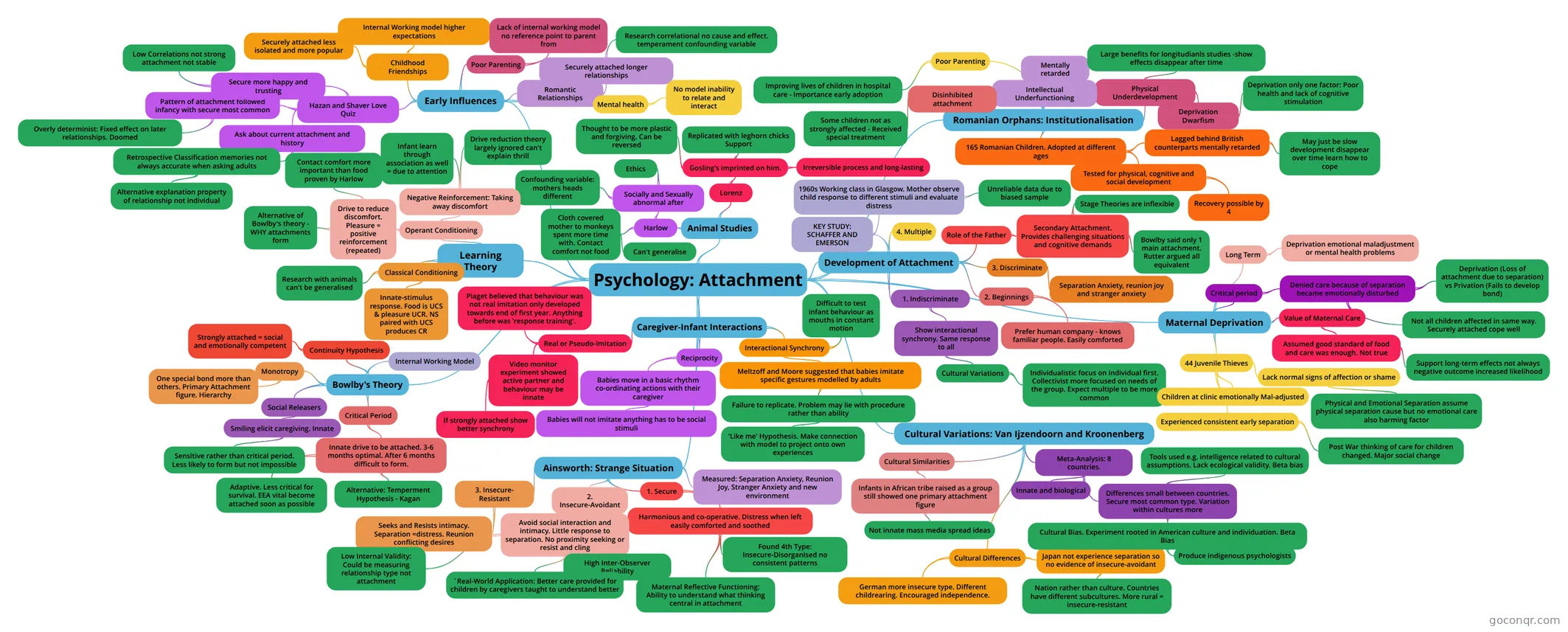
Mind map: Attachment in psychology
Inhalt der Mindmap
Psychology: Attachment
Caregiver-Infant Interactions
- Reciprocity
- Babies move in a basic rhythm co-ordinating actions with their caregiver
- Babies will not imitate anything has to be social stimuli
- Babies move in a basic rhythm co-ordinating actions with their caregiver
- Interactional Synchrony
- Meltzoff and Moore suggested that babies imitate specific gestures modelled by adults
- Failure to replicate. Problem may lie with procedure rather than ability
- 'Like me' Hypothesis. Make connection with model to project onto own experiences
- Failure to replicate. Problem may lie with procedure rather than ability
- Difficult to test infant behaviour as mouths in constant motion
- Meltzoff and Moore suggested that babies imitate specific gestures modelled by adults
- Real or Pseudo-Imitation
- Piaget believed that behaviour was not real imitation only developed towards end of first year. Anything before was 'response training'.
- Video monitor experiment showed active partner and behaviour may be innate
- If strongly attached show better synchrony
- Reciprocity
Development of Attachment
- 1. Indiscriminate
- Show interactional synchrony. Same response to all
- Cultural Variations
- Individualistic focus on individual first. Collectivist more focused on needs of the group. Expect multiple to be more common
- Cultural Variations
- Show interactional synchrony. Same response to all
- 2. Beginnings
- Prefer human company - knows familiar people. Easily comforted
- 3. Discriminate
- Separation Anxiety, reunion joy and stranger anxiety
- 4. Multiple
- KEY STUDY: SCHAFFER AND EMERSON
- 1960s Working class in Glasgow. Mother observe child response to different stimuli and evaluate distress
- Unreliable data due to biased sample
- 1960s Working class in Glasgow. Mother observe child response to different stimuli and evaluate distress
- Role of the Father
- Secondary Attachment. Provides challenging situations and cognitive demands
- Bowlby said only 1 main attachment. Rutter argued all equivalent
- Stage Theories are inflexible
- Secondary Attachment. Provides challenging situations and cognitive demands
- 1. Indiscriminate
Animal Studies
- Harlow
- Cloth covered mother to monkeys spent more time with. Contact comfort not food
- Can't generalise
- Socially and Sexually abnormal after
- Confounding variable: mothers heads different
- Ethics
- Cloth covered mother to monkeys spent more time with. Contact comfort not food
- Lorenz
- Gosling's imprinted on him.
- Irreversible process and long-lasting
- Replicated with leghorn chicks Support
- Thought to be more plastic and forgiving. Can be reversed
- Gosling's imprinted on him.
- Harlow
Learning Theory
- Classical Conditioning
- Innate-stimulus response. Food is UCS & pleasure UCR. NS paired with UCS produces CR
- Research with animals can't be generalised
- Operant Conditioning
- Drive to reduce discomfort. Pleasure = positive reinforcement (repeated)
- Contact comfort more important than food proven by Harlow
- Alternative of Bowlby's theory - WHY attachments form
- Negative Reinforcement: Taking away discomfort
- Infant learn through association as well = due to attention
- Drive reduction theory largely ignored can't explain thrill
- Drive to reduce discomfort. Pleasure = positive reinforcement (repeated)
- Classical Conditioning
Bowlby's Theory
- Critical Period
- Innate drive to be attached. 3-6 months optimal. After 6 months difficult to form.
- Adaptive. Less critical for survival. EEA vital become attached soon as possible
- Alternative: Temperment Hypothesis - Kagan
- Innate drive to be attached. 3-6 months optimal. After 6 months difficult to form.
- Social Releasers
- Smiling elicit caregiving. Innate
- Sensitive rather than critical period. Less likely to form but not impossible
- Smiling elicit caregiving. Innate
- Monotropy
- One special bond more than others. Primary Attachment figure. Hierarchy
- Continuity Hypothesis
- Strongly attached = social and emotionally competent
- Internal Working Model
- Critical Period
Ainsworth: Strange Situation
- Measured: Separation Anxiety, Reunion Joy, Stranger Anxiety and new environment
- 1. Secure
- Harmonious and co-operative. Distress when left easily comforted and soothed
- Found 4th Type: Insecure-Disorganised no consistent patterns
- Maternal Reflective Functioning: Ability to understand what thinking central in attachment
- Harmonious and co-operative. Distress when left easily comforted and soothed
- 2. Insecure-Avoidant
- Avoid social interaction and intimacy. Little response to separation. No proximity seeking or resist and cling
- High Inter-Observer Reliability
- `Real-World Application: Better care provided for children by caregivers taught to understand better
- Low Internal Validity: Could be measuring relationship type not attachment
- Avoid social interaction and intimacy. Little response to separation. No proximity seeking or resist and cling
- 3. Insecure- Resistant
- Seeks and Resists intimacy. Separation =distress. Reunion conflicting desires
Cultural Variations: Van Ijzendoorn and Kroonenberg
- Meta-Analysis: 8 countries.
- Differences small between countries. Secure most common type. Variation within cultures more
- Tools used e.g. intelligence related to cultural assumptions. Lack ecological validity. Beta bias
- Cultural Bias. Experiment rooted in American culture and individuation. Beta Bias
- Produce indigenous psychologists
- Innate and biological
- Differences small between countries. Secure most common type. Variation within cultures more
- Cultural Similarities
- Infants in African tribe raised as a group still showed one primary attachment figure
- Not innate mass media spread ideas
- Infants in African tribe raised as a group still showed one primary attachment figure
- Cultural Differences
- German more insecure type. Different childrearing. Encouraged independence.
- Japan not experience separation so no evidence of insecure-avoidant
- Nation rather than culture. Countries have different subcultures. More rural = insecure-resistant
- Meta-Analysis: 8 countries.
Maternal Deprivation
- 44 Juvenile Thieves
- Children at clinic emotionally Mal-adjusted
- Lack normal signs of affection or shame
- Physical and Emotional Separation assume physical separation cause but no emotional care also harming factor
- Experienced consistent early separation
- Post War thinking of care for children changed. Major social change
- Value of Maternal Care
- Assumed good standard of food and care was enough. Not true
- Support long-term effects not always negative outcome increased likelihood
- Assumed good standard of food and care was enough. Not true
- Critical period
- Denied care because of separation became emotionally disturbed
- Not all children affected in same way. Securely attached cope well
- Deprivation (Loss of attachment due to separation) vs Privation (Fails to develop bond)
- Denied care because of separation became emotionally disturbed
- Long Term
- Deprivation emotional maladjustment or mental health problems
- 44 Juvenile Thieves
Romanian Orphans: Institutionalisation
- 165 Romanian Children. Adopted at different ages
- Tested for physical, cognitive and social development
- Recovery possible by 4
- Lagged behind British counterparts mentally retarded
- May just be slow development disappear over time learn how to cope
- Tested for physical, cognitive and social development
- Physical Underdevelopment
- Deprivation Dwarfism
- Deprivation only one factor: Poor health and lack of cognitive stimulation
- Large benefits for longitudianls studies -show effects disappear after time
- Deprivation Dwarfism
- Intellectual Underfunctioning
- Mentally retarded
- Disinhibited attachment
- Some children not as strongly affected - Received special treatment
- Poor Parenting
- Improving lives of children in hospital care - Importance early adoption
- 165 Romanian Children. Adopted at different ages
Early Influences
- Hazan and Shaver Love Quiz
- Ask about current attachment and history
- Retrospective Classification memories not always accurate when asking adults
- Alternative explanation property of relationship not individual
- Retrospective Classification memories not always accurate when asking adults
- Pattern of attachment followed infancy with secure most common
- Overly determinist: Fixed effect on later relationships. Doomed
- Secure more happy and trusting
- Low Correlations not strong attachment not stable
- Ask about current attachment and history
- Childhood Friendships
- Securely attached less isolated and more popular
- Internal Working model higher expectations
- Poor Parenting
- Lack of internal working model no reference point to parent from
- Romantic Relationships
- Securely attached longer relationships
- Research correlational no cause and effect. temperament confounding variable
- Securely attached longer relationships
- Mental health
- No model inability to relate and interact
- Hazan and Shaver Love Quiz
Informationen
- Beschreibung
- Mindmap of the Attachment section from AQA Psychology AS book.
- Erstellt von
- Emilia Leydon
- Aufrufe
- 20
- Tags
- Bewertung