
Mindmap
Wall Street Crash Consequences Continued
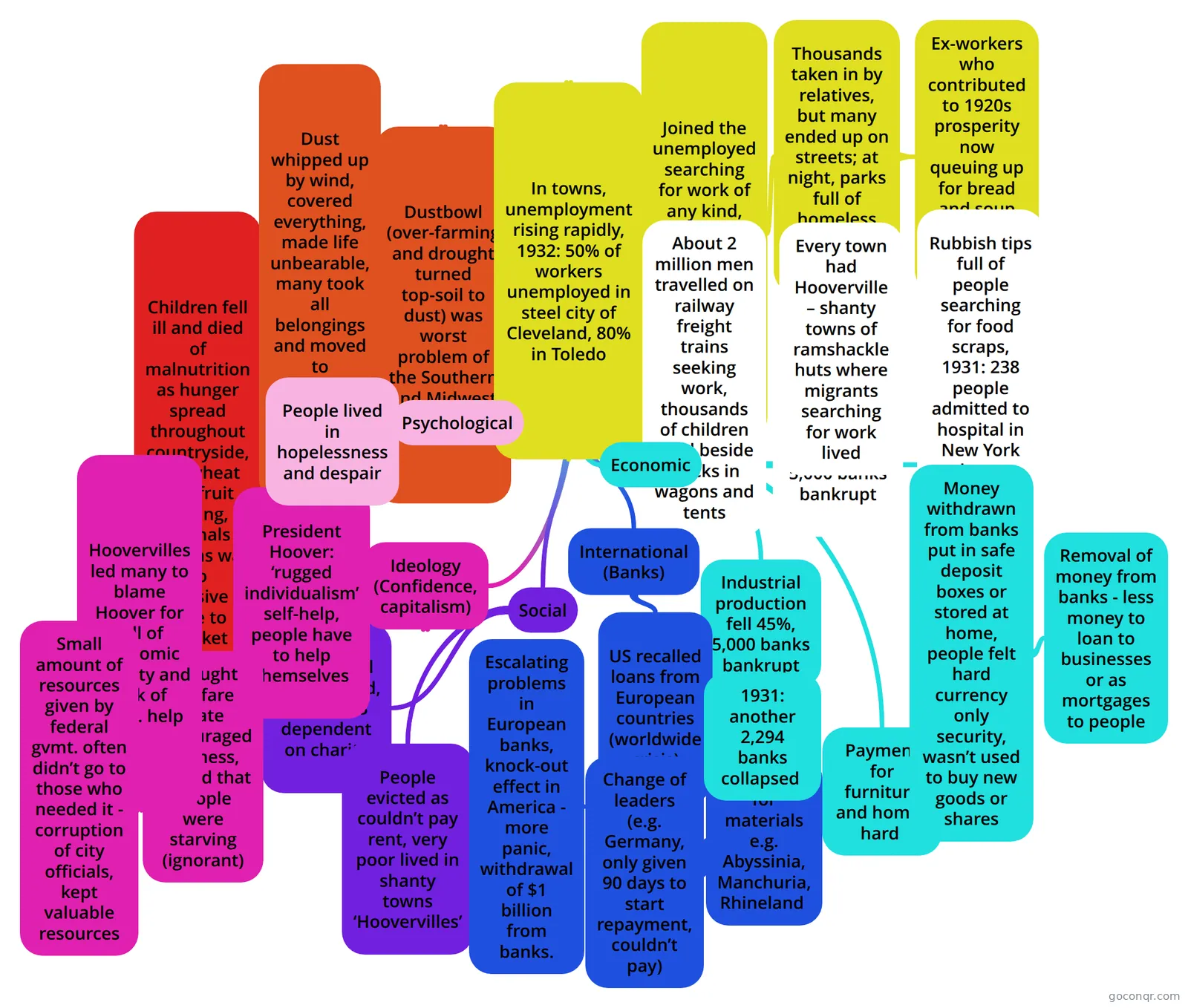
Mind map: Wall Street Crash consequences
Inhalt der Mindmap
Wall Street Crash Consequences Continued
Children fell ill and died of malnutrition as hunger spread throughout countryside, but wheat and fruit rotting, animals killed as was so expensive to take to market
Dustbowl (over-farming and drought turned top-soil to dust) was worst problem of the Southern and Midwest states
- Dust whipped up by wind, covered everything, made life unbearable, many took all belongings and moved to California to look for work
In towns, unemployment rising rapidly, 1932: 50% of workers unemployed in steel city of Cleveland, 80% in Toledo
- Joined the unemployed searching for work of any kind, forced to sell homes or kicked out as couldn’t pay rent
- Thousands taken in by relatives, but many ended up on streets; at night, parks full of homeless and unemployed
- Ex-workers who contributed to 1920s prosperity now queuing up for bread and soup from charity workers
- Thousands taken in by relatives, but many ended up on streets; at night, parks full of homeless and unemployed
- Joined the unemployed searching for work of any kind, forced to sell homes or kicked out as couldn’t pay rent
Economic
- Payment for furniture and homes hard
- Industrial production fell 45%, 5,000 banks bankrupt
- 1931: another 2,294 banks collapsed
- Money withdrawn from banks put in safe deposit boxes or stored at home, people felt hard currency only security, wasn’t used to buy new goods or shares
- Removal of money from banks - less money to loan to businesses or as mortgages to people
International (Banks)
- US recalled loans from European countries (worldwide crisis)
- Escalating problems in European banks, knock-out effect in America - more panic, withdrawal of $1 billion from banks.
- Change of leaders (e.g. Germany, only given 90 days to start repayment, couldn’t pay)
- Invasions for materials e.g. Abyssinia, Manchuria, Rhineland
- US recalled loans from European countries (worldwide crisis)
Social
- 1933: 13mil unemployed, nearly 1/3 dependent on charity
- People evicted as couldn’t pay rent, very poor lived in shanty towns ‘Hoovervilles’
Ideology (Confidence, capitalism)
- President Hoover: ‘rugged individualism’ self-help, people have to help themselves
- Thought welfare state encouraged idleness, denied that people were starving (ignorant)
- Hoovervilles led many to blame Hoover for fall of economic stability and lack of gvmt. help
- Small amount of resources given by federal gvmt. often didn’t go to those who needed it - corruption of city officials, kept valuable resources
- President Hoover: ‘rugged individualism’ self-help, people have to help themselves
Psychological
- People lived in hopelessness and despair
Informationen
- Beschreibung
- Mind Map on Wall Street Consequences Continued, created by Chloe Vasconcelos on 15/11/2018.
- Erstellt von
- Chloe Vasconcelos
- Aufrufe
- 4
- Bewertung