
Mindmap
Memory and the Multi-Store Model

Inhalt der Mindmap
Memory and the Multi-Store Model
MEMORY: a system of retaining information from our daily experiences, these daily experiences create schemas SCHEMAS: a mental template for interpreting and processing incoming information; based on our unique experiences of the world
- Memory involves 3 basic features
- ENCODING: the format that information is held E.g sounds
- STORAGE: the retaining of information in the memory system
- RETRIEVAL: accessing information when it is needed
- Memory can differ in terms of Capacity, Duration and Encoding
- Memory involves 3 basic features
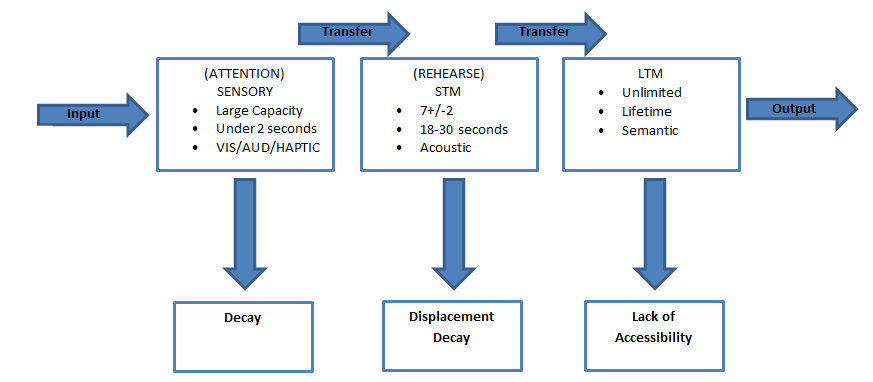
The Multi-Store Model (ATKINSON AND SHIFFRIN) MSM believes information flows through 3 seperate stores in a fixed linear order and each store has a different rrole in the memory process
- SENSORY MEMORY (SM)
- Gathers information from our sense organs E.g eyes
- Modality specific; large capacity
- Limited duration of less than a second
- Information here decays rapidly unless we pay attention to it (if we do it passes to the STM)
- SHORT TERM MEMORY (STM)
- Limited capacity of 9-5 items
- Limited duration of 30 seconds; based on sounds
- Forgetting here is due to displacement and decay; maintenance (repeating something over and over again) allows information to be held in the STM
- Elaborative rehearsal transfers information from the STM to the LTM by processing the information semantically
- LONG TERM MEMORY (LTM)
- Unlimited capacity
- Duration of a few seconds - a lifetime
- Encodes information semantically (with meaning)
- Forgetting occurs when there are problems with accessing information (including lack of retrieval cues and interference)
- SENSORY MEMORY (SM)
Strengths of the MSM; suggests that STM and LTM are seperate stores
- CLINICAL STUDY 1: Korsakoffs syndrome (result of becoming an alcoholic) damages part of the brain. It has little effect on the STM but severely impairs the LTM E.g you can have a conversation with them but they wouldn't remember
- CLINICAL STUDY 2: KF suffered from brain damage, had no effect on LTM but led to poor performance on many STM tasks, suggesting STM and LTM memory are different stores in the memory
- EXPERIMENTAL SUPPORT; GLAZNER AND CUNITZ'S: study in primary and recency effects show when people were asked to recall a list of words they were more likely to be able to recall the first few words (primary recall) and the last few words (recency recall) and are more likely to forget those in the middle of the list. First few words are in the LTM through rehearsal and last few in the STM
Limitations of the MSM
- OVERSIMPLIFIED; COHEN AND SQUIRE: suggested that LTM is separated into declarative memory (knowing that) and procedural memory (knowing how). Clive Wearing got extensive brain damage after contracting a viral infection, he lost his declarative memory (no memory of his wedding) nut still has his procedural memory (can still play the piano). LTM is more complex than the MSM suggests
- TOO MUCH EMPHASIS ON REHEARSAL: MSM suggests rehearsal is the only method of transferring information from the STM to the LTM, but other things other than rehearsal can impact this E.g if something is funny or significant. Also not everyone finds the same things funny or significant and these individual differences are not accounted for in the MSM
RESEARCH EVIDENCE FOR THE DURATION OF THE STM; PETERSON AND PETERSON
- PROCEDURE: Used laboratory experiment using nonsense trigrams (E.g VGT, PXR) PP's were asked to recall the trigrams after wither 3, 6, 9, 12 or 18 seconds to see if they would decay. Prevented from rehearsing by being asked to count backwards in 3's from 999
- FINDINGS: If rehearsal is prevented then recall is negatively affected. Rehearsal prevented for 3 seconds 80% trigrams recalled, after 18 seconds this droped to 10%. Supports the duration of the STM being 18-30 seconds
RESEARCH EVIDENCE FOR CAPACITY OF STM; JACOBS - SERIAL DIGIT-SPAN
- PROCEDURE: Laboratory experiment to measure the capacity of the STM. PP's were presented with a series of letters/digits, which they had to repeat to the experimenter in the order that they were presented (serial recall) List increased by one single item until the PP made consistent mistakes.
- FINDINGS: Average STM span was between 5-9 items. Digits (9.3) were re-called better than letters (7.3) STM span increased with age E.g 8 years (6.6) and 19 years (8.6)
RESEARCH EVIDENCE FOR DURATION OF LTM: Bahrick et al
- PROCEDURE: Longitudinal study of 400 PP's aged between 17 and 74. They were shown photos/ names of old high school class mates. They were asked to identify their old friends
- FINDINGS: 90% could remember names and faces after 15 years. 80% remember classmates names and 70% of faces after 48 years suggesting meaningful memories are long lasting
Bilder und Dateien der Mindmap
Informationen
- Beschreibung
- A Level AS Psychology Mindmap am Memory and the Multi-Store Model, erstellt von samyajahangir am 15/02/2015.
- Erstellt von
- samyajahangir
- Aufrufe
- 7
- Bewertung