
Mindmap
Culture & Romantic Relationships
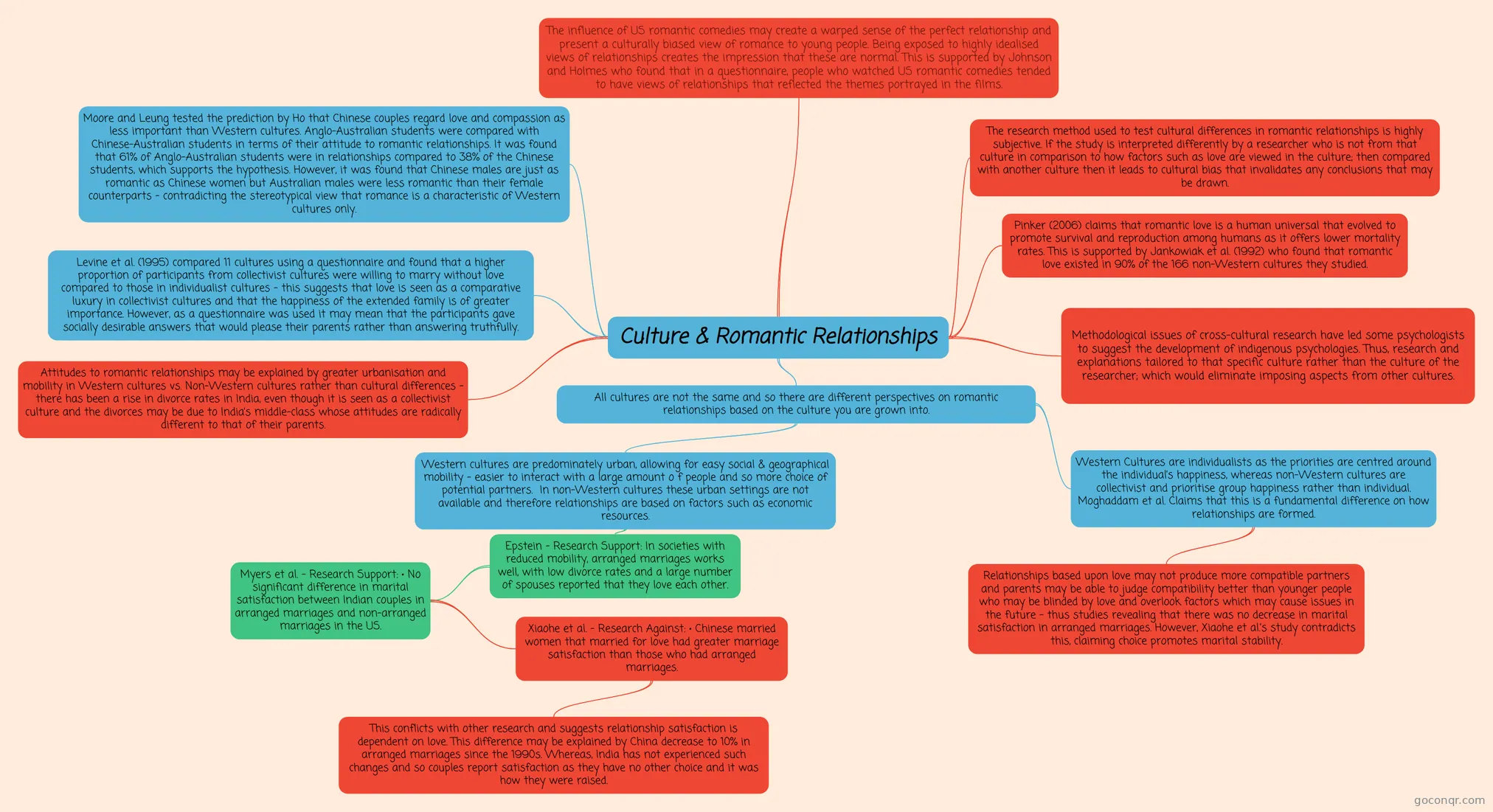
Mind map: Culture and Romantic Relationships
Inhalt der Mindmap
Culture & Romantic Relationships
All cultures are not the same and so there are different perspectives on romantic relationships based on the culture you are grown into.
- Western cultures are predominately urban, allowing for easy social & geographical mobility - easier to interact with a large amount o f people and so more choice of potential partners. In non-Western cultures these urban settings are not available and therefore relationships are based on factors such as economic resources.
- Epstein - Research Support: In societies with reduced mobility, arranged marriages works well, with low divorce rates and a large number of spouses reported that they love each other.
- Myers et al. - Research Support: • No significant difference in marital satisfaction between Indian couples in arranged marriages and non-arranged marriages in the US.
- Xiaohe et al. – Research Against: • Chinese married women that married for love had greater marriage satisfaction than those who had arranged marriages.
- This conflicts with other research and suggests relationship satisfaction is dependent on love. This difference may be explained by China decrease to 10% in arranged marriages since the 1990s. Whereas, India has not experienced such changes and so couples report satisfaction as they have no other choice and it was how they were raised.
- Xiaohe et al. – Research Against: • Chinese married women that married for love had greater marriage satisfaction than those who had arranged marriages.
- Myers et al. - Research Support: • No significant difference in marital satisfaction between Indian couples in arranged marriages and non-arranged marriages in the US.
- Epstein - Research Support: In societies with reduced mobility, arranged marriages works well, with low divorce rates and a large number of spouses reported that they love each other.
- Western Cultures are individualists as the priorities are centred around the individual’s happiness, whereas non-Western cultures are collectivist and prioritise group happiness rather than individual. Moghaddam et al. Claims that this is a fundamental difference on how relationships are formed.
- Relationships based upon love may not produce more compatible partners and parents may be able to judge compatibility better than younger people who may be blinded by love and overlook factors which may cause issues in the future – thus studies revealing that there was no decrease in marital satisfaction in arranged marriages. However, Xiaohe et al.’s study contradicts this, claiming choice promotes marital stability.
- Western cultures are predominately urban, allowing for easy social & geographical mobility - easier to interact with a large amount o f people and so more choice of potential partners. In non-Western cultures these urban settings are not available and therefore relationships are based on factors such as economic resources.
Attitudes to romantic relationships may be explained by greater urbanisation and mobility in Western cultures vs. Non-Western cultures rather than cultural differences – there has been a rise in divorce rates in India, even though it is seen as a collectivist culture and the divorces may be due to India’s middle-class whose attitudes are radically different to that of their parents.
Levine et al. (1995) compared 11 cultures using a questionnaire and found that a higher proportion of participants from collectivist cultures were willing to marry without love compared to those in individualist cultures – this suggests that love is seen as a comparative luxury in collectivist cultures and that the happiness of the extended family is of greater importance. However, as a questionnaire was used it may mean that the participants gave socially desirable answers that would please their parents rather than answering truthfully.
Moore and Leung tested the prediction by Ho that Chinese couples regard love and compassion as less important than Western cultures. Anglo-Australian students were compared with Chinese-Australian students in terms of their attitude to romantic relationships. It was found that 61% of Anglo-Australian students were in relationships compared to 38% of the Chinese students, which supports the hypothesis. However, it was found that Chinese males are just as romantic as Chinese women but Australian males were less romantic than their female counterparts – contradicting the stereotypical view that romance is a characteristic of Western cultures only.
The research method used to test cultural differences in romantic relationships is highly subjective. If the study is interpreted differently by a researcher who is not from that culture in comparison to how factors such as love are viewed in the culture; then compared with another culture then it leads to cultural bias that invalidates any conclusions that may be drawn.
Methodological issues of cross-cultural research have led some psychologists to suggest the development of indigenous psychologies. Thus, research and explanations tailored to that specific culture rather than the culture of the researcher; which would eliminate imposing aspects from other cultures.
Pinker (2006) claims that romantic love is a human universal that evolved to promote survival and reproduction among humans as it offers lower mortality rates. This is supported by Jankowiak et al. (1992) who found that romantic love existed in 90% of the 166 non-Western cultures they studied.
The influence of US romantic comedies may create a warped sense of the perfect relationship and present a culturally biased view of romance to young people. Being exposed to highly idealised views of relationships creates the impression that these are normal. This is supported by Johnson and Holmes who found that in a questionnaire, people who watched US romantic comedies tended to have views of relationships that reflected the themes portrayed in the films.
Informationen
- Beschreibung
- Mindmap am Culture & Romantic Relationships, erstellt von sakchuu am 17/05/2015.
- Erstellt von
- sakchuu
- Aufrufe
- 6
- Tags
- Bewertung
Mehr zu Cultural influences on relationships