
Mindmap
Biological Explanations for Anorexia Nervosa
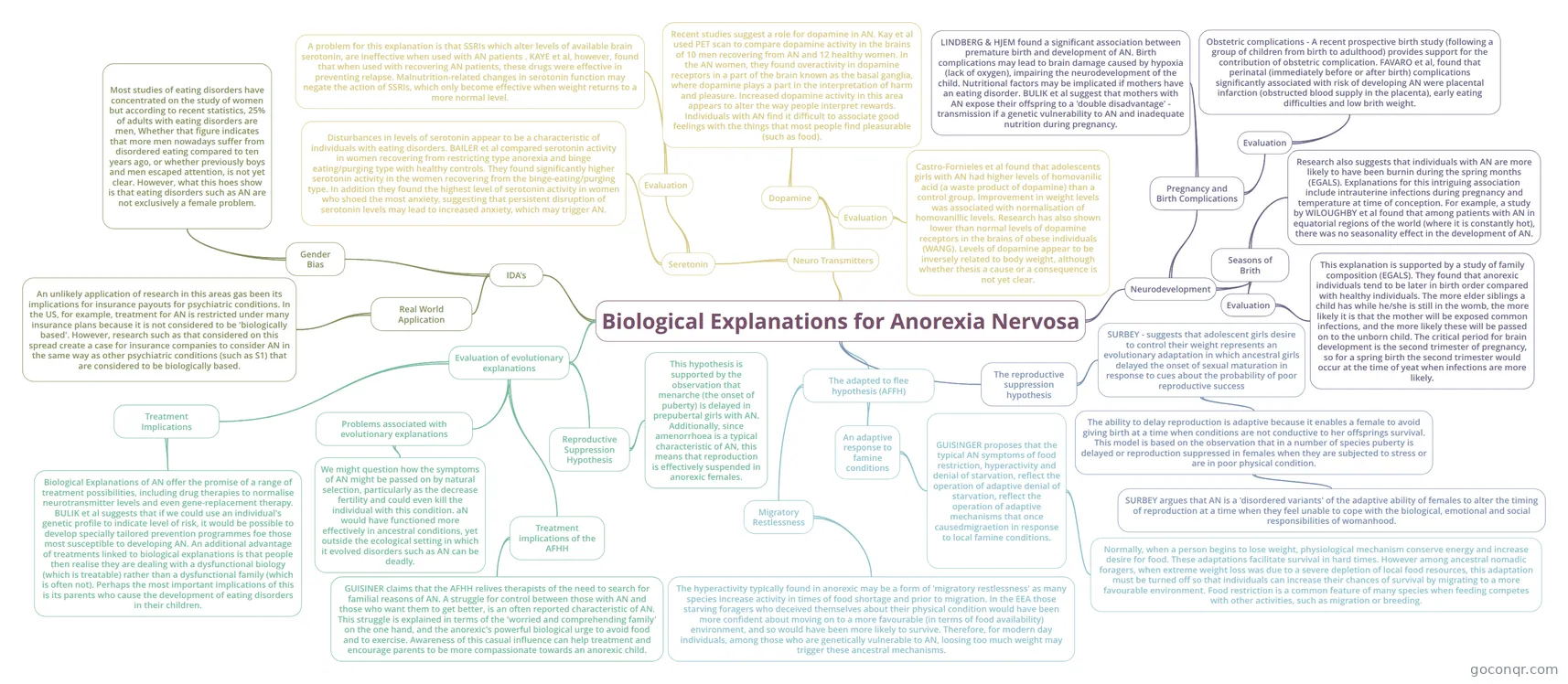
Mind map: Biological explanations for anorexia nervosa
Inhalt der Mindmap
Biological Explanations for Anorexia Nervosa
Neuro Transmitters
- Seretonin
- Disturbances in levels of serotonin appear to be a characteristic of individuals with eating disorders. BAILER et al compared serotonin activity in women recovering from restricting type anorexia and binge eating/purging type with healthy controls. They found significantly higher serotonin activity in the women recovering from the binge-eating/purging type. In addition they found the highest level of serotonin activity in women who shoed the most anxiety, suggesting that persistent disruption of serotonin levels may lead to increased anxiety, which may trigger AN.
- Evaluation
- A problem for this explanation is that SSRIs which alter levels of available brain serotonin, are ineffective when used with AN patients . KAYE et al, however, found that when used with recovering AN patients, these drugs were effective in preventing relapse. Malnutrition-related changes in serotonin function may negate the action of SSRIs, which only become effective when weight returns to a more normal level.
- Dopamine
- Recent studies suggest a role for dopamine in AN. Kay et al used PET scan to compare dopamine activity in the brains of 10 men recovering from AN and 12 healthy women. In the AN women, they found overactivity in dopamine receptors in a part of the brain known as the basal ganglia, where dopamine plays a part in the interpretation of harm and pleasure. Increased dopamine activity in this area appears to alter the way people interpret rewards. Individuals with AN find it difficult to associate good feelings with the things that most people find pleasurable (such as food).
- Evaluation
- Castro-Fornieles et al found that adolescents girls with AN had higher levels of homovanilic acid (a waste product of dopamine) than a control group. Improvement in weight levels was associated with normalisation of homovanillic levels. Research has also shown lower than normal levels of dopamine receptors in the brains of obese individuals (WANG). Levels of dopamine appear to be inversely related to body weight, although whether thesis a cause or a consequence is not yet clear.
- Seretonin
Neurodevelopment
- Pregnancy and Birth Complications
- LINDBERG & HJEM found a significant association between premature birth and development of AN. Birth complications may lead to brain damage caused by hypoxia (lack of oxygen), impairing the neurodevelopment of the child. Nutritional factors may be implicated if mothers have an eating disorder. BULIK et al suggest that mothers with AN expose their offspring to a 'double disadvantage' - transmission if a genetic vulnerability to AN and inadequate nutrition during pregnancy.
- Evaluation
- Obstetric complications - A recent prospective birth study (following a group of children from birth to adulthood) provides support for the contribution of obstetric complication. FAVARO et al, found that perinatal (immediately before or after birth) complications significantly associated with risk of developing AN were placental infarction (obstructed blood supply in the placenta), early eating difficulties and low brith weight.
- Seasons of Brith
- Research also suggests that individuals with AN are more likely to have been burnin during the spring months (EGALS). Explanations for this intriguing association include intrauterine infections during pregnancy and temperature at time of conception. For example, a study by WILOUGHBY et al found that among patients with AN in equatorial regions of the world (where it is constantly hot), there was no seasonality effect in the development of AN.
- Evaluation
- This explanation is supported by a study of family composition (EGALS). They found that anorexic individuals tend to be later in birth order compared with healthy individuals. The more elder siblings a child has while he/she is still in the womb, the more likely it is that the mother will be exposed common infections, and the more likely these will be passed on to the unborn child. The critical period for brain development is the second trimester of pregnancy, so for a spring birth the second trimester would occur at the time of yeat when infections are more likely.
- Pregnancy and Birth Complications
The reproductive suppression hypothesis
- SURBEY - suggests that adolescent girls desire to control their weight represents an evolutionary adaptation in which ancestral girls delayed the onset of sexual maturation in response to cues about the probability of poor reproductive success
- The ability to delay reproduction is adaptive because it enables a female to avoid giving birth at a time when conditions are not conductive to her offsprings survival. This model is based on the observation that in a number of species puberty is delayed or reproduction suppressed in females when they are subjected to stress or are in poor physical condition.
- SURBEY argues that AN is a 'disordered variants' of the adaptive ability of females to alter the timing of reproduction at a time when they feel unable to cope with the biological, emotional and social responsibilities of womanhood.
- The ability to delay reproduction is adaptive because it enables a female to avoid giving birth at a time when conditions are not conductive to her offsprings survival. This model is based on the observation that in a number of species puberty is delayed or reproduction suppressed in females when they are subjected to stress or are in poor physical condition.
- SURBEY - suggests that adolescent girls desire to control their weight represents an evolutionary adaptation in which ancestral girls delayed the onset of sexual maturation in response to cues about the probability of poor reproductive success
Evaluation of evolutionary explanations
- Reproductive Suppression Hypothesis
- This hypothesis is supported by the observation that menarche (the onset of puberty) is delayed in prepubertal girls with AN. Additionally, since amenorrhoea is a typical characteristic of AN, this means that reproduction is effectively suspended in anorexic females.
- Treatment implications of the AFHH
- GUISINER claims that the AFHH relives therapists of the need to search for familial reasons of AN. A struggle for control between those with AN and those who want them to get better, is an often reported characteristic of AN. This struggle is explained in terms of the 'worried and comprehending family' on the one hand, and the anorexic's powerful biological urge to avoid food and to exercise. Awareness of this casual influence can help treatment and encourage parents to be more compassionate towards an anorexic child.
- Problems associated with evolutionary explanations
- We might question how the symptoms of AN might be passed on by natural selection, particularly as the decrease fertility and could even kill the individual with this condition. aN would have functioned more effectively in ancestral conditions, yet outside the ecological setting in which it evolved disorders such as AN can be deadly.
- Treatment Implications
- Biological Explanations of AN offer the promise of a range of treatment possibilities, including drug therapies to normalise neurotransmitter levels and even gene-replacement therapy. BULIK et al suggests that if we could use an individual's genetic profile to indicate level of risk, it would be possible to develop specially tailored prevention programmes foe those most susceptible to developing AN. An additional advantage of treatments linked to biological explanations is that people then realise they are dealing with a dysfunctional biology (which is treatable) rather than a dysfunctional family (which is often not). Perhaps the most important implications of this is its parents who cause the development of eating disorders in their children.
- Reproductive Suppression Hypothesis
The adapted to flee hypothesis (AFFH)
- An adaptive response to famine conditions
- GUISINGER proposes that the typical AN symptoms of food restriction, hyperactivity and denial of starvation, reflect the operation of adaptive denial of starvation, reflect the operation of adaptive mechanisms that once causedmigraetion in response to local famine conditions.
- Normally, when a person begins to lose weight, physiological mechanism conserve energy and increase desire for food. These adaptations facilitate survival in hard times. However among ancestral nomadic foragers, when extreme weight loss was due to a severe depletion of local food resources, this adaptation must be turned off so that individuals can increase their chances of survival by migrating to a more favourable environment. Food restriction is a common feature of many species when feeding competes with other activities, such as migration or breeding.
- GUISINGER proposes that the typical AN symptoms of food restriction, hyperactivity and denial of starvation, reflect the operation of adaptive denial of starvation, reflect the operation of adaptive mechanisms that once causedmigraetion in response to local famine conditions.
- Migratory Restlessness
- The hyperactivity typically found in anorexic may be a form of 'migratory restlessness' as many species increase activity in times of food shortage and prior to migration. In the EEA those starving foragers who deceived themselves about their physical condition would have been more confident about moving on to a more favourable (in terms of food availability) environment, and so would have been more likely to survive. Therefore, for modern day individuals, among those who are genetically vulnerable to AN, loosing too much weight may trigger these ancestral mechanisms.
- An adaptive response to famine conditions
IDA's
- Real World Application
- An unlikely application of research in this areas gas been its implications for insurance payouts for psychiatric conditions. In the US, for example, treatment for AN is restricted under many insurance plans because it is not considered to be 'biologically based'. However, research such as that considered on this spread create a case for insurance companies to consider AN in the same way as other psychiatric conditions (such as S1) that are considered to be biologically based.
- Gender Bias
- Most studies of eating disorders have concentrated on the study of women but according to recent statistics, 25% of adults with eating disorders are men, Whether that figure indicates that more men nowadays suffer from disordered eating compared to ten years ago, or whether previously boys and men escaped attention, is not yet clear. However, what this hoes show is that eating disorders such as AN are not exclusively a female problem.
- Real World Application
Informationen
- Beschreibung
- Alevel Psychology Mindmap am Biological Explanations for Anorexia Nervosa, erstellt von grace51296 am 25/05/2015.
- Erstellt von
- grace51296
- Aufrufe
- 2
- Bewertung