
Mindmap
Biology B4
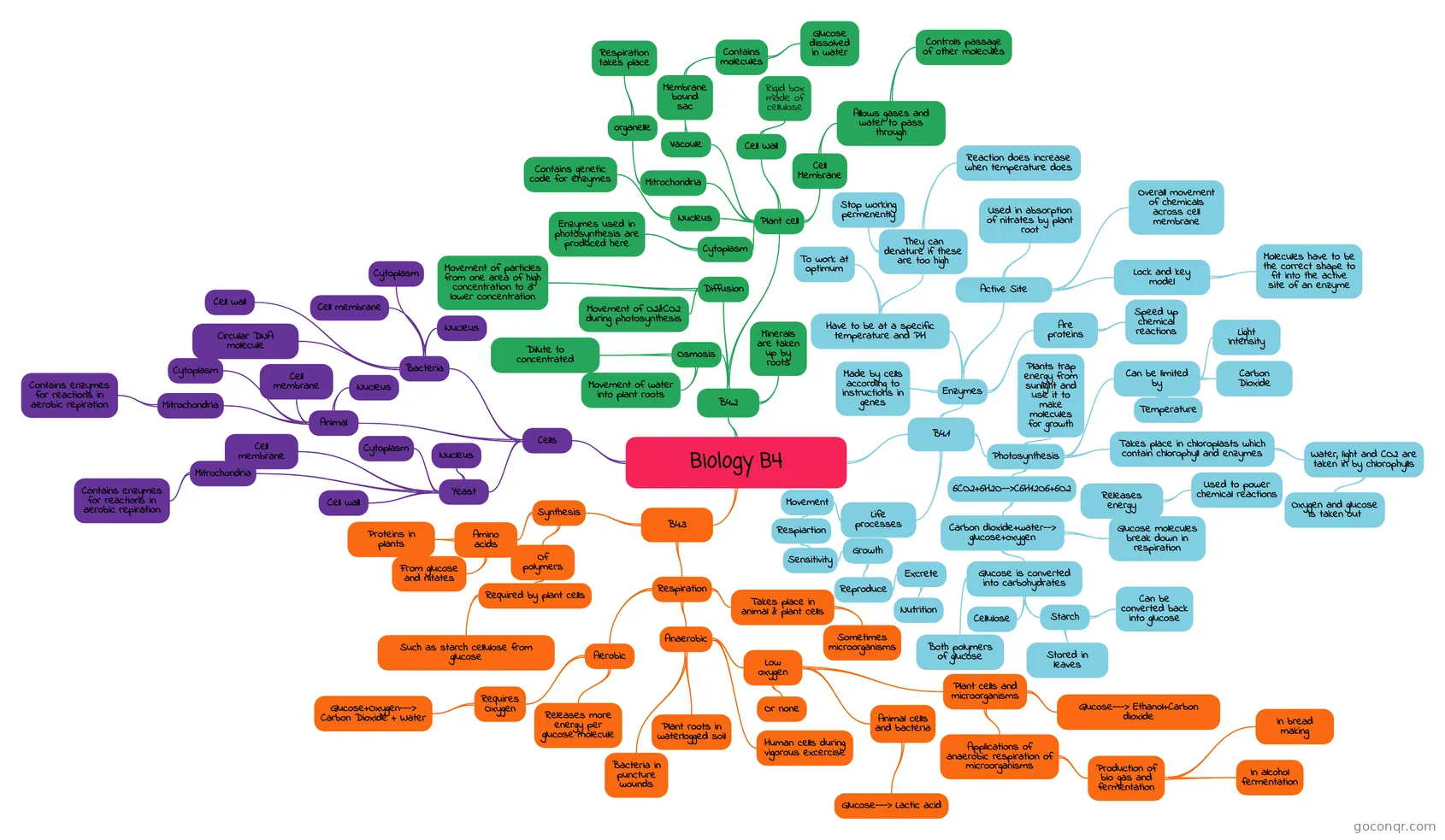
Mind map: Biology B4 cells
Inhalt der Mindmap
Biology B4
B4.3
- Synthesis
- Of polymers
- Required by plant cells
- Such as starch cellulose from glucose
- Required by plant cells
- Amino acids
- From glucose and nitates
- Proteins in plants
- Of polymers
- Respiration
- Aerobic
- Requires Oxygen
- Glucose+Oxygen---> Carbon Dioxide + Water
- Releases more energy per glucose molecule
- Requires Oxygen
- Takes place in animal & plant cells
- Sometimes microorganisms
- Anaerobic
- Low oxygen
- Or none
- Animal cells and bacteria
- Glucose---> Lactic acid
- Plant cells and microorganisms
- Glucose---> Ethanol+Carbon dioxide
- Applications of anaerobic respiration of microorganisms
- Production of bio gas and fermentation
- In bread making
- In alcohol fermentation
- Production of bio gas and fermentation
- Plant roots in waterlogged soil
- Bacteria in puncture wounds
- Human cells during vigorous excercise
- Low oxygen
- Aerobic
- Synthesis
B4.2
- Plant cell
- Cell Membrane
- Allows gases and water to pass through
- Controls passage of other molecules
- Allows gases and water to pass through
- Nucleus
- Contains genetic code for enzymes
- Cytoplasm
- Enzymes used in photosynthesis are produced here
- Mitrochondria
- organelle
- Respiration takes place
- organelle
- Vacoule
- Membrane bound sac
- Contains molecules
- Glucose dissolved in water
- Contains molecules
- Membrane bound sac
- Cell Wall
- Rigid box made of cellulose
- Cell Membrane
- Minerals are taken up by roots
- Diffusion
- Movement of particles from one area of high concentration to a lower concentration
- Movement of O2&CO2 during photosynthesis
- Osmosis
- Dilute to concentrated
- Movement of water into plant roots
- Plant cell
B4.1
- Life processes
- Movement
- Respiartion
- Sensitivity
- Growth
- Reproduce
- Excrete
- Nutrition
- Excrete
- Reproduce
- Growth
- Sensitivity
- Respiartion
- Movement
- Photosynthesis
- 6CO2+6H2O-->C6H12O6+6O2
- Carbon dioxide+water--> glucose+oxygen
- Glucose is converted into carbohydrates
- Cellulose
- Starch
- Stored in leaves
- Can be converted back into glucose
- Both polymers of glucose
- Glucose molecules break down in respiration
- Releases energy
- Used to power chemical reactions
- Releases energy
- Glucose is converted into carbohydrates
- Carbon dioxide+water--> glucose+oxygen
- Takes place in chloroplasts which contain chlorophyll and enzymes
- Water, light and CO2 are taken in by chlorophylls
- Oxygen and glucose is taken out
- Water, light and CO2 are taken in by chlorophylls
- Plants trap energy from sunlight and use it to make molecules for growth
- Can be limited by
- Temperature
- Carbon Dioxide
- Light Intensity
- 6CO2+6H2O-->C6H12O6+6O2
- Enzymes
- Are proteins
- Speed up chemical reactions
- Made by cells according to instructions in genes
- Have to be at a specific temperature and PH
- They can denature if these are too high
- Stop working permenently
- Reaction does increase when temperature does
- To work at optimum
- They can denature if these are too high
- Active Site
- Lock and key model
- Molecules have to be the correct shape to fit into the active site of an enzyme
- Overall movement of chemicals across cell membrane
- Used in absorption of nitrates by plant root
- Lock and key model
- Are proteins
- Life processes
Cells
- Animal
- Nucleus
- Cytoplasm
- Cell membrane
- Mitrochondria
- Contains enzymes for reactions in aerobic repiration
- Yeast
- Nucleus
- Cytoplasm
- Cell membrane
- Mitrochondria
- Contains enzymes for reactions in aerobic repiration
- Cell wall
- Bacteria
- Nucleus
- Cytoplasm
- Cell membrane
- Cell wall
- Circular DNA molecule
- Animal