
Mindmap
POP
Inhalt der Mindmap
POP
Defenitions
- Persuasion: •The process by which a message induces change in beliefs, attitudes, or behaviours.
- At the simplest level, influence is the art of getting others to take your lead—to believe something you want them to believe, think in a way you want them to think, or do something you want them to do.
Basic points
- Influence is not some magic power only a few people have. Every person on the planet exercises influence all the time. Influence is part of nearly every communication.It occurs in virtually every human interaction. It is so fundamental to leadershipthat there could be no leadership without it.
- You have influenced and been influenced your entire life.
- Influencing across cultures is challenging because people in different cultures have different sets of beliefs and values and use different influence conventions. What works for you in your country will not necessarily work—or work the same way—in another culture.
- If you are a foreigner, do you see any difference in the way persuasion works in Korea and your own country?
- nfluence can be ethical or unethical. When it is ethical, the influencee consents to be influenced, although most of the time that consent is implicit and unstated. When influence attempts are coercive or manipulative, the influence is unethical. Unethical influence is expedient, but it usually destroys the relationship between the influencer and influencee.
- Our focus
- Unethical manipulation (e.g., fraud, conning) and aggression may be considered persuasive techniques, but in the present class, our focus is on ethical and non-aggressive techniques of persuasion.
- Influential, charismatic, and magnetic
- Influencing is a skill. It can be learned. You can become better at influencing others.
- Why learn to persuade?
- To sell my ideas better
- To build rapport and better relationships
- To get support for my projects
- To be more successful in political situations
- To run more effective meetings
- To get people more involved and committed
- To handle conflict more effectively in both business and personal life
- To avoid being persuaded to do stupid things
- To be able to influence oneself
- Influence is not some magic power only a few people have. Every person on the planet exercises influence all the time. Influence is part of nearly every communication.It occurs in virtually every human interaction. It is so fundamental to leadershipthat there could be no leadership without it.
The spectrum of influence
- Sayings
- We cannot influence anyone to do anything. There are limits. People are sophisticated.
- Abraham Lincoln: “You can fool some of the people all of the time, and all of the people some of the time, but you cannot fool all of the people all of the time.”
- Barometer
- Rebellion
- influencee takes the lead in resisting the influencer and tries to enlist others in a rebellion against what the influencer seeks
- no way, this idea is dangerous, unfair, terrible, etc., I will try to tell everyone how bad this idea is. We may form groups to resist the idea. We will talk to governmental bodies and community members. We will make banners and raise petitions.
- influencee takes the lead in resisting the influencer and tries to enlist others in a rebellion against what the influencer seeks
- Resistance
- influencee either actively or passively resists what the influencer wants
- no I am not interested in doing what you want me to do, and feel this is not a good idea, so do not try to persuade me. I may try to tell others that I do not agree.
- influencee either actively or passively resists what the influencer wants
- Skepticism
- doubt or distrust
- no, I am not interested in doing what you want me to do. I do not have enough reasons to do it.
- doubt or distrust
- Apathy
- Start
- Complicance
- agree to do what you want
- It made sense. I had no reason to say no.
- agree to do what you want
- Commitment
- agree wholeheartedly, to be enthusiastic and engaged, to consent not merely with the head but also with the heart
- Because I believed it. Because it was the right thing to do. Because it moved me to tears
- agree wholeheartedly, to be enthusiastic and engaged, to consent not merely with the head but also with the heart
- Leadership
- Beyond commitment, another possible outcome of an influence attempt is leadership. Here, the person is not merely influenced to become committed to the cause but goes beyond that and assumes a leadership role, and advancing the cause even further.
- Mohandas Gandhi influenced a number of political protégés to assume greater leadership roles, including Jawaharlal Nehru, who became India’s first prime minister.
- Beyond commitment, another possible outcome of an influence attempt is leadership. Here, the person is not merely influenced to become committed to the cause but goes beyond that and assumes a leadership role, and advancing the cause even further.
- Rebellion
- Sayings
Fundamentals of Influence
- Influence Attempts May Fail for Many Legitimate Reasons
- People:
- are too busy elsewhere
- are not really capable of helping
- do not care about what you want them to support
- may disagree with your opinion, idea, suggestion, proposal, or point of view
- may be distracted
- Influence Anyone, Any Time, Anywhere
- People:
- People Respond Best to the Influence Techniques They Use Themselves
- A person who is sociable and influences people using socializing, responds well to socializing.
- An idealist and dreamer tries to influence people by inspiring them, by appealing to their values and ideals, and this is what she responds to as well.
- If You Are Observant, People Will Reveal What They Find Most Influential
- In many cases, you don’t have to guess what people will find most influential. If you are observant, if you listen to other people and observe their behavior and the environments they create for themselves, you can discover how best to influence most people.
- If You Are Observant, People Will Reveal What They Find Most Influential
- Influence Is Often a Process Rather Than an Event
- Sometimes, people may not be influenced the first time you approach them. You may need to keep trying.
- However, if the influence technique you are using is not working, don’t keep doing the same thing. Try something else.
- Influence is cultural
- People in different countries and cultures may differ in how they respond to the different influence techniques. To influence effectively in different cultures, you need to understand how power and influence are used in that culture and adapt accordingly.
- If I were trying to influence a customer in Germany, for instance, I would expect the customer
- to be more responsive to hierarchy and authority
- to be direct and perhaps bold in stating her position
- to expect me to respond when she refers to authorities to substantiate her points.
- In Japan, I would expect that customer
- to involve others in the decision making
- to seek consensus around the buying decision
- to spend more time socializing before getting down to business
- to value building a closer relationship as a prerequisite to doing business.
- Moreover, I would understand that my Japanese customer would be confounded and perhaps even embarrassed for me if I were to interact with him the same way I interacted with my German customer. He might interpret my boldness, expressiveness, and directness as impolite and even aggressive.
- If I were trying to influence a customer in Germany, for instance, I would expect the customer
- People in different countries and cultures may differ in how they respond to the different influence techniques. To influence effectively in different cultures, you need to understand how power and influence are used in that culture and adapt accordingly.
- Unethical Influence May Succeed but Always at a Cost
- Destructive influence tactics do work.
- These tactics destroy trust, damage relationships, and are rarely worth their perceived short-term gains.
- These methods produce hatred and distrust, and cannot be used long-term. The resulting achievement is short.
- The majority of people do not like Hitler, Mao, and Stalin and anyone who resembles them.
- These methods produce hatred and distrust, and cannot be used long-term. The resulting achievement is short.
- These tactics destroy trust, damage relationships, and are rarely worth their perceived short-term gains.
- Destructive influence tactics do work.
- Influence Attempts May Fail for Many Legitimate Reasons
The science of persuation
- Direct studies
- Emotional inconsistency
- oscillating or fluctuating between different psychological states over the course of a single encounter, e.g. between happy and angry
- The advantages of being unpredictable in negotiations
- Only happiness
- Only anger
- Alternating between anger and happiness
- Experiment 1
- dyads negotiated face-to-face after one negotiator within each dyad expressed either anger or emotional inconsistency by alternating between anger and happiness.
- Experiment 2
- participants received angry and/or happy messages from a simulated negotiation opponent.
- Experiment 3
- participants read a scenario about a negotiator who expressed either anger or emotional inconsistency by alternating between anger and disappointment.
- The research found that in all three experiments, the effect of emotional inconsistency was mediated by recipients' feeling less control
- IE = less control feelings in the recipient
- This study shows that the most important factor in EI is that it makes recipients feel less control
- The study also impliesthat less control in the recipient may be achieved using other techniques
- This study shows that the most important factor in EI is that it makes recipients feel less control
- IE = less control feelings in the recipient
- The research found that in all three experiments, the effect of emotional inconsistency was mediated by recipients' feeling less control
- participants read a scenario about a negotiator who expressed either anger or emotional inconsistency by alternating between anger and disappointment.
- Emotional inconsistency
- Indirect studies
- Research has revealed that the insular cortex is implicated in processing both the physical and the psychological versions of warmth information
- For these theoretical and empirical reasons, researchers hypothesized that mere experiences of physical warmth should activate concepts or feelings of interpersonal warmth. •Without one being aware of this influence
- study 1
- Participants held either a cup of hot coffee, or a cup of iced coffee.
- People who had briefly held the hot coffee cup perceived the target person as being significantly warmer than did those who had briefly held the cup of iced coffee
- Participants held either a cup of hot coffee, or a cup of iced coffee.
- Study 2
- To evaluate the product, half of the sample held a hot therapeutic pad for a short time, and half of the sample held a cold therapeutic pad for a short time
- Participants who held a cold pad were more likely to choose the gift for themselves (75%) than the gift for a friend (25%) • Whereas those who held the hot pad were more likely to choose the gift for a friend (54%) than the gift for themselves (46%).
- To evaluate the product, half of the sample held a hot therapeutic pad for a short time, and half of the sample held a cold therapeutic pad for a short time
- Effect of physical coldness/warmness on movie preference
- Romantic movie = emotional, warm
- Study 1
- Claimed purpose = evaluating drinks and movie preference •Participants were given the information about the movies while they drank the tea •Four genres: romance, action, comedy, thriller
- cold drink drinkers were more likely to choose the romantic movie
- Claimed purpose = evaluating drinks and movie preference •Participants were given the information about the movies while they drank the tea •Four genres: romance, action, comedy, thriller
- Study 2
- Coldroom temperature Like romance more and willing to pay more
- In sum
- Physical coldness
- •Makes us see others as emotionally colder •Makes us emotionally colder •Makes us seek more emotional warmness
- Physical warmness
- •Makes us see others as emotionally warmer •Makes us emotionally warmer •Makes us seek less emotional warmness (in comparison to coldness)
- Physical coldness
- When men see beautiful/sexy women, they tend to discount the future. That is, they become present-oriented or impatient.
- Inducing a ‘mating opportunity mindset’ makes men present oriented
- We hypothesized that inducing a ‘mating opportunity’ mindset would raise men’s discount rates in a monetary choice task
- Discounting was assessed on the basis of choices between a smaller sum of money tomorrow and a larger sum at a later date
- Beautiful women can make men a bit financially stupid = more short-sighted
- In sum •When mating opportunity mind set is induced men tend to value their present or immediate pleasure more than future pleasure.
- Beautiful women can make men a bit financially stupid = more short-sighted
- Discounting was assessed on the basis of choices between a smaller sum of money tomorrow and a larger sum at a later date
- We hypothesized that inducing a ‘mating opportunity’ mindset would raise men’s discount rates in a monetary choice task
- Inducing a ‘mating opportunity mindset’ makes men present oriented
- Research has revealed that the insular cortex is implicated in processing both the physical and the psychological versions of warmth information
- Direct studies
Basic needs
- Self determination Theory: Humans' three basic needs
- Competence
- Need to be effective in dealing with envirnoment
- Automomy
- Need to control the course of their lives
- Relatedness
- Need to have a close, affectionate relationship with others
- Competence
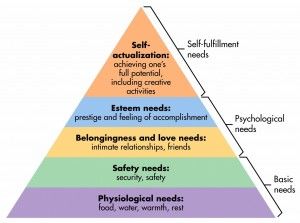
- Maslow's Hierachy of needs
- Self determination Theory: Humans' three basic needs
Cialdini's six principles of influence
- Reciprocity
- People hate the feeling of indebtedness
- Not to return favors is considered shameful
- Social normscompel us torespond to a favor with another favor,in order to not be considered ungrateful.
- Give your potential customer an item that he/she considers valuable
- Invite your target customer to free courses, events, and trainings
- Provide free samples
- Offer an e-bookwith relevant information to download for FREE
- Allow users to downloador use your applications or programs for free for a period of time
- People hate the feeling of indebtedness
- Commitment (and Consistency)
- It is easier to resist at the beginning than at the end. —Leonardo da Vinci
- Desire for consistency is a prime motivator of our behavior
- After committing yourself to a position, you should be more willing to comply with requests for behaviors that are consistent with that position.
- When making any decision,we feel the “pressure”to behave in accordance with our prior commitments.
- Foot-in-the-door
- Social proof
- We should be more willing to comply with a request for behavior if it is consistent with what similar others are thinking or doing.
- It is essentially based on Festinger’s social comparison theory
- People have a constant drive to evaluate themselves (i.e., the appropriateness of their abilities, beliefs, feelings, and behaviors)
- If available, people will prefer to use objective cues to make these evaluations;
- If objective evidence is not available, people will rely on social comparison evidence instead;
- When seeking social comparison evidence for self-evaluations, people will look to similar others as the preferred basis for comparison.
- If objective evidence is not available, people will rely on social comparison evidence instead;
- If available, people will prefer to use objective cues to make these evaluations;
- People have a constant drive to evaluate themselves (i.e., the appropriateness of their abilities, beliefs, feelings, and behaviors)
- It is essentially based on Festinger’s social comparison theory
- When we feel uncertainabout making a decision, we observe what others are doing to get “evidence” or “social proof” to see if something is OK or not.
- Social comparison is most likely to occur in situations that are objectively unclear
- It is most likely to be directed at similar others
- star rating etc.
- It is most likely to be directed at similar others
- Social comparison is most likely to occur in situations that are objectively unclear
- We should be more willing to comply with a request for behavior if it is consistent with what similar others are thinking or doing.
- Liking
- We should be more willing to comply with the requests of friends or other liked individuals
- People are more likely to buy from people like themselves, friends, and people they know and respect.
- Most influence agents get their targets to like them, before making a request
- Physical Attractiveness leads to favorable trait perceptions such as a talent, kindness, honesty, and intelligence
- As a consequence, attractive individuals are more persuasive in terms of both changing attitudes and getting what they request
- A study of Canadian Federal elections found that attractive candidates received more than two and a half times the votesof unattractive ones (Efran& Patterson, 1976).
- First impression
- We investigated the minimal conditions under which people make such inferences. In five experiments, each focusing on a specific trait judgment, we manipulated the exposure time of unfamiliar faces. Judgments made after a 100-ms exposure correlated highly with judgments made in the absence of time constraints, suggesting that this exposure time was sufficient for participants to form an impression…. additional time may simply boost confidence in judgments.
- Facial width-to-height ratio (fWHR) has been associated with aggression, unethical behavior, company profit, and dominance.
- We investigated the minimal conditions under which people make such inferences. In five experiments, each focusing on a specific trait judgment, we manipulated the exposure time of unfamiliar faces. Judgments made after a 100-ms exposure correlated highly with judgments made in the absence of time constraints, suggesting that this exposure time was sufficient for participants to form an impression…. additional time may simply boost confidence in judgments.
- Similarity creates likability
- Research also shows that prospects were more willing to purchase a policy from a salesperson who was similar to them in age, religion, politics, or even cigarette smoking habits.
- Similarity creates likability
- Speak the same language
- Praise and flattering
- People are more likely to buy from people like themselves, friends, and people they know and respect.
- We should be more willing to comply with the requests of friends or other liked individuals
- Authority
- Authority = Credibility
- Legitimate authorities are extremely influential persons.
- Whether they have acquired their positions through knowledge, talent, or fortune, their positions signify of superior information and power.
- Authority can be real or symbolic
- Actors in television commercials wear physicians’ white coats to recommend a product (= symbolic).
- •Doctors and lawyers have their degrees on the wall to appear more credible •Dress like an expert •Job titles, uniforms, and even accessories like cars or gadgets can lend an air of authority, and can persuade us to accept what these people say.
- Use difficult words
- Use rarely used words
- Use numbers
- •Doctors and lawyers have their degrees on the wall to appear more credible •Dress like an expert •Job titles, uniforms, and even accessories like cars or gadgets can lend an air of authority, and can persuade us to accept what these people say.
- Actors in television commercials wear physicians’ white coats to recommend a product (= symbolic).
- Authority can be real or symbolic
- Whether they have acquired their positions through knowledge, talent, or fortune, their positions signify of superior information and power.
- Legitimate authorities are extremely influential persons.
- Authority = Credibility
- Scarcity
- What is rare is a greater good than what is plentiful. —Aristotle
- The way to love anything is to realize that it might be lost. —Gilbert Keith Chesterton
- With this principle, people have to know that they’re going to miss it if they don’t act quickly. It mainly relies on the fact that things are more attractive when their availability is limited, or when we risk losing the opportunity to acquire them.
- The law of supply and demand plays a big role in the principle of scarcity •If the customer perceives a low supply or high demand for a good, they’ll show that they’re immediately interested and even willing to pay a higher price. Interestingly, this is often true even when the opportunity holds little attraction for us on its own merits. High demand > Social proof
- Three sources of the power of scarcity
- Because we know that the things that are difficult to possess are typically better than those that are easy to possess, we can often use an item’s availability to help us quickly and correctly decide on its quality. Thus, one reason for the potency of scarcity is that, by assessing it, we can obtain a quick indication of an item’s value.
- Scarcity is sometimes used as a heuristic cue in decision making: what is rare is good.
- As the things we can have become less available, we lose freedoms; and we hate to lose the freedoms we already have.
- This desire to preserve our established privileges is the centerpiece of psychological reactance theory developed to explain the human response to diminishing personal control.
- Loss is stronger than gain. Negative is stronger than positive.
- People hate to lose any opportunity, specially when it is rare or limited
- Because we know that the things that are difficult to possess are typically better than those that are easy to possess, we can often use an item’s availability to help us quickly and correctly decide on its quality. Thus, one reason for the potency of scarcity is that, by assessing it, we can obtain a quick indication of an item’s value.
- When our freedom to have something is limited, the item becomes less available, and we experience an increased desire for it. However, we rarely recognize that psychological reactance has caused us to want the item more; all we know is that we want it. Still, we need to make sense of our desire for the item, so we begin to assign it positive qualities to justify or rationalize the desire.
- Anticipated regret
- Frame your request in such a way that induces “anticipated regret” in your clients = describe in what ways your client will regret their decision if they do not comply with your request now
- When people experience anticipated regret, they tend to take action to prevent the regret
- Frame your request in such a way that induces “anticipated regret” in your clients = describe in what ways your client will regret their decision if they do not comply with your request now
- Related techniques
- The limited number tactic
- •If you sell a product and there are only a few items left, make it known! People will want to buy the product even more. •Limit the number of units per person. We buy more when we know we can NOT buy more than “5 items per person”
- The deadline technique
- •If you're selling a product, limit the availability of stock, or set a closing date for the offer. •Include a limited quantity description and/or countdown, include limited time notices
- The limited number tactic
- Reciprocity
Color and emotion
- This is an underdeveloped area of research
- Green makes us more creative
- Red is related to love and sex in relational contexts
- In achievement contexts, redis associated with danger, specifically the psychological danger of failure
- Blue is relaxing
- Black is associated with evil and death
- This is an underdeveloped area of research
Freedom-threatening language
- The research assessing the ineffectiveness of controlling language has benefited from several studies sampling from various demographics.
- For example, Rains and Turner (2007) found exposure to freedom-threatening language resulted in greater reactance in her two-study experiment utilizing college students.
- Similarly, Quick and colleagues discovered that domineering language was perceived as a freedom threat among adolescent (Quick & Kim, 2009), college student (Quick & Stephenson, 2008), and adult samples (Quick & Considine, 2008) across multiple topics.
- For example, Rains and Turner (2007) found exposure to freedom-threatening language resulted in greater reactance in her two-study experiment utilizing college students.
- The research assessing the ineffectiveness of controlling language has benefited from several studies sampling from various demographics.
Reactance Theory
- Humans place a high value on choice, autonomy, and control
- Anything that makes it more difficult for a person to exercise that freedom constitutes a threat
- If your message is perceived as “threat-to-freedom”, it will elicit psychological reactance.
- Anything that makes it more difficult for a person to exercise that freedom constitutes a threat
- Psychological reactance is “the motivational state that is hypothesized to occur when a freedom is eliminated or threatened with elimination”.
- When freedom is eliminated or threatened with elimination, the individual will be motivated to reestablish that freedom.
- Study 1
- Henriksen, Dauphinee, Wang, and Fortmann (2006) discovered that adolescents exposed to ads containing strong language, received poor evaluations, thus resulting in increased curiosity toward cigarettes.
- Study 2
- Text-only warnings elicited little reactance, whereas over 80% of smokers who were exposed to graphic warnings experienced some reactance. Smokers who were exposed to graphic warnings were more likely to experience elevated and extreme levels of reactance. Our findings are consistent with recent studies indicating that graphic anti-smoking warnings can elicit maladaptive psychological responses.
- Study 1
- When freedom is eliminated or threatened with elimination, the individual will be motivated to reestablish that freedom.
- Humans place a high value on choice, autonomy, and control
Mirroring
- Successful negotiators recommend that you should mimic the mannerisms of your negotiation partner to get a better deal. For example, when the other person rubs his/her face, you should too. If he/she leans back or leans forward in the chair, you should too. However, they say it is very important that you mimic subtly enough that the other person does not notice what you are doing, otherwise this technique completely backfires. Also, do not direct too much of your attention to the mimicking so you don’t lose focus on the outcome of the negotiation. Thus, you should find a happy medium of consistent but subtle mimicking that does not disrupt your focus
Cognitive biases
- Confirmation bias
- A confirmation bias is a type of cognitive bias that involves favoring information that confirms previously existing beliefs or biases.
- During an election season, for example, people tend to seek out positive information that paints their favored candidates in a good light while looking for information that casts the opposing candidate in a negative light.
- A confirmation bias is a type of cognitive bias that involves favoring information that confirms previously existing beliefs or biases.
- Availability heuristic
- An availability heuristic is a mental shortcut that relies on immediate examples that come to mind.
- After seeing news reports about people losing their jobs, you might start to believe that you are in danger of being layed-off. You start lying awake in bed each night worrying that you are about to be fired.
- An availability heuristic is a mental shortcut that relies on immediate examples that come to mind.
- Self-serving bias
- The self-serving bias refers to our tendency to take personal credit for success while blaming outside sources for our failures.
- If you ace an exam, it's because you studied hard. If you failed, on the other hand, it's because the teacher didn't explain the subject properly, or the classroom was too warm, or your roommate kept you up all night before the exam.
- The self-serving bias refers to our tendency to take personal credit for success while blaming outside sources for our failures.
- Confirmation bias
Enclothed cognition
- The systematic influence that clothes have on the wearer's psychological processes
- Through clothing you can make yourself appear more smart and efficient
- By dressing you can fool others and yourself, so > would not hurt to dress like an expert
- Studies
- The Standard English accent outperformed the Singaporean English accent in terms of spokesperson credibility.
- The study focuses on assessing the impact of a salesperson's accent on people's perception of his effectiveness, including credibility, competence, friendliness, and intentions to buy. 146 students listened to tape recordings of three presenters speaking with Greek-accented English and three presenters speaking with standard American accent. The message was a hypothetical sales pitch for a VCR. The results indicate that, for an American audience, a sales pitch in standard American accent evoked more favorable judgments on all measured dimensions than Greek-accented English.
- Non-native speech is harder to understand than native speech. We demonstrate that this “processing difficulty” causes non-native speakers to sound less credible. People judged trivia statements such as “Ants don't sleep” as less true when spoken by a non-native than a native speaker.
- The systematic influence that clothes have on the wearer's psychological processes
Power distance
- Power distance is the extent to which a community accepts and endorses authority, power differences, and status privileges
Censorship
- Studies suggest that restricting information can empower that information in unintended ways. Individuals typically respond to censorship by wanting to receive the banned information to a greater extent and by becoming more favorable to it than before the ban. •Especially interesting is the finding that people will come to believe in banned information more.
Fear and Persuation
- A fear appeal is a persuasive message that attempts to arouse fear in order to divert behavior through the threat of impending danger or harm.
- Fear is a negative emotion accompanied by a high level of arousal and is elicited by a threat that is perceived to be significant and personally relevant
- The results of several meta-analytic investigations are relatively clear: Fear appeals work, for most audiences and messages if done correctly.
- The stronger the fear appeal is, the better the outcome
- Opportunities for avoiding the threat are presented by recommending protective action.
- In sum •A fear appeal that is strong enough and provides the two types of efficacy may work. •A weak fear appeal that does not provide efficacy information is likely to fail
- The results of several meta-analytic investigations are relatively clear: Fear appeals work, for most audiences and messages if done correctly.
Bilder und Dateien der Mindmap
Informationen
- Beschreibung
- Mindmap am POP, erstellt von Maaike Dassen am 12/06/2015.
- Erstellt von
- Maaike Dassen · Jun 2015
- Aktualisiert
- 3 Feb 2018
- Aufrufe
- 3
- Bewertung