
Mindmap
Relationships 3
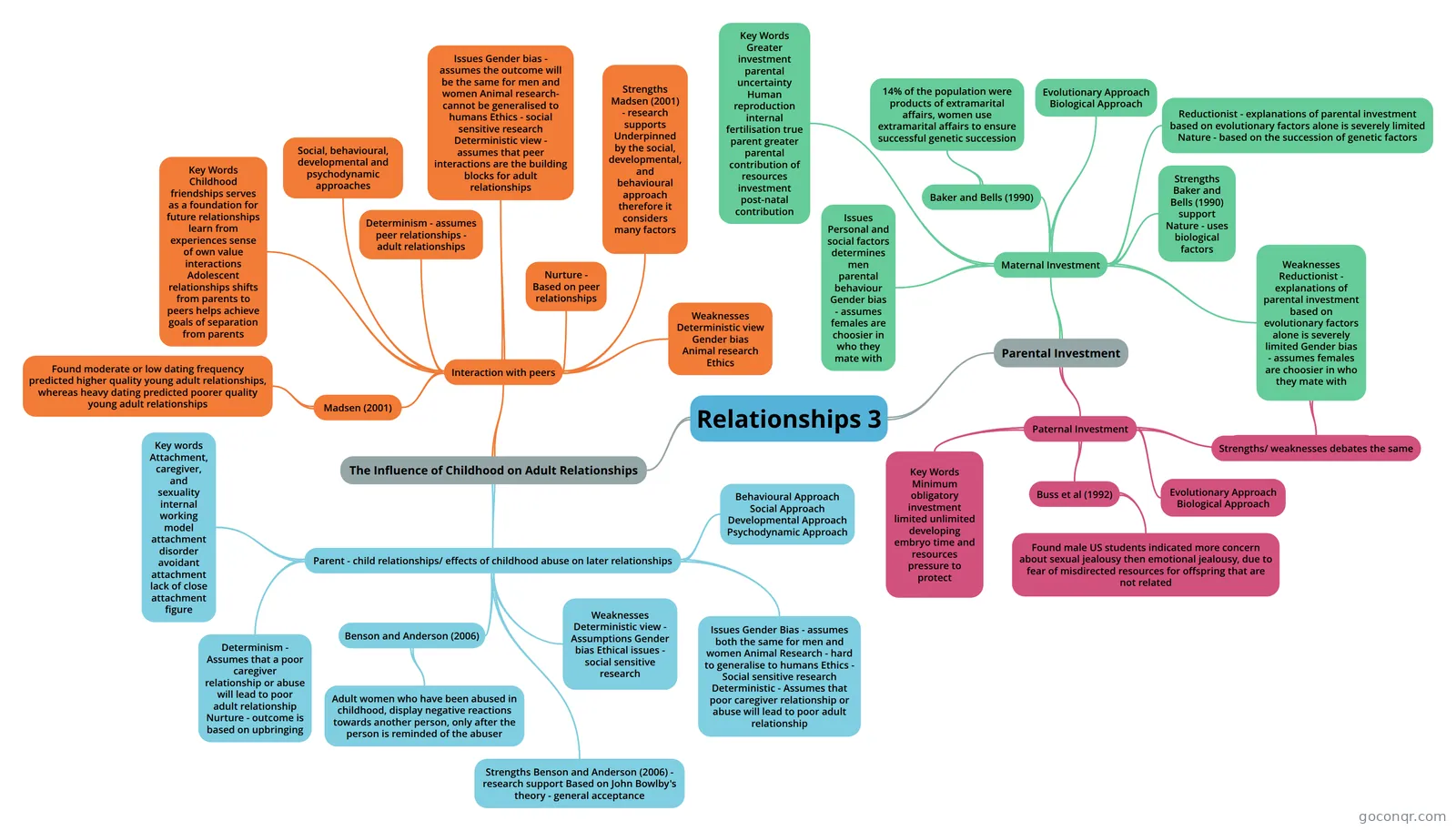
Mind map: Relationships 3
Inhalt der Mindmap
Relationships 3
Parental Investment
- Maternal Investment
- Key Words Greater investment parental uncertainty Human reproduction internal fertilisation true parent greater parental contribution of resources investment post-natal contribution
- Baker and Bells (1990)
- 14% of the population were products of extramarital affairs, women use extramarital affairs to ensure successful genetic succession
- Evolutionary Approach Biological Approach
- Issues Personal and social factors determines men parental behaviour Gender bias - assumes females are choosier in who they mate with
- Reductionist - explanations of parental investment based on evolutionary factors alone is severely limited Nature - based on the succession of genetic factors
- Strengths Baker and Bells (1990) support Nature - uses biological factors
- Weaknesses Reductionist - explanations of parental investment based on evolutionary factors alone is severely limited Gender bias - assumes females are choosier in who they mate with
- Strengths/ weaknesses debates the same
- Paternal Investment
- Key Words Minimum obligatory investment limited unlimited developing embryo time and resources pressure to protect
- Buss et al (1992)
- Found male US students indicated more concern about sexual jealousy then emotional jealousy, due to fear of misdirected resources for offspring that are not related
- Evolutionary Approach Biological Approach
- Strengths / weaknesses same
- Maternal Investment
The Influence of Childhood on Adult Relationships
- Parent - child relationships/ effects of childhood abuse on later relationships
- Key words Attachment, caregiver, and sexuality internal working model attachment disorder avoidant attachment lack of close attachment figure
- Benson and Anderson (2006)
- Adult women who have been abused in childhood, display negative reactions towards another person, only after the person is reminded of the abuser
- Behavioural Approach Social Approach Developmental Approach Psychodynamic Approach
- Issues Gender Bias - assumes both the same for men and women Animal Research - hard to generalise to humans Ethics - Social sensitive research Deterministic - Assumes that poor caregiver relationship or abuse will lead to poor adult relationship
- Determinism - Assumes that a poor caregiver relationship or abuse will lead to poor adult relationship Nurture - outcome is based on upbringing
- Strengths Benson and Anderson (2006) - research support Based on John Bowlby's theory - general acceptance
- Weaknesses Deterministic view - Assumptions Gender bias Ethical issues - social sensitive research
- Interaction with peers
- Key Words Childhood friendships serves as a foundation for future relationships learn from experiences sense of own value interactions Adolescent relationships shifts from parents to peers helps achieve goals of separation from parents
- Madsen (2001)
- Found moderate or low dating frequency predicted higher quality young adult relationships, whereas heavy dating predicted poorer quality young adult relationships
- Social, behavioural, developmental and psychodynamic approaches
- Issues Gender bias - assumes the outcome will be the same for men and women Animal research- cannot be generalised to humans Ethics - social sensitive research Deterministic view - assumes that peer interactions are the building blocks for adult relationships
- Determinism - assumes peer relationships - adult relationships
- Strengths Madsen (2001) - research supports Underpinned by the social, developmental, and behavioural approach therefore it considers many factors
- Weaknesses Deterministic view Gender bias Animal research Ethics
- Nurture - Based on peer relationships
- Parent - child relationships/ effects of childhood abuse on later relationships
Informationen
- Beschreibung
- A-Level Psychology Mindmap am Relationships 3, erstellt von hbaker9nrr am 10/02/2016.
- Erstellt von
- hbaker9nrr
- Aufrufe
- 0
- Bewertung
Mehr zu Sexual selection and partner preferences