
Mindmap
Memory
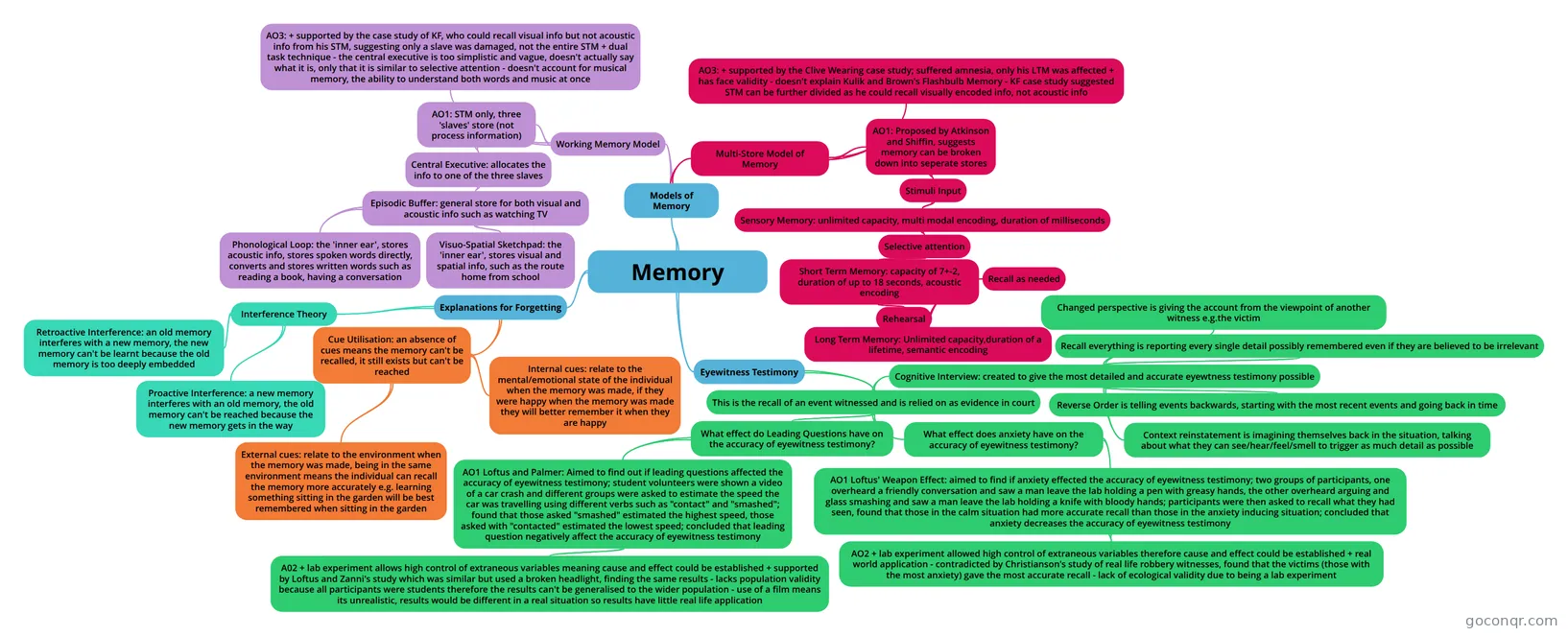
Mind map: memory psychology
Inhalt der Mindmap
Memory
Models of Memory
- Multi-Store Model of Memory
- AO1: Proposed by Atkinson and Shiffin, suggests memory can be broken down into seperate stores
- Stimuli Input
- Sensory Memory: unlimited capacity, multi modal encoding, duration of milliseconds
- Selective attention
- Short Term Memory: capacity of 7+-2, duration of up to 18 seconds, acoustic encoding
- Rehearsal
- Long Term Memory: Unlimited capacity,duration of a lifetime, semantic encoding
- Recall as needed
- Long Term Memory: Unlimited capacity,duration of a lifetime, semantic encoding
- Rehearsal
- Short Term Memory: capacity of 7+-2, duration of up to 18 seconds, acoustic encoding
- Selective attention
- Sensory Memory: unlimited capacity, multi modal encoding, duration of milliseconds
- Stimuli Input
- AO3: + supported by the Clive Wearing case study; suffered amnesia, only his LTM was affected + has face validity - doesn't explain Kulik and Brown's Flashbulb Memory - KF case study suggested STM can be further divided as he could recall visually encoded info, not acoustic info
- AO1: Proposed by Atkinson and Shiffin, suggests memory can be broken down into seperate stores
- Working Memory Model
- AO1: STM only, three 'slaves' store (not process information)
- Central Executive: allocates the info to one of the three slaves
- Episodic Buffer: general store for both visual and acoustic info such as watching TV
- Phonological Loop: the 'inner ear', stores acoustic info, stores spoken words directly, converts and stores written words such as reading a book, having a conversation
- Visuo-Spatial Sketchpad: the 'inner ear', stores visual and spatial info, such as the route home from school
- Episodic Buffer: general store for both visual and acoustic info such as watching TV
- Central Executive: allocates the info to one of the three slaves
- AO3: + supported by the case study of KF, who could recall visual info but not acoustic info from his STM, suggesting only a slave was damaged, not the entire STM + dual task technique - the central executive is too simplistic and vague, doesn't actually say what it is, only that it is similar to selective attention - doesn't account for musical memory, the ability to understand both words and music at once
- AO1: STM only, three 'slaves' store (not process information)
- Multi-Store Model of Memory
Explanations for Forgetting
- Interference Theory
- Retroactive Interference: an old memory interferes with a new memory, the new memory can't be learnt because the old memory is too deeply embedded
- Proactive Interference: a new memory interferes with an old memory, the old memory can't be reached because the new memory gets in the way
- Cue Utilisation: an absence of cues means the memory can't be recalled, it still exists but can't be reached
- Internal cues: relate to the mental/emotional state of the individual when the memory was made, if they were happy when the memory was made they will better remember it when they are happy
- External cues: relate to the environment when the memory was made, being in the same environment means the individual can recall the memory more accurately e.g. learning something sitting in the garden will be best remembered when sitting in the garden
- Interference Theory
Eyewitness Testimony
- This is the recall of an event witnessed and is relied on as evidence in court
- What effect do Leading Questions have on the accuracy of eyewitness testimony?
- AO1 Loftus and Palmer: Aimed to find out if leading questions affected the accuracy of eyewitness testimony; student volunteers were shown a video of a car crash and different groups were asked to estimate the speed the car was travelling using different verbs such as "contact" and "smashed"; found that those asked "smashed" estimated the highest speed, those asked with "contacted" estimated the lowest speed; concluded that leading question negatively affect the accuracy of eyewitness testimony
- A02 + lab experiment allows high control of extraneous variables meaning cause and effect could be established + supported by Loftus and Zanni's study which was similar but used a broken headlight, finding the same results - lacks population validity because all participants were students therefore the results can't be generalised to the wider population - use of a film means its unrealistic, results would be different in a real situation so results have little real life application
- AO1 Loftus and Palmer: Aimed to find out if leading questions affected the accuracy of eyewitness testimony; student volunteers were shown a video of a car crash and different groups were asked to estimate the speed the car was travelling using different verbs such as "contact" and "smashed"; found that those asked "smashed" estimated the highest speed, those asked with "contacted" estimated the lowest speed; concluded that leading question negatively affect the accuracy of eyewitness testimony
- What effect does anxiety have on the accuracy of eyewitness testimony?
- AO1 Loftus' Weapon Effect: aimed to find if anxiety effected the accuracy of eyewitness testimony; two groups of participants, one overheard a friendly conversation and saw a man leave the lab holding a pen with greasy hands, the other overheard arguing and glass smashing and saw a man leave the lab holding a knife with bloody hands; participants were then asked to recall what they had seen, found that those in the calm situation had more accurate recall than those in the anxiety inducing situation; concluded that anxiety decreases the accuracy of eyewitness testimony
- AO2 + lab experiment allowed high control of extraneous variables therefore cause and effect could be established + real world application - contradicted by Christianson's study of real life robbery witnesses, found that the victims (those with the most anxiety) gave the most accurate recall - lack of ecological validity due to being a lab experiment
- AO1 Loftus' Weapon Effect: aimed to find if anxiety effected the accuracy of eyewitness testimony; two groups of participants, one overheard a friendly conversation and saw a man leave the lab holding a pen with greasy hands, the other overheard arguing and glass smashing and saw a man leave the lab holding a knife with bloody hands; participants were then asked to recall what they had seen, found that those in the calm situation had more accurate recall than those in the anxiety inducing situation; concluded that anxiety decreases the accuracy of eyewitness testimony
- Cognitive Interview: created to give the most detailed and accurate eyewtness testimony possible
- Changed perspective is giving the account from the viewpoint of another witness e.g.the victim
- Recall everything is reporting every single detail possibly remembered even if they are believed to be irrelevant
- Reverse Order is telling events backwards, starting with the most recent events and going back in time
- Context reinstatement is imagining themselves back in the situation, talking about what they can see/hear/feel/smell to trigger as much detail as possible
- What effect do Leading Questions have on the accuracy of eyewitness testimony?
- This is the recall of an event witnessed and is relied on as evidence in court
Informationen
- Beschreibung
- AQA AS Psychology - Paper One
- Erstellt von
- Emily Cushlow
- Aufrufe
- 17
- Bewertung