
Mindmap
Euthanasia
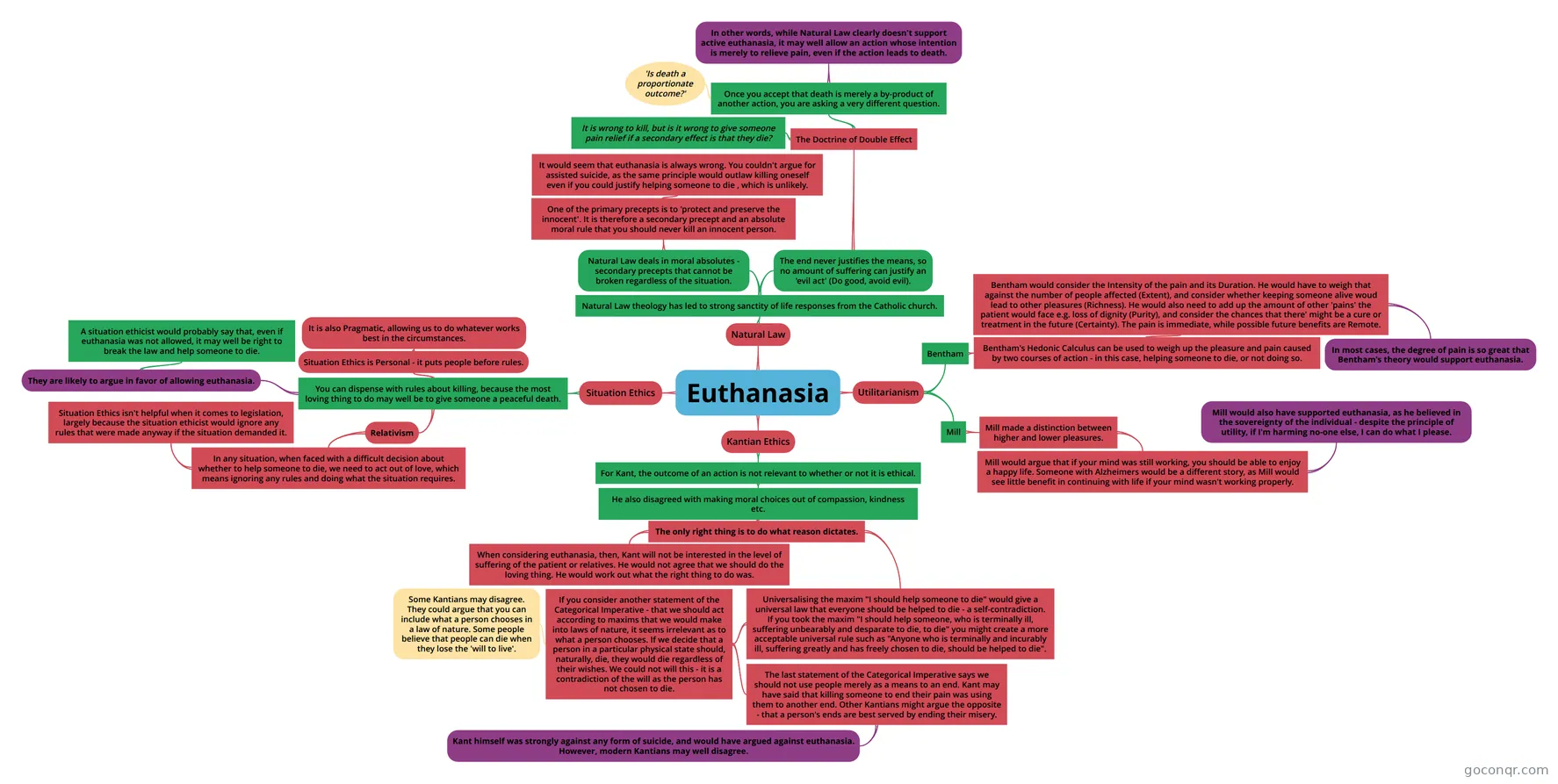
Mind map: Euthanasia ethics
Inhalt der Mindmap
Euthanasia
Utilitarianism
- Bentham
- Bentham's Hedonic Calculus can be used to weigh up the pleasure and pain caused by two courses of action - in this case, helping someone to die, or not doing so.
- Bentham would consider the Intensity of the pain and its Duration. He would have to weigh that against the number of people affected (Extent), and consider whether keeping someone alive woud lead to other pleasures (Richness). He would also need to add up the amount of other 'pains' the patient would face e.g. loss of dignity (Purity), and consider the chances that there' might be a cure or treatment in the future (Certainty). The pain is immediate, while possible future benefits are Remote.
- In most cases, the degree of pain is so great that Bentham's theory would support euthanasia.
- Bentham would consider the Intensity of the pain and its Duration. He would have to weigh that against the number of people affected (Extent), and consider whether keeping someone alive woud lead to other pleasures (Richness). He would also need to add up the amount of other 'pains' the patient would face e.g. loss of dignity (Purity), and consider the chances that there' might be a cure or treatment in the future (Certainty). The pain is immediate, while possible future benefits are Remote.
- Bentham's Hedonic Calculus can be used to weigh up the pleasure and pain caused by two courses of action - in this case, helping someone to die, or not doing so.
- Mill
- Mill made a distinction between higher and lower pleasures.
- Mill would argue that if your mind was still working, you should be able to enjoy a happy life. Someone with Alzheimers would be a different story, as Mill would see little benefit in continuing with life if your mind wasn't working properly.
- Mill would also have supported euthanasia, as he believed in the sovereignty of the individual - despite the principle of utility, if I'm harming no-one else, I can do what I please.
- Mill would argue that if your mind was still working, you should be able to enjoy a happy life. Someone with Alzheimers would be a different story, as Mill would see little benefit in continuing with life if your mind wasn't working properly.
- Mill made a distinction between higher and lower pleasures.
- Bentham
Kantian Ethics
- For Kant, the outcome of an action is not relevant to whether or not it is ethical.
- He also disagreed with making moral choices out of compassion, kindness etc.
- The only right thing is to do what reason dictates.
- When considering euthanasia, then, Kant will not be interested in the level of suffering of the patient or relatives. He would not agree that we should do the loving thing. He would work out what the right thing to do was.
- Universalising the maxim "I should help someone to die" would give a universal law that everyone should be helped to die - a self-contradiction. If you took the maxim "I should help someone, who is terminally ill, suffering unbearably and desparate to die, to die" you might create a more acceptable universal rule such as "Anyone who is terminally and incurably ill, suffering greatly and has freely chosen to die, should be helped to die".
- If you consider another statement of the Categorical Imperative - that we should act according to maxims that we would make into laws of nature, it seems irrelevant as to what a person chooses. If we decide that a person in a particular physical state should, naturally, die, they would die regardless of their wishes. We could not will this - it is a contradiction of the will as the person has not chosen to die.
- Some Kantians may disagree. They could argue that you can include what a person chooses in a law of nature. Some people believe that people can die when they lose the 'will to live'.
- The last statement of the Categorical Imperative says we should not use people merely as a means to an end. Kant may have said that killing someone to end their pain was using them to another end. Other Kantians might argue the opposite - that a person's ends are best served by ending their misery.
- Kant himself was strongly against any form of suicide, and would have argued against euthanasia. However, modern Kantians may well disagree.
- If you consider another statement of the Categorical Imperative - that we should act according to maxims that we would make into laws of nature, it seems irrelevant as to what a person chooses. If we decide that a person in a particular physical state should, naturally, die, they would die regardless of their wishes. We could not will this - it is a contradiction of the will as the person has not chosen to die.
- The only right thing is to do what reason dictates.
- He also disagreed with making moral choices out of compassion, kindness etc.
- For Kant, the outcome of an action is not relevant to whether or not it is ethical.
Natural Law
- Natural Law theology has led to strong sanctity of life responses from the Catholic church.
- Natural Law deals in moral absolutes - secondary precepts that cannot be broken regardless of the situation.
- One of the primary precepts is to 'protect and preserve the innocent'. It is therefore a secondary precept and an absolute moral rule that you should never kill an innocent person.
- It would seem that euthanasia is always wrong. You couldn't argue for assisted suicide, as the same principle would outlaw killing oneself even if you could justify helping someone to die , which is unlikely.
- One of the primary precepts is to 'protect and preserve the innocent'. It is therefore a secondary precept and an absolute moral rule that you should never kill an innocent person.
- The end never justifies the means, so no amount of suffering can justify an 'evil act' (Do good, avoid evil).
- The Doctrine of Double Effect
- It is wrong to kill, but is it wrong to give someone pain relief if a secondary effect is that they die?
- Once you accept that death is merely a by-product of another action, you are asking a very different question.
- 'Is death a proportionate outcome?'
- In other words, while Natural Law clearly doesn't support active euthanasia, it may well allow an action whose intention is merely to relieve pain, even if the action leads to death.
- The Doctrine of Double Effect
- Natural Law deals in moral absolutes - secondary precepts that cannot be broken regardless of the situation.
- Natural Law theology has led to strong sanctity of life responses from the Catholic church.
Situation Ethics
- You can dispense with rules about killing, because the most loving thing to do may well be to give someone a peaceful death.
- Situation Ethics is Personal - it puts people before rules.
- It is also Pragmatic, allowing us to do whatever works best in the circumstances.
- Relativism
- In any situation, when faced with a difficult decision about whether to help someone to die, we need to act out of love, which means ignoring any rules and doing what the situation requires.
- Situation Ethics isn't helpful when it comes to legislation, largely because the situation ethicist would ignore any rules that were made anyway if the situation demanded it.
- In any situation, when faced with a difficult decision about whether to help someone to die, we need to act out of love, which means ignoring any rules and doing what the situation requires.
- They are likely to argue in favor of allowing euthanasia.
- A situation ethicist would probably say that, even if euthanasia was not allowed, it may well be right to break the law and help someone to die.
- Situation Ethics is Personal - it puts people before rules.
- You can dispense with rules about killing, because the most loving thing to do may well be to give someone a peaceful death.
Informationen
- Beschreibung
- A-Level Philosophy and ethics (Ethics) Mindmap am Euthanasia, erstellt von Harriet Denton am 23/05/2016.
- Erstellt von
- Harriet Denton
- Aufrufe
- 0
- Bewertung