
Mindmap
Discuss research into institutional aggression
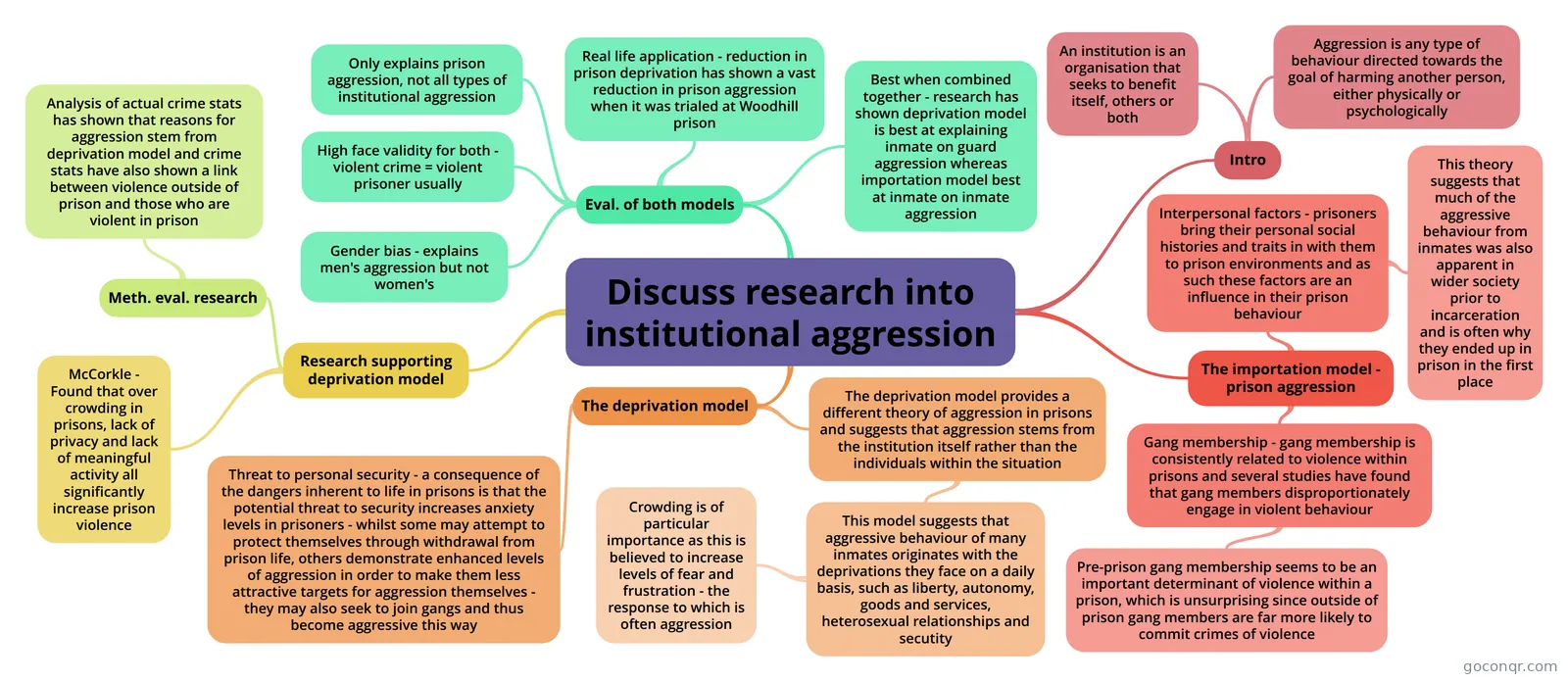
Mind map: institutional aggression research
Inhalt der Mindmap
Discuss research into institutional aggression
Intro
- Aggression is any type of behaviour directed towards the goal of harming another person, either physically or psychologically
- An institution is an organisation that seeks to benefit itself, others or both
The importation model - prison aggression
- Interpersonal factors - prisoners bring their personal social histories and traits in with them to prison environments and as such these factors are an influence in their prison behaviour
- This theory suggests that much of the aggressive behaviour from inmates was also apparent in wider society prior to incarceration and is often why they ended up in prison in the first place
- Gang membership - gang membership is consistently related to violence within prisons and several studies have found that gang members disproportionately engage in violent behaviour
- Pre-prison gang membership seems to be an important determinant of violence within a prison, which is unsurprising since outside of prison gang members are far more likely to commit crimes of violence
- Interpersonal factors - prisoners bring their personal social histories and traits in with them to prison environments and as such these factors are an influence in their prison behaviour
The deprivation model
- The deprivation model provides a different theory of aggression in prisons and suggests that aggression stems from the institution itself rather than the individuals within the situation
- This model suggests that aggressive behaviour of many inmates originates with the deprivations they face on a daily basis, such as liberty, autonomy, goods and services, heterosexual relationships and secutity
- Crowding is of particular importance as this is believed to increase levels of fear and frustration - the response to which is often aggression
- This model suggests that aggressive behaviour of many inmates originates with the deprivations they face on a daily basis, such as liberty, autonomy, goods and services, heterosexual relationships and secutity
- Threat to personal security - a consequence of the dangers inherent to life in prisons is that the potential threat to security increases anxiety levels in prisoners - whilst some may attempt to protect themselves through withdrawal from prison life, others demonstrate enhanced levels of aggression in order to make them less attractive targets for aggression themselves - they may also seek to join gangs and thus become aggressive this way
- The deprivation model provides a different theory of aggression in prisons and suggests that aggression stems from the institution itself rather than the individuals within the situation
Research supporting deprivation model
- McCorkle - Found that over crowding in prisons, lack of privacy and lack of meaningful activity all significantly increase prison violence
- Meth. eval. research
- Analysis of actual crime stats has shown that reasons for aggression stem from deprivation model and crime stats have also shown a link between violence outside of prison and those who are violent in prison
Eval. of both models
- Gender bias - explains men's aggression but not women's
- High face validity for both - violent crime = violent prisoner usually
- Only explains prison aggression, not all types of institutional aggression
- Real life application - reduction in prison deprivation has shown a vast reduction in prison aggression when it was trialed at Woodhill prison
- Best when combined together - research has shown deprivation model is best at explaining inmate on guard aggression whereas importation model best at inmate on inmate aggression
Informationen
- Beschreibung
- A-Level Psychology (Psych 3 - Aggression) Mindmap am Discuss research into institutional aggression, erstellt von Abbey Wrigley am 06/06/2016.
- Erstellt von
- Abbey Wrigley
- Aufrufe
- 0
- Bewertung