
Mindmap
Memory
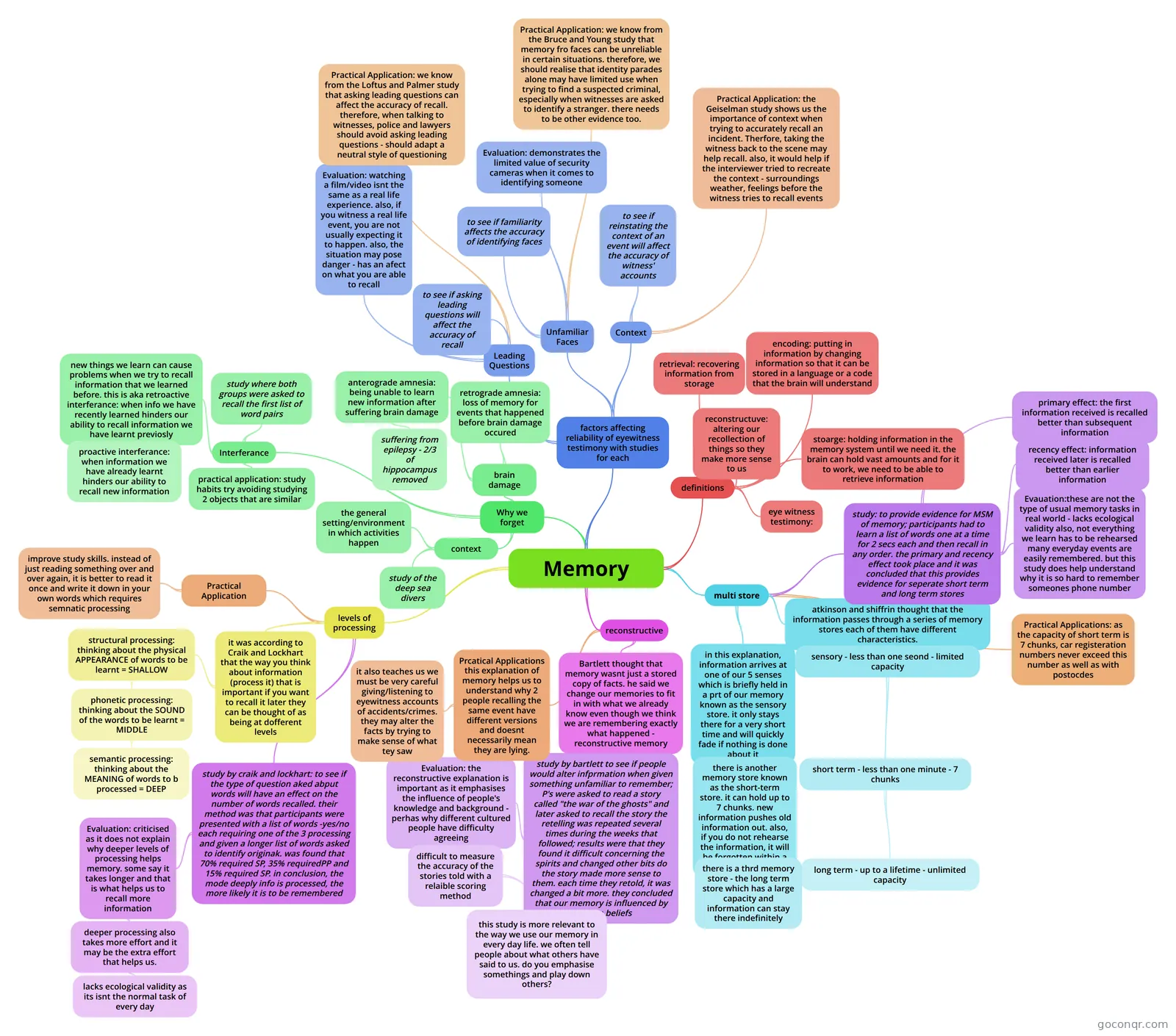
Mind map: Memory
Inhalt der Mindmap
Memory
definitions
- encoding: putting in information by changing information so that it can be stored in a language or a code that the brain will understand
- stoarge: holding information in the memory system until we need it. the brain can hold vast amounts and for it to work, we need to be able to retrieve information
- retrieval: recovering information from storage
- eye witness testimony:
- reconstructuve: altering our recollection of things so they make more sense to us
multi store
- atkinson and shiffrin thought that the information passes through a series of memory stores each of them have different characteristics.
- sensory - less than one seond - limited capacity
- short term - less than one minute - 7 chunks
- long term - up to a lifetime - unlimited capacity
- short term - less than one minute - 7 chunks
- sensory - less than one seond - limited capacity
- in this explanation, information arrives at one of our 5 senses which is briefly held in a prt of our memory known as the sensory store. it only stays there for a very short time and will quickly fade if nothing is done about it
- there is another memory store known as the short-term store. it can hold up to 7 chunks. new information pushes old information out. also, if you do not rehearse the information, it will be forgotten within a minute
- there is a thrd memory store - the long term store which has a large capacity and information can stay there indefinitely
- there is another memory store known as the short-term store. it can hold up to 7 chunks. new information pushes old information out. also, if you do not rehearse the information, it will be forgotten within a minute
- study: to provide evidence for MSM of memory; participants had to learn a list of words one at a time for 2 secs each and then recall in any order. the primary and recency effect took place and it was concluded that this provides evidence for seperate short term and long term stores
- Evauation:these are not the type of usual memory tasks in real world - lacks ecological validity also, not everything we learn has to be rehearsed many everyday events are easily remembered. but this study does help understand why it is so hard to remember someones phone number
- primary effect: the first information received is recalled better than subsequent information
- recency effect: information received later is recalled better than earlier information
- Practical Applications: as the capacity of short term is 7 chunks, car registeration numbers never exceed this number as well as with postocdes
- atkinson and shiffrin thought that the information passes through a series of memory stores each of them have different characteristics.
reconstructive
- Bartlett thought that memory wasnt just a stored copy of facts. he said we change our memories to fit in with what we already know even though we think we are remembering exactly what happened - reconstructive memory
- study by bartlett to see if people would alter infprmation when given something unfamiliar to remember; P's were asked to read a story called "the war of the ghosts" and later asked to recall the story the retelling was repeated several times during the weeks that followed; results were that they found it difficult concerning the spirits and changed other bits do the story made more sense to them. each time they retold, it was changed a bit more. they concluded that our memory is influenced by our own beliefs
- Evaluation: the reconstructive explanation is important as it emphasises the influence of people's knowledge and background - perhas why different cultured people have difficulty agreeing
- difficult to measure the accuracy of the stories told with a relaible scoring method
- this study is more relevant to the way we use our memory in every day life. we often tell people about what others have said to us. do you emphasise somethings and play down others?
- difficult to measure the accuracy of the stories told with a relaible scoring method
- Evaluation: the reconstructive explanation is important as it emphasises the influence of people's knowledge and background - perhas why different cultured people have difficulty agreeing
- study by bartlett to see if people would alter infprmation when given something unfamiliar to remember; P's were asked to read a story called "the war of the ghosts" and later asked to recall the story the retelling was repeated several times during the weeks that followed; results were that they found it difficult concerning the spirits and changed other bits do the story made more sense to them. each time they retold, it was changed a bit more. they concluded that our memory is influenced by our own beliefs
- Prcatical Applications this explanation of memory helps us to understand why 2 people recalling the same event have different versions and doesnt necessarily mean they are lying.
- it also teaches us we must be very careful giving/listening to eyewitness accounts of accidents/crimes. they may alter the facts by trying to make sense of what tey saw
- Bartlett thought that memory wasnt just a stored copy of facts. he said we change our memories to fit in with what we already know even though we think we are remembering exactly what happened - reconstructive memory
levels of processing
- it was according to Craik and Lockhart that the way you think about information (process it) that is important if you want to recall it later they can be thought of as being at dofferent levels
- structural processing: thinking about the physical APPEARANCE of words to be learnt = SHALLOW
- phonetic processing: thinking about the SOUND of the words to be learnt = MIDDLE
- semantic processing: thinking about the MEANING of words to b processed = DEEP
- phonetic processing: thinking about the SOUND of the words to be learnt = MIDDLE
- structural processing: thinking about the physical APPEARANCE of words to be learnt = SHALLOW
- study by craik and lockhart: to see if the type of question aked abput words will have an effect on the number of words recalled. their method was that participants were presented with a list of words -yes/no each requiring one of the 3 processing and given a longer list of words asked to identify originak. was found that 70% required SP, 35% requiredPP and 15% required SP. in conclusion, the mode deeply info is processed, the more likely it is to be remembered
- Evaluation: criticised as it does not explain why deeper levels of processing helps memory. some say it takes longer and that is what helps us to recall more information
- deeper processing also takes more effort and it may be the extra effort that helps us.
- lacks ecological validity as its isnt the normal task of every day
- deeper processing also takes more effort and it may be the extra effort that helps us.
- Evaluation: criticised as it does not explain why deeper levels of processing helps memory. some say it takes longer and that is what helps us to recall more information
- Practical Application
- improve study skills. instead of just reading something over and over again, it is better to read it once and write it down in your own words which requires semnatic processing
- it was according to Craik and Lockhart that the way you think about information (process it) that is important if you want to recall it later they can be thought of as being at dofferent levels
factors affecting reliability of eyewitness testimony with studies for each
- Leading Questions
- to see if asking leading questions will affect the accuracy of recall
- Evaluation: watching a film/video isnt the same as a real life experience. also, if you witness a real life event, you are not usually expecting it to happen. also, the situation may pose danger - has an afect on what you are able to recall
- Practical Application: we know from the Loftus and Palmer study that asking leading questions can affect the accuracy of recall. therefore, when talking to witnesses, police and lawyers should avoid asking leading questions - should adapt a neutral style of questioning
- Unfamiliar Faces
- to see if familiarity affects the accuracy of identifying faces
- Evaluation: demonstrates the limited value of security cameras when it comes to identifying someone
- Practical Application: we know from the Bruce and Young study that memory fro faces can be unreliable in certain situations. therefore, we should realise that identity parades alone may have limited use when trying to find a suspected criminal, especially when witnesses are asked to identify a stranger. there needs to be other evidence too.
- Context
- to see if reinstating the context of an event will affect the accuracy of witness' accounts
- Practical Application: the Geiselman study shows us the importance of context when trying to accurately recall an incident. Therfore, taking the witness back to the scene may help recall. also, it would help if the interviewer tried to recreate the context - surroundings weather, feelings before the witness tries to recall events
- Leading Questions
Why we forget
- Interferance
- new things we learn can cause problems when we try to recall information that we learned before. this is aka retroactive interferance: when info we have recently learned hinders our ability to recall information we have learnt previosly
- proactive interferance: when information we have already learnt hinders our ability to recall new information
- practical application: study habits try avoiding studying 2 objects that are similar
- study where both groups were asked to recall the first list of word pairs
- new things we learn can cause problems when we try to recall information that we learned before. this is aka retroactive interferance: when info we have recently learned hinders our ability to recall information we have learnt previosly
- context
- the general setting/environment in which activities happen
- study of the deep sea divers
- brain damage
- retrograde amnesia: loss of memory for events that happened before brain damage occured
- anterograde amnesia: being unable to learn new information after suffering brain damage
- suffering from epilepsy - 2/3 of hippocampus removed
- Interferance
Informationen
- Beschreibung
- GCSE Psychology Mindmap am Memory, erstellt von pv7137 am 06/04/2014.
- Erstellt von
- pv7137
- Aufrufe
- 17
- Tags
- Bewertung