
Mindmap
Parental Investment
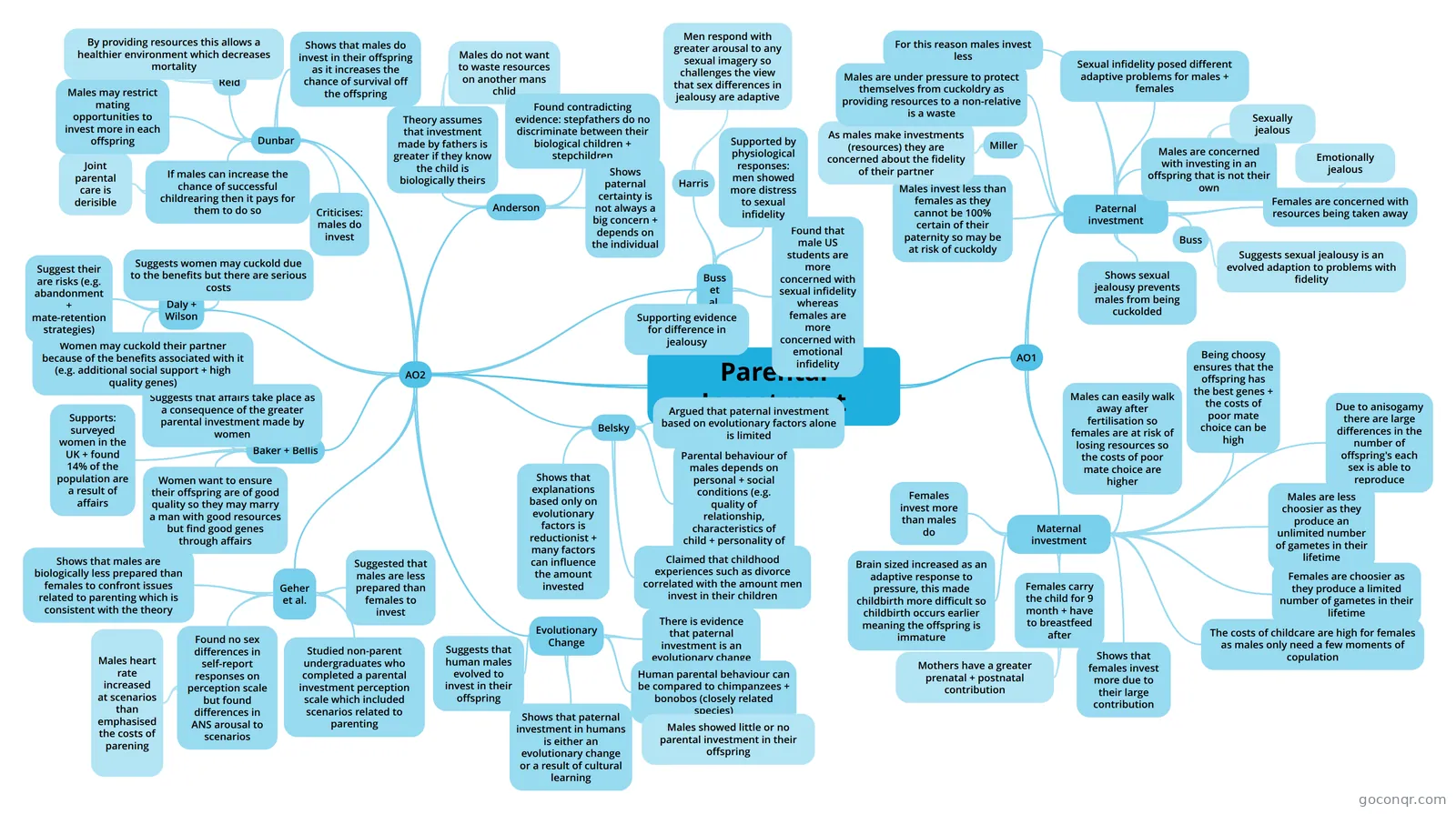
Mind map: Parental investment
Inhalt der Mindmap
Parental Investment
AO1
- Maternal investment
- Females invest more than males do
- Brain sized increased as an adaptive response to pressure, this made childbirth more difficult so childbirth occurs earlier meaning the offspring is immature
- Females carry the child for 9 month + have to breastfeed after
- Mothers have a greater prenatal + postnatal contribution
- Shows that females invest more due to their large contribution
- The costs of childcare are high for females as males only need a few moments of copulation
- Due to anisogamy there are large differences in the number of offspring's each sex is able to reproduce
- Females are choosier as they produce a limited number of gametes in their lifetime
- Males are less choosier as they produce an unlimited number of gametes in their lifetime
- Being choosy ensures that the offspring has the best genes + the costs of poor mate choice can be high
- Males can easily walk away after fertilisation so females are at risk of losing resources so the costs of poor mate choice are higher
- Paternal investment
- Males invest less than females as they cannot be 100% certain of their paternity so may be at risk of cuckoldy
- Miller
- As males make investments (resources) they are concerned about the fidelity of their partner
- Males are under pressure to protect themselves from cuckoldry as providing resources to a non-relative is a waste
- For this reason males invest less
- Sexual infidelity posed different adaptive problems for males + females
- Males are concerned with investing in an offspring that is not their own
- Sexually jealous
- Females are concerned with resources being taken away
- Emotionally jealous
- Buss
- Suggests sexual jealousy is an evolved adaption to problems with fidelity
- Shows sexual jealousy prevents males from being cuckolded
- Maternal investment
AO2
- Belsky
- Argued that paternal investment based on evolutionary factors alone is limited
- Parental behaviour of males depends on personal + social conditions (e.g. quality of relationship, characteristics of child + personality of father
- Claimed that childhood experiences such as divorce correlated with the amount men invest in their children
- Shows that explanations based only on evolutionary factors is reductionist + many factors can influence the amount invested
- Evolutionary Change
- There is evidence that paternal investment is an evolutionary change
- Human parental behaviour can be compared to chimpanzees + bonobos (closely related species)
- Males showed little or no parental investment in their offspring
- Shows that paternal investment in humans is either an evolutionary change or a result of cultural learning
- Suggests that human males evolved to invest in their offspring
- Geher et al.
- Suggested that males are less prepared than females to invest
- Studied non-parent undergraduates who completed a parental investment perception scale which included scenarios related to parenting
- Found no sex differences in self-report responses on perception scale but found differences in ANS arousal to scenarios
- Males heart rate increased at scenarios than emphasised the costs of parening
- Shows that males are biologically less prepared than females to confront issues related to parenting which is consistent with the theory
- Baker + Bellis
- Women want to ensure their offspring are of good quality so they may marry a man with good resources but find good genes through affairs
- Supports: surveyed women in the UK + found 14% of the population are a result of affairs
- Suggests that affairs take place as a consequence of the greater parental investment made by women
- Daly + Wilson
- Women may cuckold their partner because of the benefits associated with it (e.g. additional social support + high quality genes)
- Suggest their are risks (e.g. abandonment + mate-retention strategies)
- Suggests women may cuckold due to the benefits but there are serious costs
- Dunbar
- Criticises: males do invest
- If males can increase the chance of successful childrearing then it pays for them to do so
- Joint parental care is derisible
- Males may restrict mating opportunities to invest more in each offspring
- Reid
- By providing resources this allows a healthier environment which decreases mortality
- Shows that males do invest in their offspring as it increases the chance of survival off the offspring
- Buss et al.
- Supporting evidence for difference in jealousy
- Found that male US students are more concerned with sexual infidelity whereas females are more concerned with emotional infidelity
- Supported by physiological responses: men showed more distress to sexual infidelity
- Harris
- Men respond with greater arousal to any sexual imagery so challenges the view that sex differences in jealousy are adaptive
- Anderson
- Theory assumes that investment made by fathers is greater if they know the child is biologically theirs
- Males do not want to waste resources on another mans chlid
- Found contradicting evidence: stepfathers do no discriminate between their biological children + stepchildren
- Shows paternal certainty is not always a big concern + depends on the individual
- Theory assumes that investment made by fathers is greater if they know the child is biologically theirs
- Belsky
Informationen
- Beschreibung
- Psychology Mindmap am Parental Investment, erstellt von Balinder am 10/04/2014.
- Erstellt von
- Balinder
- Aufrufe
- 20
- Tags
- Bewertung
Mehr zu Sexual selection and partner preferences