
Mindmap
SEXUAL SELECTION & HUMAN REPRODUCTIVE BEHAVIOUR
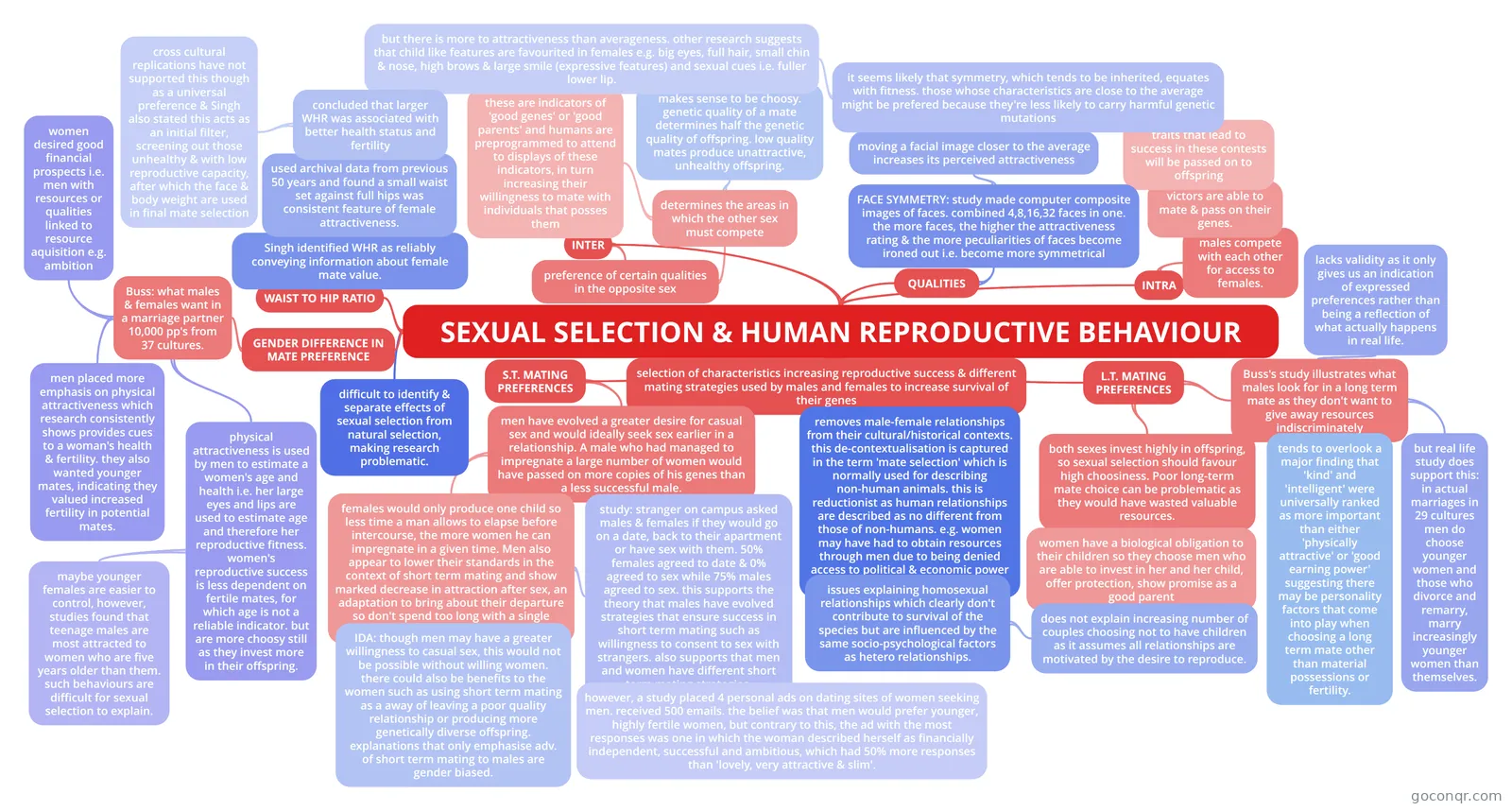
Mind map: sexual selection and human reproductive behaviour
Inhalt der Mindmap
SEXUAL SELECTION & HUMAN REPRODUCTIVE BEHAVIOUR
INTER
- preference of certain qualities in the opposite sex
- determines the areas in which the other sex must compete
- these are indicators of 'good genes' or 'good parents' and humans are preprogrammed to attend to displays of these indicators, in turn increasing their willingness to mate with individuals that posses them
- makes sense to be choosy. genetic quality of a mate determines half the genetic quality of offspring. low quality mates produce unattractive, unhealthy offspring.
- determines the areas in which the other sex must compete
- preference of certain qualities in the opposite sex
INTRA
- males compete with each other for access to females.
- victors are able to mate & pass on their genes.
- traits that lead to success in these contests will be passed on to offspring
- victors are able to mate & pass on their genes.
- males compete with each other for access to females.
S.T. MATING PREFERENCES
- men have evolved a greater desire for casual sex and would ideally seek sex earlier in a relationship. A male who had managed to impregnate a large number of women would have passed on more copies of his genes than a less successful male.
- females would only produce one child so less time a man allows to elapse before intercourse, the more women he can impregnate in a given time. Men also appear to lower their standards in the context of short term mating and show marked decrease in attraction after sex, an adaptation to bring about their departure so don't spend too long with a single woman.
- study: stranger on campus asked males & females if they would go on a date, back to their apartment or have sex with them. 50% females agreed to date & 0% agreed to sex while 75% males agreed to sex. this supports the theory that males have evolved strategies that ensure success in short term mating such as willingness to consent to sex with strangers. also supports that men and women have different short term mating strategies.
- however, a study placed 4 personal ads on dating sites of women seeking men. received 500 emails. the belief was that men would prefer younger, highly fertile women, but contrary to this, the ad with the most responses was one in which the woman described herself as financially independent, successful and ambitious, which had 50% more responses than 'lovely, very attractive & slim'.
- IDA: though men may have a greater willingness to casual sex, this would not be possible without willing women. there could also be benefits to the women such as using short term mating as a away of leaving a poor quality relationship or producing more genetically diverse offspring. explanations that only emphasise adv. of short term mating to males are gender biased.
- study: stranger on campus asked males & females if they would go on a date, back to their apartment or have sex with them. 50% females agreed to date & 0% agreed to sex while 75% males agreed to sex. this supports the theory that males have evolved strategies that ensure success in short term mating such as willingness to consent to sex with strangers. also supports that men and women have different short term mating strategies.
- females would only produce one child so less time a man allows to elapse before intercourse, the more women he can impregnate in a given time. Men also appear to lower their standards in the context of short term mating and show marked decrease in attraction after sex, an adaptation to bring about their departure so don't spend too long with a single woman.
- men have evolved a greater desire for casual sex and would ideally seek sex earlier in a relationship. A male who had managed to impregnate a large number of women would have passed on more copies of his genes than a less successful male.
L.T. MATING PREFERENCES
- both sexes invest highly in offspring, so sexual selection should favour high choosiness. Poor long-term mate choice can be problematic as they would have wasted valuable resources.
- women have a biological obligation to their children so they choose men who are able to invest in her and her child, offer protection, show promise as a good parent
- Buss's study illustrates what males look for in a long term mate as they don't want to give away resources indiscriminately
- lacks validity as it only gives us an indication of expressed preferences rather than being a reflection of what actually happens in real life.
- but real life study does support this: in actual marriages in 29 cultures men do choose younger women and those who divorce and remarry, marry increasingly younger women than themselves.
- tends to overlook a major finding that 'kind' and 'intelligent' were universally ranked as more important than either 'physically attractive' or 'good earning power' suggesting there may be personality factors that come into play when choosing a long term mate other than material possessions or fertility.
- both sexes invest highly in offspring, so sexual selection should favour high choosiness. Poor long-term mate choice can be problematic as they would have wasted valuable resources.
selection of characteristics increasing reproductive success & different mating strategies used by males and females to increase survival of their genes
QUALITIES
- FACE SYMMETRY: study made computer composite images of faces. combined 4,8,16,32 faces in one. the more faces, the higher the attractiveness rating & the more peculiarities of faces become ironed out i.e. become more symmetrical
- moving a facial image closer to the average increases its perceived attractiveness
- it seems likely that symmetry, which tends to be inherited, equates with fitness. those whose characteristics are close to the average might be prefered because they're less likely to carry harmful genetic mutations
- but there is more to attractiveness than averageness. other research suggests that child like features are favourited in females e.g. big eyes, full hair, small chin & nose, high brows & large smile (expressive features) and sexual cues i.e. fuller lower lip.
- it seems likely that symmetry, which tends to be inherited, equates with fitness. those whose characteristics are close to the average might be prefered because they're less likely to carry harmful genetic mutations
- moving a facial image closer to the average increases its perceived attractiveness
- FACE SYMMETRY: study made computer composite images of faces. combined 4,8,16,32 faces in one. the more faces, the higher the attractiveness rating & the more peculiarities of faces become ironed out i.e. become more symmetrical
WAIST TO HIP RATIO
- Singh identified WHR as reliably conveying information about female mate value.
- used archival data from previous 50 years and found a small waist set against full hips was consistent feature of female attractiveness.
- concluded that larger WHR was associated with better health status and fertility
- cross cultural replications have not supported this though as a universal preference & Singh also stated this acts as an initial filter, screening out those unhealthy & with low reproductive capacity, after which the face & body weight are used in final mate selection
- concluded that larger WHR was associated with better health status and fertility
- used archival data from previous 50 years and found a small waist set against full hips was consistent feature of female attractiveness.
- Singh identified WHR as reliably conveying information about female mate value.
GENDER DIFFERENCE IN MATE PREFERENCE
- Buss: what males & females want in a marriage partner 10,000 pp's from 37 cultures.
- women desired good financial prospects i.e. men with resources or qualities linked to resource aquisition e.g. ambition
- men placed more emphasis on physical attractiveness which research consistently shows provides cues to a woman's health & fertility. they also wanted younger mates, indicating they valued increased fertility in potential mates.
- physical attractiveness is used by men to estimate a women's age and health i.e. her large eyes and lips are used to estimate age and therefore her reproductive fitness. women's reproductive success is less dependent on fertile mates, for which age is not a reliable indicator. but are more choosy still as they invest more in their offspring.
- maybe younger females are easier to control, however, studies found that teenage males are most attracted to women who are five years older than them. such behaviours are difficult for sexual selection to explain.
- Buss: what males & females want in a marriage partner 10,000 pp's from 37 cultures.
difficult to identify & separate effects of sexual selection from natural selection, making research problematic.
removes male-female relationships from their cultural/historical contexts. this de-contextualisation is captured in the term 'mate selection' which is normally used for describing non-human animals. this is reductionist as human relationships are described as no different from those of non-humans. e.g. women may have had to obtain resources through men due to being denied access to political & economic power in the past.
- issues explaining homosexual relationships which clearly don't contribute to survival of the species but are influenced by the same socio-psychological factors as hetero relationships.
- does not explain increasing number of couples choosing not to have children as it assumes all relationships are motivated by the desire to reproduce.
- issues explaining homosexual relationships which clearly don't contribute to survival of the species but are influenced by the same socio-psychological factors as hetero relationships.
Informationen
- Beschreibung
- GCE Relationships Mindmap am SEXUAL SELECTION & HUMAN REPRODUCTIVE BEHAVIOUR, erstellt von diana.m1629 am 24/04/2014.
- Erstellt von
- diana.m1629
- Aufrufe
- 30
- Bewertung
Mehr zu Sexual selection and partner preferences