
Mindmap
COGNITIVE PSYCHOLOGY
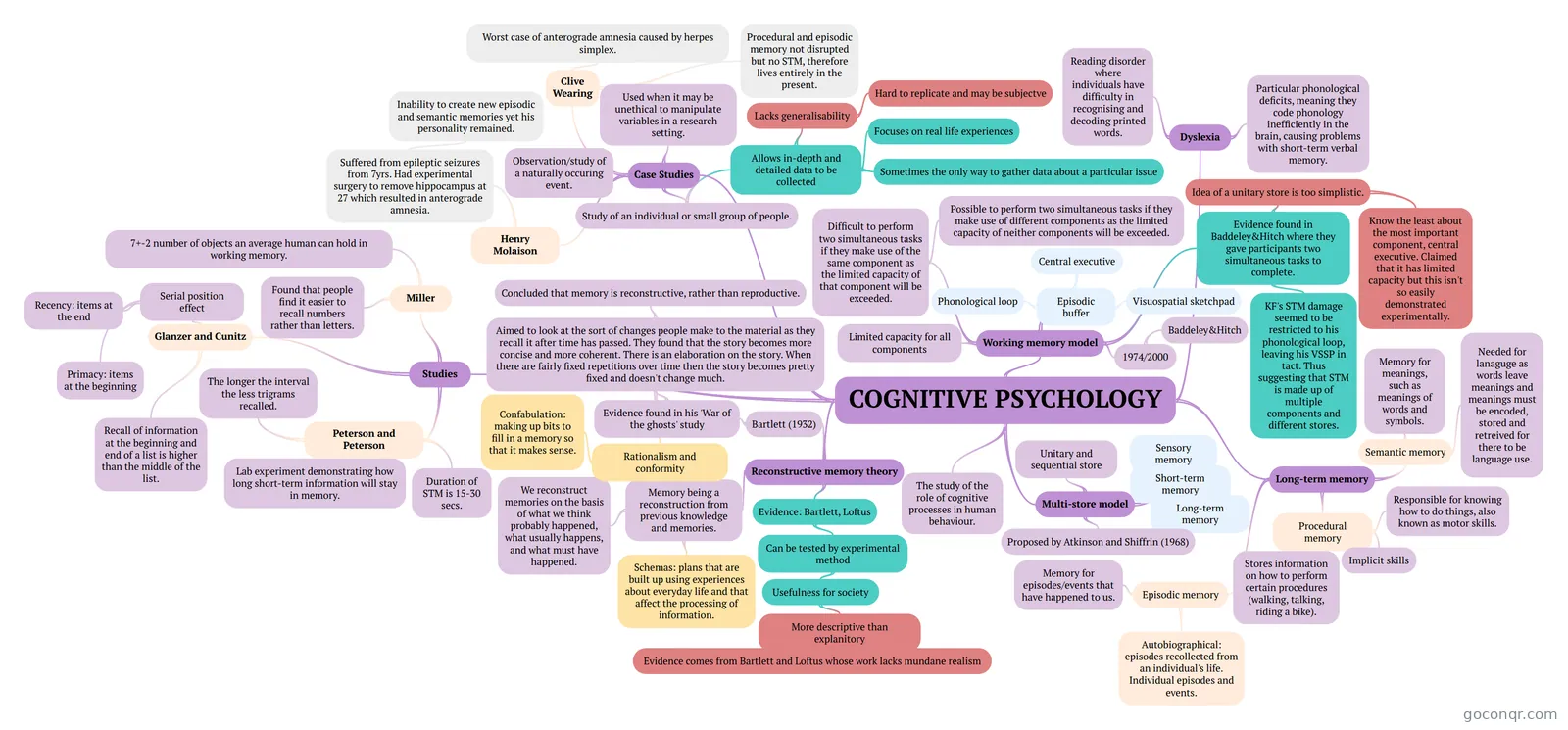
Mind map: cognitive psychology memory
Inhalt der Mindmap
COGNITIVE PSYCHOLOGY
Multi-store model
- Sensory memory
- Short-term memory
- Long-term memory
- Short-term memory
- Proposed by Atkinson and Shiffrin (1968)
- Unitary and sequential store
- Sensory memory
Working memory model
- Central executive
- Episodic buffer
- Visuospatial sketchpad
- Phonological loop
- Episodic buffer
- 1974/2000
- Baddeley&Hitch
- Limited capacity for all components
- Difficult to perform two simultaneous tasks if they make use of the same component as the limited capacity of that component will be exceeded.
- Possible to perform two simultaneous tasks if they make use of different components as the limited capacity of neither components will be exceeded.
- Evidence found in Baddeley&Hitch where they gave participants two simultaneous tasks to complete.
- KF's STM damage seemed to be restricted to his phonological loop, leaving his VSSP in tact. Thus suggesting that STM is made up of multiple components and different stores.
- Idea of a unitary store is too simplistic.
- Know the least about the most important component, central executive. Claimed that it has limited capacity but this isn't so easily demonstrated experimentally.
- Central executive
Long-term memory
- Semantic memory
- Memory for meanings, such as meanings of words and symbols.
- Needed for lanaguge as words leave meanings and meanings must be encoded, stored and retreived for there to be language use.
- Procedural memory
- Responsible for knowing how to do things, also known as motor skills.
- Implicit skills
- Stores information on how to perform certain procedures (walking, talking, riding a bike).
- Episodic memory
- Memory for episodes/events that have happened to us.
- Autobiographical: episodes recollected from an individual's life. Individual episodes and events.
- Semantic memory
Reconstructive memory theory
- Bartlett (1932)
- Evidence found in his 'War of the ghosts' study
- Aimed to look at the sort of changes people make to the material as they recall it after time has passed. They found that the story becomes more concise and more coherent. There is an elaboration on the story. When there are fairly fixed repetitions over time then the story becomes pretty fixed and doesn't change much.
- Rationalism and conformity
- Confabulation: making up bits to fill in a memory so that it makes sense.
- Concluded that memory is reconstructive, rather than reproductive.
- Rationalism and conformity
- Aimed to look at the sort of changes people make to the material as they recall it after time has passed. They found that the story becomes more concise and more coherent. There is an elaboration on the story. When there are fairly fixed repetitions over time then the story becomes pretty fixed and doesn't change much.
- Evidence found in his 'War of the ghosts' study
- Memory being a reconstruction from previous knowledge and memories.
- Schemas: plans that are built up using experiences about everyday life and that affect the processing of information.
- We reconstruct memories on the basis of what we think probably happened, what usually happens, and what must have happened.
- Evidence: Bartlett, Loftus
- Can be tested by experimental method
- Usefulness for society
- More descriptive than explanitory
- Evidence comes from Bartlett and Loftus whose work lacks mundane realism
- More descriptive than explanitory
- Usefulness for society
- Can be tested by experimental method
- Bartlett (1932)
Case Studies
- Study of an individual or small group of people.
- Allows in-depth and detailed data to be collected
- Focuses on real life experiences
- Sometimes the only way to gather data about a particular issue
- Lacks generalisability
- Hard to replicate and may be subjectve
- Allows in-depth and detailed data to be collected
- Used when it may be unethical to manipulate variables in a research setting.
- Observation/study of a naturally occuring event.
- Henry Molaison
- Suffered from epileptic seizures from 7yrs. Had experimental surgery to remove hippocampus at 27 which resulted in anterograde amnesia.
- Inability to create new episodic and semantic memories yet his personality remained.
- Suffered from epileptic seizures from 7yrs. Had experimental surgery to remove hippocampus at 27 which resulted in anterograde amnesia.
- Clive Wearing
- Worst case of anterograde amnesia caused by herpes simplex.
- Procedural and episodic memory not disrupted but no STM, therefore lives entirely in the present.
- Study of an individual or small group of people.
Dyslexia
- Reading disorder where individuals have difficulty in recognising and decoding printed words.
- Particular phonological deficits, meaning they code phonology inefficiently in the brain, causing problems with short-term verbal memory.
Studies
- Peterson and Peterson
- Lab experiment demonstrating how long short-term information will stay in memory.
- The longer the interval the less trigrams recalled.
- Duration of STM is 15-30 secs.
- Miller
- Found that people find it easier to recall numbers rather than letters.
- 7+-2 number of objects an average human can hold in working memory.
- Glanzer and Cunitz
- Serial position effect
- Primacy: items at the beginning
- Recency: items at the end
- Recall of information at the beginning and end of a list is higher than the middle of the list.
- Serial position effect
- Peterson and Peterson
The study of the role of cognitive processes in human behaviour.
Informationen
- Beschreibung
- Content summary of cognitive psychology
- Erstellt von
- Laura McDonald
- Aufrufe
- 14
- Bewertung