
Mindmap
The fight or flight response
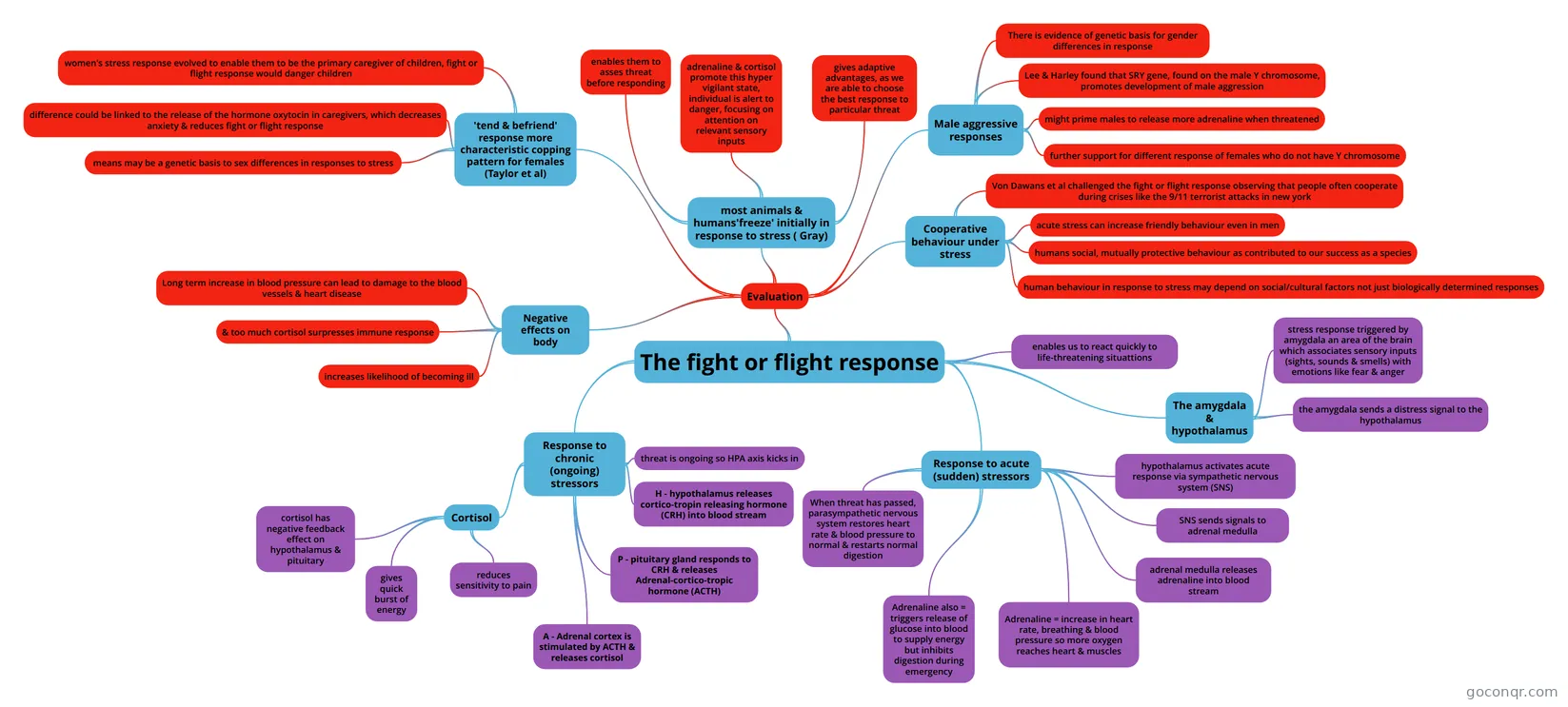
Mind map: The fight or flight response
Inhalt der Mindmap
The fight or flight response
enables us to react quickly to life-threatening situattions
The amygdala & hypothalamus
- stress response triggered by amygdala an area of the brain which associates sensory inputs (sights, sounds & smells) with emotions like fear & anger
- the amygdala sends a distress signal to the hypothalamus
Response to acute (sudden) stressors
- hypothalamus activates acute response via sympathetic nervous system (SNS)
- SNS sends signals to adrenal medulla
- adrenal medulla releases adrenaline into blood stream
- Adrenaline = increase in heart rate, breathing & blood pressure so more oxygen reaches heart & muscles
- Adrenaline also = triggers release of glucose into blood to supply energy but inhibits digestion during emergency
- When threat has passed, parasympathetic nervous system restores heart rate & blood pressure to normal & restarts normal digestion
Response to chronic (ongoing) stressors
- threat is ongoing so HPA axis kicks in
- H - hypothalamus releases cortico-tropin releasing hormone (CRH) into blood stream
- P - pituitary gland responds to CRH & releases Adrenal-cortico-tropic hormone (ACTH)
- A - Adrenal cortex is stimulated by ACTH & releases cortisol
- Cortisol
- reduces sensitivity to pain
- gives quick burst of energy
- cortisol has negative feedback effect on hypothalamus & pituitary
Evaluation
- Negative effects on body
- Long term increase in blood pressure can lead to damage to the blood vessels & heart disease
- & too much cortisol surpresses immune response
- increases likelihood of becoming ill
- 'tend & befriend' response more characteristic copping pattern for females (Taylor et al)
- women's stress response evolved to enable them to be the primary caregiver of children, fight or flight response would danger children
- difference could be linked to the release of the hormone oxytocin in caregivers, which decreases anxiety & reduces fight or flight response
- means may be a genetic basis to sex differences in responses to stress
- most animals & humans'freeze' initially in response to stress ( Gray)
- enables them to asses threat before responding
- adrenaline & cortisol promote this hyper vigilant state, individual is alert to danger, focusing on attention on relevant sensory inputs
- gives adaptive advantages, as we are able to choose the best response to particular threat
- Male aggressive responses
- There is evidence of genetic basis for gender differences in response
- Lee & Harley found that SRY gene, found on the male Y chromosome, promotes development of male aggression
- might prime males to release more adrenaline when threatened
- further support for different response of females who do not have Y chromosome
- Cooperative behaviour under stress
- Von Dawans et al challenged the fight or flight response observing that people often cooperate during crises like the 9/11 terrorist attacks in new york
- acute stress can increase friendly behaviour even in men
- humans social, mutually protective behaviour as contributed to our success as a species
- human behaviour in response to stress may depend on social/cultural factors not just biologically determined responses
- Negative effects on body
Informationen
- Beschreibung
- A level Psychology (Biopsychology) Mindmap am The fight or flight response, erstellt von Hannah Atkinson am 25/05/2017.
- Erstellt von
- Hannah Atkinson
- Aufrufe
- 1
- Bewertung