
Notizen
GLOSSARY
Inhalt der Notizen (1)
Seite 1
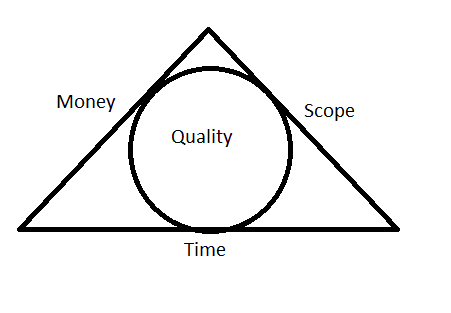
Project Management - A methodical, planned and ongoing process that guides all development task and resources throughout a projects development.
Team - Two or more people with complimentary skills, behaviours and personalitites who are committed to achieving a common goal.
System Analyst - A person who analyses systems, determines requirements and designs new information systems.
Requirements - Features, properties or behaviours a system must have to achieve its purpose. Each requirement must be verifiable.
Requirements Prototype - A working model of an information system, built in order to understand the requirements of the system.
Feasible - Capable of being achieved using the available resources and meeting the identified requirements.
User interface - Part of a software application that displays information of the user. The user interface provides the means by which users interact with software.
Acceptance Tests - Formal tests conducted to verify whether or not a system meets its requirements. Acceptance testing enables the client to determine whether or not to accept the new system.
Procedure - The series of steps required to complete a process successfully.
Evaluation - The process of examining a system to determine the extent to which it is meeting its requirements
Ergonomics - The study of the relationship between human workers and their work environment.
Information - is the meaning that a human
assigns to data. Knowledge is acquired when information is received.
Purpose - The aim or objective of the system
and the reason the system exists. The purpose fulfils the needs of those for
whom the system is created.
Environment - The circumstances and conditions
that surround an information system. Everything that influences or is
influenced by the system.
Participants - People who carry out or initiate
information processes within an information system. An integral part of the
system during information processing.
Information technology - The hardware and
software used by an information system to carry out its information process.
Information processes - What needs to be done
to transform the data into useful information. These actions coordinate and
direct the system's resources to achieve the system's purpose.
Flat-file database - A single table of data
stored as a single file. All rows (records) are composed of the same sequence
of fields (attributes).
Normalisation - The process of normalising the
design of the database to exclude redundant data. Progressively decomposing the
design into a sequence of normal forms.
Redundant data - Unnecessary duplicate data.
Reducing or preferably eliminating data redundancy is the aim of normalisation.
Hypertext - Bodies of text that are linked in a
non-sequential manner. Each block of text contains links to other blocks of
text.
Hypermedia - An extension of hypertext to
include non-sequential links with other media types, such as image, audio and
video.
Metadata - Data that defines or describes other
data.
Data independence - The separation of data and
its management from the software applications that process the data.
Back up - To copy files to a separate secondary
storage device as a precaution in case the first device fails or data is lost.
Encryption - The process of making data
unreadable by those who do not possess the decryption key.
Decryption - The process of decoding encrypted
data using a key. The opposite of encryption.
View (or User View) - The restricted portion of
a database made available to a user. Views select particular data but have no
affect on the underlying organisation of the database.
Search - To look through a collection of data
in order to locate required data.
Sort - To arrange a collection of items in some
specified order.
QBE (Query By Example) - A visual method for
specifying a query. Often search criteria are entered into fields within what
appears to be an empty record.
Centralised Database - A single database under
control of a single DBMS. All users and client applications connect directly to
the DBMS.
Distributed Database - A set of connected
databases stored on multiple computers that appears to users as a single
database.
Search Engine - A program that builds an index
of website content. Users can search the indexed content to locate relevant
website content.
Data Validation - A check, at the time of data
collection, to ensure the data is reasonable and meets certain criteria.
Data Integrity - A measure of how correct and
accurately data reflects its source. The quality of the data.
Data Verification - A check to ensure the data
collected and stored matches and continues to match the source of the data.
Data Mining - The process of discovering
non-obvious patterns within large collections of data.
MAC Address - Media Access Controller Address
hardwired into each device. A hardware address that uniquely identifies each
node on a network.
Protocol - A formal set of rules and procedures
that must be observed for two devices to transfer data efficiently and
successfully.
Handshaking - The process of negotiating and
establishing the rules of communication between two or more devices.
Bits per second (bps) - The number of bits
transferred each second. The speed of binary data transmission.
Baud (or baud rate) - The number of signal
events occurring each second along a communication channel. Equivalent to the
number of symbols per second.
Bandwidth - The difference between the highest
and lowest frequencies in a transmission channel. Hence bandwidth is expressed
in hertz (Hz), usually kilohertz (kHz) or megahertz (MHz).
Teleconference - A multi-location, multi-person
conference where audio, video and/or other data is communicated in real time to
all participants.
Virtual organisation - An organisation or
business whose members are geographically separated. They work together using
electronic communication to achieve common goals.
Client-server Architecture - Servers provide
specific processing services for clients. Clients request a service, and wait
for a response while the server processes the request.
Authentication - The process of determining if
someone, or something, is who they claim to be.
Physical Topology - The physical layout of
devices on a network and how the cables and wires connect these devices.
Logical Topology - How data is transmitted and
received between devices on a network regardless of their physical connections.
Modulation - The process of encoding digital
information onto an analog wave by changing its amplitude, frequency or phase.
Demodulation - The process of decoding a
modulated analog wave back into its original digital signal. The opposite of
modulation.
Fault Tolerance - The ability of a system to
continue operating despite the failure of one or more of its components.
Transaction - A unit of work composed of
multiple events that must all succeed or must all fail. Events perform actions
that create and/or modify data.
Data integrity - A measure of how correct and accurately data reflects its source. The quality of the data.
Data validation - A check, at the time of data collection, to ensure the data is reasonable and meets certain criteria.
Data verification - A check to ensure the data collected and stored matches and continues to match the sources of the data.
Back up - To copy files to a seperate secondary storage device as a precaution in case the first device fails or data is lost.
Bias - An inclination or preference towards an outcome. Bias unfairly influences the outcome.
Batch transaction processing - the collection
and storage of data for processing at a scheduled time or when there is
sufficient data.
Real time transaction data - the immediate
processing of data.
Multimedia systems - information systems that
include combinations of media, including text & numbers, audio, images
and/or animations, video and hyperlinks.
Cel-based animation - A sequence of cels (images) with small changes between each cel. When played the illusion of movement is created.
Path-based animation - A line (path) is drawn for each character to follow. When played each character moves along their line in front of the background.
Project management
Information systems and databases
Communication systems
Transaction Processing Systems
Multimedia
Informationen
- Beschreibung
- HSC IPT Notiz am GLOSSARY, erstellt von Skye Boulton am 25/09/2013.
- Erstellt von
- Skye Boulton · Sep 2013
- Aktualisiert
- 14 Aug 2016
- Aufrufe
- 896
- Tags
- Bewertung