
Notizen
Memory
Inhalt der Notizen (1)
Seite 1
MEMORY
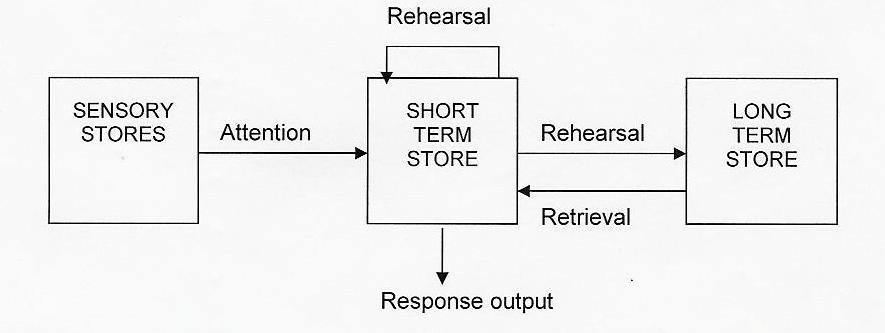
Jacobs and Miller- Evidence for the STM capacity. Lab experiment. Increasingly long digits. Told to recall in right order. Miller = STM capacity is 7+/- 2.
Peterson and Peterson- Pt's read trigrams of consonants (e.g. BHL). Had to count backwards in threes from a high number from 3-18 secs. This prevented rehearsal. 3 secs= 90% and 18secs= 6% Limited STM.
Bahrick- Evidence for duration of LTM. 400 pt's, ages from 17-74. First, free recall of classmates names. Then given photos and a list of names. They had to identify their ex-classmates. Left for 48 yrs= 80% name recall and 70% of faces. LTM can last a lifetime.
Clive Wearing- Case study. Supports MSM= Lost all STM and only has some LTM, supports the idea of separate stores. Goes against MSM= shows we have different types of LTM (emotional, episodic)
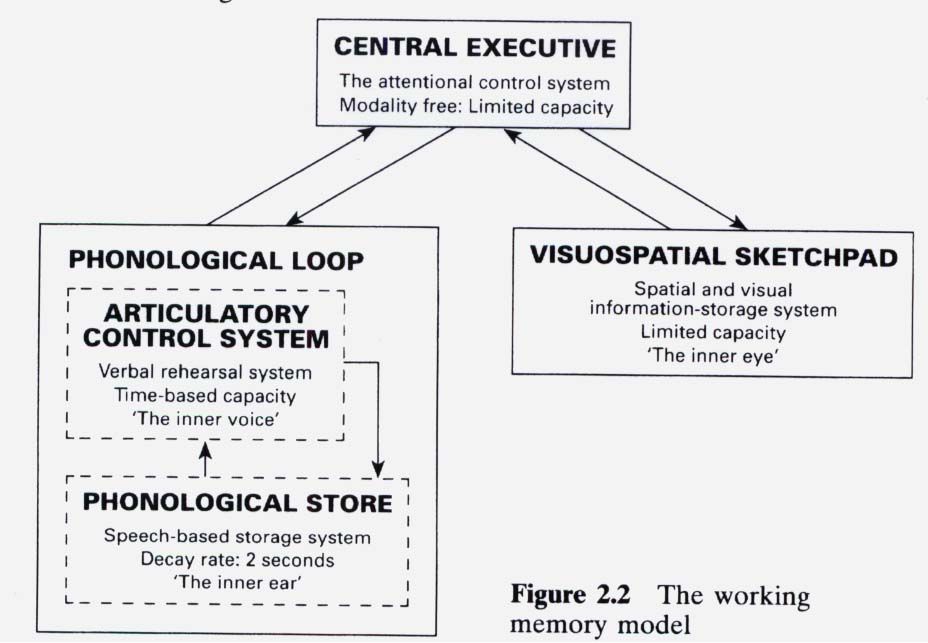
Gathercole & Baddeley- Pt's had to follow a spot of light with a pointer and describe the angles in a hollow letter F. But some had to do a verbal task. The group that had to describe the hollow letter F found it harder because they were doing 2 visual tasks.
Baddeley
Eyewitness Testimony
LEADING QUESTIONS
Loftus & Palmer- Lab experiment. 45 students shown a video of a car crash, then asked how fast the car was going in different conditions ( hit, smashed, collided). Hit av= 34mph and Smashed av= 41mph.
A week later she asked the students if they saw glass. Hit pt's= 14% said yes. Smashed pt's= 32% said yes.
Yuille and Cutshall- Real life witnesses of a robbery where someone died were asked leading questions but the witnesses stayed very accurate.
ANXIETY
Yuille and Cutshall- Natural experiment. Real life witnesses of a robbery had reliable testimony's and people closer to the incident were more accurate. Anxiety heightens recall.
Peters- Field experiment. Pt's go for an injection and see the nurse and researcher for the same amount of time. A week later they were shown random photos, told to identify them and they found it easier to identify the researcher. Anxiety lowers recall.
AGE
Cohen and Faulkner- Lab. Showed pt's a video of a kidnapping. Then presented them with misleading facts. Older pt's (mean age 70) were more mislead than younger ones (mean age 35).
Yarmey- Field. Stopped 651 adults in public places. Asked to recall characteristics of a women they spoke to two minutes earlier. Younger people were more confident than older people but there was no significant different in accuracy
R- reinstate (Ask about the environment, weather)
O- order (Start from the event and go backwards)
P- perspective (From someone else's view like someone closer)
E- everything (Recall events in detail)
THE COGNITIVE INTERVIEW
Geiselman- Compared the standard interview with cognitive interview. Recall improved by 34%.
Evaluation of C.I.
Time consuming- can't interrupt them
Gets more detail
More likely to get things incorrect
More detail than a standard interview
Memory
Informationen
- Beschreibung
- Psychology Notiz am Memory, erstellt von 97nat.brooks am 19/03/2014.
- Erstellt von
- 97nat.brooks · Mär 2014
- Aktualisiert
- 19 Feb 2016
- Aufrufe
- 52
- Tags
- Bewertung