
Research: Attachment
Folien in diesem Satz (9)
-
Infant Attachment (Schaffer & Emmerson)
- Aim: to identify order in which attachments form and how strong they are to each figure
- Method: a longitudinal study was completed in which 60 Glaswegian babies and mothers were studied monthly for the first year of their lives, and then at 18 months. observations were taken by the mothers and they were interviewed looking at who they responded to, smiled at, caused distress. attachment was measured by either separation anxiety or stranger anxiety
- Findings: - within 25 to 35 weeks showed separation anxiety to a specific person
- - the primary caregiver was usually more sensitive to the infants signals e.g. facial expressions
- - by 40 weeks almost 30% formed a second attachment usually after the specific attachment formed
- Evaluation: - good external validity due to being a naturalistic observation method
- - could be unreliable as it is from the parental observation
- - not generalisible as all families were of the same class
- - longitudinal research means data is more reliable as data is from the same participants throughout
-
- Aim: test the learning theory by comparing attachment in in baby monkeys given a wire surrogate with milk or a soft towelling mother without milk
- Method: monkeys were put into one of four conditions: cage with a wire mother with milk and towelling mother without milk, cage with a wire mother without milk and a towelling mother with milk, a wire mother with milk, or a towelling mother with milk. the amount of time with each mother and feeding time was recorded and the monkeys were then frightened by a loud noise.
- Findings: - baby monkeys preferred towelling monkey regardless of milk production, some even clung to the towelling monkey while feeding from the wire monkey
- - monkeys with wire surrogate had diarrhoea a sign of stress, and overall spent less time with this mother than the towelling mother.
- - after being scared the monkeys clung to the towelling mother where available
- Conclusion: monkeys have an innate need for comfort and security more so than food.contact comfort is associated with a willingness to explore and lower stress levels
- Evaluation: - involves animals so may not be generalisible
- - ethical issues of the level of stress caused to the monkeys
-
- Aim: to investigate mechanisms of imprinting in baby geese and how they form an attachment to the first large moving object they encounter
- Method: Lorenz split a clutch of gosling eggs between the mother to be raised naturally and the other half were hatched in an incubator with Lorenz as the first large moving object they encountered. Following behaviour was recorded. all the geese were marked to indicate which group they were from, and placed them under an upturned box. behaviour was recorded after the box was removed.
- Findings: - immediately after birth, natural geese followed the mother around, while the incubated geese followed Lorenz around
- - when released from the upturned box, natural goslings went directly to the mother while the incubated geese went to Lorenz
- - Imprinting only occurred within 4-25 hours of hatching
- - goslings which imprinted on humans later tried to mate with humans
- Conclusion: imprinting is a common form of attachment made with the first large moving object encountered upon hatching
- Evaluation: - imprinting is irreversible suggesting a biological basis
- - the fact imprinting only occurs in a brief time period supports Bowlby's idea of a critical period
- - the bird imprinting on humans later tried to mate with humans suggesting the effect of initial attachments on later relationships
- - behaviuor of geese is not necessarily generalizable to humans
-
Strange Situation (Ainsworth et al)
- Aim: to assess how infants between 9 and 18 months of age behave under mild stress in order to test separation anxiety and stranger anxiety
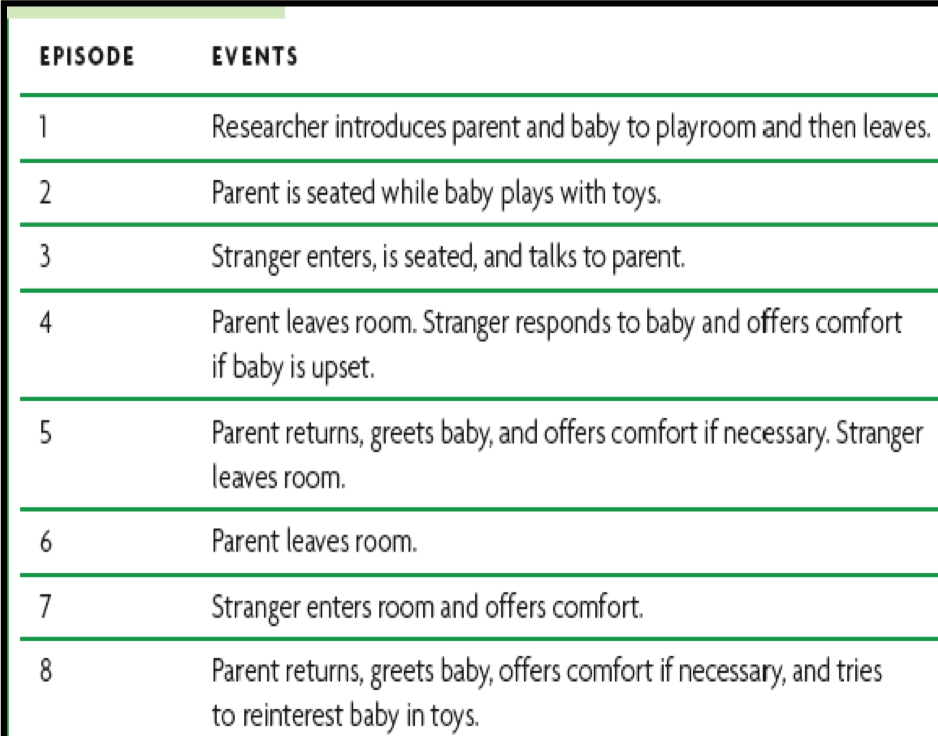
- Method: each of the episodes on the right were completed in a room for 3 minutes, with the exception of the first which was done for 30 seconds. every 15 seconds the behaviour of the infant was recorded and intensity was scored on a scale of 1 to 7.
- Findings: there were three main types of attachment; 70% were secure, 15% were insecure avodant and 15%were insecure resistant
- Conclusions: the type of attachment fomed by a chlid depends upon the responsiveness and sensitivity of the caregiver
-
Strange Situation (Ainsworth et al)
- Evaluation:
- - the findings by Ainsworth about sensitivity and responsiveness were backed up by similar findings from other studies using larger samples
- - the strange situation assumes the attachment type is constant, however it might change if the family situation changes e.g. stress levels
- - it is laboratory based so the child may not be acting in a way which is natural to their every day lives making the findings unreliable due to lacking ecological validity
- - it only looks at the behaviour of the infant, but the behaviour of the mother may also affect the results
- - may be seen as unethical as it deliberately causes the infant stress even though it can be justified as there is no more stress that that causes by being left with a baby sitter
- - the relationships are also dependent of who the primary attachment is with as it is not always with the mother, and Ainsworth only used the mothers in this situation meaning it may not be a completely valid conclusion
-
Cultural Variation in Attachment
- by Van Lizjendoom and Kroonenberg
- Aim: to find out if the strange situation shows similar patterns of attachment types in all cultures and countries
- Method: completed a meta analysis of 32 studies from 8 countries using over 2000 babies.
- Findings: - secure attachments were the most common in all countries
- - Germany had the highest number of insecure avoidant children
- - Japan had few insecure avoidant children but many insecure resistant children
- Evaluation: - some samples were too small to be reliable abut a country as a whole
- - they were ethical studies
- - the majority of studies used were done in individualistic cultures so they may not be truly representative
-
- Aim: to study the link between affectionless psychopathy and maternal deprivation
- Method: the used a sample of 44 teenage delinquents. the participants were interviewed for signs of affectionless psychopathy and their families were interviewed to establish if there was prolonged early separation from their mothers. a control group of 44 non-criminal teenagers with emotional problems were all assessed to see how often maternal deprivation occurred to the children who were not thieves.
- Results: 14 of the thieves were affectionless psychopaths and 17 of them had maternal deprivation at an early age. of theses 14, 12 had also had maternal deprivation. of the non-thieves, 2 had maternal deprivation, but non were affectionless psychopaths.
- Conclusion: prolonged separation from the mother contributed to affectionless psychopathy
- Evaluation: -the relationship established was correlational but may not have been causal
- - the study uses self reporting data which may not have been accurate
- - the study had researcher bias as Bowlby himself carried out the psychiatric assessments which may have unconsciously affected the results
-
- Aim: to assess weather care and nurturing would reverse the effects of privation in Romainan orphans
- Method: they looked at the effect on children who were adopted before 6 months, from 6 months to 2 years, and from above the age of 2. they tested the level of cognitive functioning in the children by doing IQ tests at the age of 4 and compared the results to British adoptees at the same ages.
- Findings: upon initial assessment, around 50% of the Romanian orphans were underweight and were retarded in cognitive functioning. by the age of 4, the Romanian orphans showed great improvement in cognitive functioning and those adopted before 6 months were doing as well as the British children
- Conclusion: the effect of institutionalisation can be overcome by sensitive nurturing care however the critical period fr adoption was found to be 6 months as after this age the children did not do as well as the same aged British children, and did not fully recover from the effect of their privation
- Evaluation: - children were only assessed to the age of 4 so would need more follow ups to fully assess their well-being
- - findings cant be generalised as not all of the children received clinical investigations
- - the children weren't assessed in the orphanages so there may be other factors involved in their recovery
-
Romantic Attachments, Hazan and Shaver
- Aim - to explore the possibility that attachment theory offers a perspective on adult romantic love and to create a framework for understanding love, loneliness and grief through life
- Method - placed a love quiz in a newspaper and asked for voluntary responses to the questions. they asked people questions to determine their attachment type to their parents, and were asked to describe themselves as well as having a series of questions to determine their opinions on romantic relationships.
- Findings - those described as securely attached described their most important relationship as happy ant trusting as well as believing in long lasing love and having confidence in themselves as being likable
- - insecure-avoidant people were found to be doubtful about the existence and durability of love
- - both insecure types were vulnerable to loneliness and insecure-resistant were the most vulnerable to loneliness
Informationen
- Beschreibung
- a-level Psychology Folienset am Research: Attachment, erstellt von Olivia McKenzie-Allen am 29/04/2018.
- Erstellt von
- Olivia McKenzie-Allen
- Aufrufe
- 0
- Bewertung