
Flashcards
Year 11 - Topic 5: Response and regulation

Cards in this deck (23)
- 1What are sense organs?Groups of receptor cells which respond to specific stimuli
- 2What types of stimuli cause a response by the nervous system?Light
Sound
Touch
Temperature
Chemicals - 3What does the central nervous system consist of?Brain and spinal cord
- 4What are the properties of a reflex action?Fast
Automatic
Some are protective - 5Describe a reflex response.1. Receptor cells in the skin detect a stimulus (the heat from the candle).
2. Sensory neurone sends impulses to relay neurone in the spinal cord.
3. The relay neurone connects to the motor neurone (and also sends a message to the brain).
4. Motor neurone sends impulses to effector.
5. Effector produces a response (muscle contracts to move hand away). - 6What is homeostasis?Maintaining a stable internal environment
- 7Why is homeostasis important?Metabolism operates only within a narrow
range of temperature and pH and requires
appropriate nutrients and water.
(Remember what happens to enzymes when they get too hot) - 8What are hormones?Chemical messengers carried by the blood
- 9What does the body do to return blood levels to normal if they are too high?
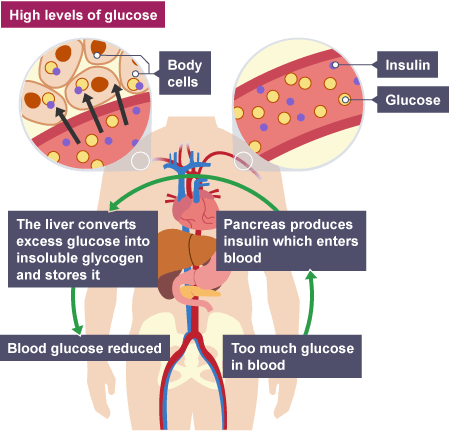
- 10What does the body do to return blood levels to normal if they are too low?
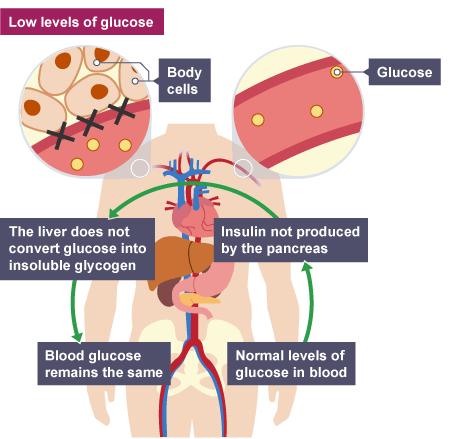
- 11What is diabetes?A common disease in which a person has a high blood glucose level
- 12How is type 1 diabetes caused?The body not producing insulin
- 13How is type 2 diabetes caused?The body cells not properly responding to the insulin that is produced
- 14How is diabetes diagnosed?Test urine for glucose
Test blood for higher than normal glucose levels - 15How is diabetes treated?1. Regular injections of insulin into the body.
2. Controlling the carbohydrate and fat content of a diet.
3. Possible transplant of pancreatic tissue. - 16Why is there a link between being overweight and having type 2 diabetes?Too much carbohydrate and fat in the diet and lack of exercise
- 17—1 - Hair
2 - Sweat pore
3 - Sweat duct
4 - Sweat gland
5 - Blood capillaries
6 - Erector muscle
- 18What does your body do if you get too hot?1. The diameter of the blood vessels in the skin increases (get wider); more blood flows through them; more heat is lost from the skin surface.
2. Hair erector muscle relax; hair lies flat; less air is trapped next to the skin
so more heat is lost.
3. Sweat is released from the sweat
pores; body heat is used to evaporate
the sweat. - 19What does your body do if you get too cold?1. The diameter of blood vessels in the
skin decrease (they become narrow);
less blood flows through them; less
heat is lost from the skin surface.
2. Hair erector muscles contract; hair stands up; layer of warm air trapped next to the skin helps insulate heat in
the body.
3. Heat is released as muscles in the
body contract causing shivering. - 20What is negative feedback?Any change from the balance in optimal internal conditions results in the body's
hormonal and nervous system compensating for the change and restoring the balance.
For example, blood glucose levels, thermoregulation - 21What are the short term effects of alcohol?Slows down reactions as it is a depressant
- 22What are the long term effects of alcohol?Can become addicted or dependent on alcohol
Physical damage: liver disease, circulatory, heart diseases - 23How can you test reaction time?Do a ruler drop test (specified practical)
Information
- Description
- GCSE Biology Flashcards on Year 11 - Topic 5: Response and regulation, created by Mrs Z Rourke on 26/03/2018.
- Created by
- Mrs Z Rourke · Mar 2018
- Updated
- Apr 19, 2018
- Views
- 351
- Rating