
Quiz
Forensics Final MCQs- 5th Year PMU
Questions in this quiz (130)
1Forensic medicine is a branch of medicine that
- Aapplies the principles and knowledge of the medical sciences to problems in the field of surgery
- Bapplies the principles and knowledge of the medical sciences to problems in the field of law
- Capplies the principles and knowledge of the medical sciences to problems in the field of microbiology
2The Forensic Pathologist can determine
- Acause of death, mechanism of death and manner of death
- Bcause of death and manner of death
- Cmechanism of death and manner of death
3If the mechanism of death is asphyxia, the cause of death is
- Astabbing
- Bstrangulation
- Cgunshot
4The manner of death by gunshot could be
- Aaccidental or homicidal
- Bhomicidal or suicidal
- Caccidental, homicidal or suicidal
5In which of the following cases forensic autopsy is applicable
- Aviolent deaths
- Ball kinds of death
- Cdeath in hospital
6Which are the components of the forensic autopsy
- Acrime scene investigation, autopsy and laboratory
- Blaboratory and crime scene investigation
- Cautopsy and laboratory
7An autopsy includes
- Ainternal examination
- Bboth internal and external examination
- Cexternal examination
8Types of violent deaths are
- Aaccidents, suicides and homicides
- Baccidents and homicides
- Csuicides and homicides
9When the mechanism of death is loss of blood, the cause of death is
- Astrangulation
- Bstabbing
- Changing
10Asphyxia refers to a state in which the body becomes deprived of
- Acarbon dioxide while in excess of oxygen
- Boxygen while in excess of carbon dioxide
- Coxygen and carbon dioxide
- Dglucose in the blood
11The categories of asphyxial death are
- Aneck compression and chest compression
- Bneck compression, chest compression, positional asphyxia, airway obstruction and exhaustion or displacement of environmental oxygen
- Cneck compression
- Dchest compression
12The mechanisms of death by neck compression are
- Acompression of the jugular veins and of the carotid arteries, airway obstruction and cardiac arrhythmia
- Binjuries to the larynx
- Cintramuscular bleeding
- Dintimal carotid artery laceration
13Internal appearance of strangulation is
- Afacial edema
- Bcongestion and cyanosis of the face
- Cintramuscular bleeding
- Dpetechial hemorrhages in the skin
14The time interval of compression on the neck to loss of consciousness is approximately
- A20 sec if one of the carotid arteries is compressed and a minute if only the jugulars are compressed
- B10 sec if both carotid arteries are compressed and two minutes if only the jugulars are compressed
- C10 sec if both carotid arteries are compressed and a minute if only the jugulars are not compressed
- D10 sec if both carotid arteries are compressed and a minute if only the jugulars are compressed
15Where a constricting band is tightened around the neck, there is usually gross congestion, cyanosis and petechiae in the face if the pressure is maintained for more than about
- A20 seconds
- B10 seconds
- C5 seconds
- D15 seconds
16The categories of strangulation are
- Amanual strangulation and ligature
- Bmanual strangulation, ligature and hanging
- Cligature and hanging
- Dmanual strangulation and hanging
17Cardiac arrhythmia is a mechanism whereby pressure over the carotid artery at the carotid sinus provokes
- Apetechial haemorrhages
- Bhypocapnea
- Cbradycardia
- Dtachycardia
18The mark most often tends to encircle the neck horizontally and at a lower level in cases of
- Ahanging
- Bstrangulation by ligature
- Cmanual strangulation
- Dpositional asphyxia
19The fingernail marks indicate
- Ahanging
- Bstrangulation by ligature
- Cmanual strangulation
- Dpositional asphyxia
20This scheme shows
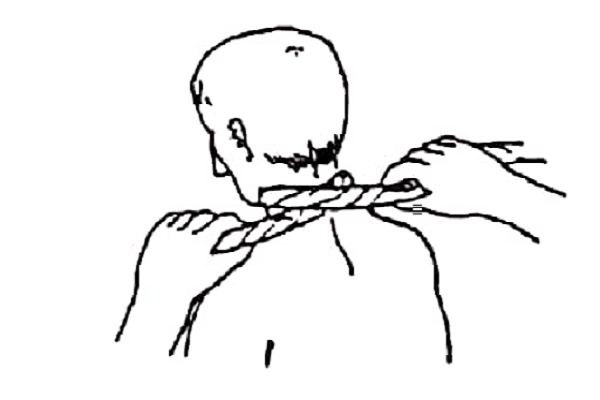
- Ahanging
- Bstrangulation by ligature
- Cmanual strangulation
- Dpositional asphyxia
21Hanging which involves free swinging results in an almost instantaneous death due to
- Apressure on the laryngeal prominence
- Bsudden pressure on the neck arteries
- Cdecreased pressure on the neck arteries
- Dincreased pressure on the laryngo-pharynx
22A wound is a ................. produced by external mechanical force
- Aleakage of blood from ruptured small vessels into the surrounding tissues
- Bdisruption of the continuity of tissues
- Cportion of the body surface, which has been moved by rubbing
23A blunt force injury is any bodily damage resulting from
- Aforceful contact between the body and a blunt object
- Bforceful contact between the body and a sharp object
- Cforceful contact between the body and chemicals
24The only mechanism of blunt force trauma (BFT) is
- Aa moving object stinking the body
- Ba moving body striking a fixed object or surface
- Ca moving object striking the body or a moving body striking a fixed object or surface
25These three blunt force injuries - abrasions, bruises and lacerations
- Amay occur singly or together in any combination
- Boccur singly
- Coccur only together
26Bruises occur when the elastic limit, the tolerance of subcutaneous blood vessels is exceeded
- Aso that they tear and bleed
- Bso that they become congested
- Cso that they shrink and remain intact
27The bruise is
- Aa leakage of blood from ruptured small vessels into the surrounding tissues
- Bthe settling of blood into the lowermost blood vessels under gravity after the circulation ceases
- Cinjuries involving superficial layers of the skin the epidermis or mucus membrane
28Tramline bruising is due to impact with
- Aan object with multiwall angles
- Ba spherical object
- Ca rod shaped weapon or stick
29The bruises usually disappear after
- A14-15 days
- B3-5 days
- C3-4 days
30The colour of a bruise depends on the colour of
- Athe skin
- Bpigments released by degeneration of red blood cells
- Cthe impacting object
31One of the differences between the lividity and the bruise is
- Athat the bruise appears over the site of injury and lividity appears depending on the part of the body
- Bthat lividity appears over the site of injury and the bruise appears depending on the part of the body
- Cthat the bruise appears opposite the site of injury and lividity appears depending on the part of the body
32An abrasion is an area of crushing, loss of skin or mucous membrane due to
- Acontact with chemicals
- Bcontact with radiation
- Cimpact against some hard, blunt and rough object
33Abrasions bleed only slightly, heal quickly and
- Aleave a scar
- Bleave no scar
- Csometimes leave a scar
34Tangential impact between an object and the skin causes a typical graze in which the superficial skin layers are most often
- Ascraped off and piled up as skin tags at the far end of the injury
- Bscraped off and piled up as skin tags at the near end of the injury
- Cscraped off and piled up as skin tags at both ends of the injury
35A scratch is a linear abrasion produced by drawing a sharp point
- Aonly over the surface of mucous membrane
- Bonly over the surface of the skin
- Cthe surface of the skin or mucous membrane
36The tissue bridges are found in
- Aabrasions
- Bbruisies
- Cdepth of lacerated wounds
37Early post-mortem change is
- Abody cooling
- Bputrefaction
- Cmummification
38Early post-mortem change is
- Aputrefaction
- Brigor mortis
- Cmummification
39Early post-mortem change is
- Alivor mortis
- Bputrefaction
- Cmummification
40Late post-mortem change is
- Alivor mortis
- Brigor mortis
- Cmummification
41Late post-mortem change is
- Aputrefaction
- Brigor mortis
- Cbody cooling
42Late post-mortem change is
- Alivor mortis
- Bbody cooling
- Cadipocere
43The "Spot of the Larche” is
- Adark discoloration of a portion of sclera exposed to air
- Bhemorrhage associated with strangulation
- Cbruise ,"black eye”
44Algor mortis is
- Astiffening of the muscles after death
- Bcooling of the body after death
- Csettling of blood into the lowermost blood vessels under gravity after death
45Rigor mortis is
- Astiffening of the muscles after death
- Bcooling of the body after death
- Csettling of blood into the lowermost blood vessels under gravity after death
46Livor mortis is
- Astiffening of the muscles after death
- Bcooling of the body after death
- Csettling of blood into the lowermost blood vessels under gravity after death
47Putrefaction is
- Adue to hydrogenation and hydrolysis of body fat
- Bdue to dehydration and desiccation of the tissues and the organs
- Cpost-mortem destruction of the soft tissues of the body by the action of bacteria (bacterial action) and endogenous enzymes (autolysis)
48Adipocere is
- Adue to hydrogenation and hydrolysis of body fat
- Bdue to dehydration and desiccation of the tissues and the organs
- Cpost-mortem destruction of the soft tissues of the body by the action of bacteria (bacterial action) and endogenous enzymes (autolysis)
49Mummification is
- Adue to hydrogenation and hydrolysis of body fat
- Bdue to dehydration and desiccation of the tissues and the organs
- Cpost-mortem destruction of the soft tissues of the body by the action of bacteria (bacterial action) and endogenous enzymes (autolysis)
50Firearm injuries occur when
- Asomeone is hit with the handle of a pistol
- Bsomeone is shot by a bullet or other sort of projectile from a firearm
- Csomeone is hit with the handle of a rifle
51The kinetic energy of a bullet is proportional to mass and
- Avelocity
- Bdeformation of projectiles
- Cfragmentation of projectiles
52The projectiles may be classified according to their speed as
- Alow velocity (<300 m/second) or high velocity (>300 m/second)
- Blow velocity (<400 m/second) or high velocity (>400 m/second)
- Clow velocity (<500 m/second) or high velocity (>500 m/second)
53The classification of firearms
- Aa rifled firearm and a smooth bore firearm
- Ba rifled firearm, smooth bore firearm, air or gas operated firearm and country made firearm
- Cair or gas operated firearm and country made firearm
54The function of the case of the cartridge is
- Ait expands and seals chamber against rearward escape of gases
- Bit explodes on compression igniting the propellant
- Cit burns to produce large volumes of gases under pressure
55The function of the primer of the cartridge is
- Ait expands and seals chamber against rearward escape of gases
- Bit explodes on compression igniting the powder
- Cit burns to produce large volumes of gases under pressure
56The function of the gun powder of the cartridge is
- Ait expands and seals chamber against rearward escape of gases
- Bit explodes on compression igniting the powder
- Cit burns to produce large volumes of gases under pressure
57The function of the bullet or pellets of the cartridge is
- Ait expands and seals chamber against rearward escape of gases
- Bit explodes on compression igniting the powder
- Cit is the part which exits the muzzle
58The wound ballistics is
- Athe study of projectile penetration of solids
- Bthe study of projectiles in the air
- Cthe study of projectile penetration of tissues
59The wounding potential depends on
- Athe weight of projectile only
- Bthe velocity of projectiles
- Cthe projectile’s deformation only
60An entry wound is
- Aa wound produced by a projectile as it enters the body
- Ba wound produced by a projectile as it exits the body
- Ca path traversed by the projectile in the body
61An exit wound is
- Aa wound produced by a projectile as it enters the body
- Ba wound produced by a projectile as it exits the body
- Ca path traversed by the projectile in the body
62The track is
- Aa wound produced by a projectile as it enters the body
- Ba wound produced by a projectile as it exits the body
- Ca path traversed by the projectile in the body
63Projectiles disrupt tissues by the following principal mechanisms:
- Apermanent cavity formation and projectile deformation
- Btemporary cavity formation and projectile fragmentation
- Cpermanent cavity formation and temporary cavity formation
64Secondary wounding mechanisms may include
- Abullet
- Bdischarge gases
- Cpellet
65Secondary wounding mechanisms may include
- Abullet
- Bflame
- Cpellet
66Secondary wounding mechanisms may include
- Abullet
- Bsmoke
- Cpellet
67Secondary wounding mechanisms may include
- Abullet
- Bgun powder particles
- Cpellet
68Secondary wounding mechanisms may include:
- Abullet
- Bsecondary projectiles such as shattered bone fragments
- Cpellet
69Skin surface characteristic of gunshot (bullet) wound is
- Askin defect
- Bexit wound
- Centry wound
70Skin surface characteristic of gunshot (bullet) wounds is
- Aabraded margin
- Bexit wound
- Centry wound
71Skin surface characteristic of gunshot (bullet) wounds is
- Agrey ring
- Bexit wound
- Centry wound
72Skin surface characteristic of gunshot (bullet) wounds is
- Asmudging
- Bexit wound
- Centry wound
73Skin surface characteristic of gunshot (bullet) wounds is
- ASingeing
- BExit wound
- CEntry wound
74Skin surface characteristic of gunshot (bullet) wounds is
- Atattooing
- Bexit wound
- Centry wound
75Skin surface characteristic of gunshot (bullet) wounds is
- Amuzzle impression
- Bexit wound
- Centry wound
76Contact range of fire of bullet wound is when
- Athe range is within the distance travelled by flame
- Bmuzzle is in contact with body
- Cthe range is within the distance travelled by unburnt or burnt gun powder burns
77Close range of fire of bullet wound is when
- Athe range is within the distance travelled by flame
- Bmuzzle is in contact with body
- Cthe range is within the distance travelled by unburnt or burnt gun powder burns
78Near range of fire of bullet wound is when
- Athe range is within the distance travelled by flame
- Bmuzzle is in contact with body
- Cthe range is within the distance travelled by unburnt or burnt gun powder burns
79Distant range of fire of bullet wound is when
- Athe range is within the distance travelled by flame
- Bmuzzle is in contact with body
- Cthe range is beyond the range of flame, smoke and gun powder burns
80Choose ONE INCORRECT answer
The following terms are often used as synonyms of mechanical asphyxia- Asuffocation
- Bthrottling
- Csmothering
- Dpassing out
- Echoking
81Choose ONE INCORRECT answer
The categories of asphyxial death are- Aneck compression
- Bchest compression
- Crupture of capillaries
- Dairway obstruction
- Eexhaustion or displacement of environmental oxygen
82Choose ONE INCORRECT answer
The classical signs of asphyxia are- Atraumatic skin injury
- Bcongestion of the face
- Cfacial oedema
- Dcyanosis
- Epetechial haemorrhages in the skin and eyes etc
83The scheme shows types of hanging /typical and atypical / on the basis of position of body.
Which type is INCORRECT?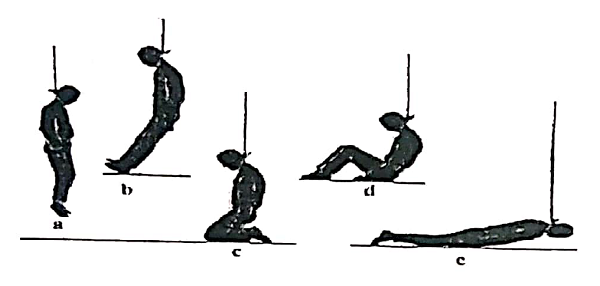
- Aposition A is an atypical hanging
- Bposition A is a typical hanging
- Cposition C is an atypical hanging
- Dposition D is an atypical hanging
- Epositions E and B are atypical hangings
84This scheme shows types of hanging /typical and atypical / on the basis of position of knot.
Which type is incorrect: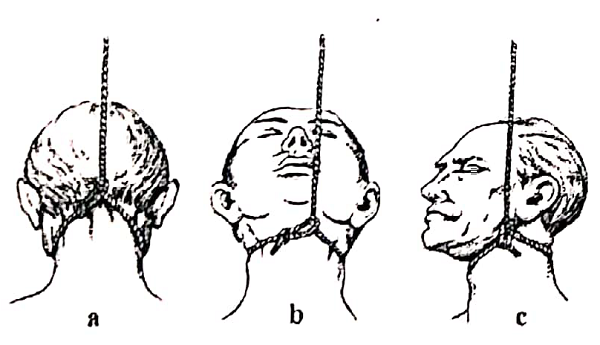
- Aposition A is an atypical hanging
- Bposition A is a typical hanging
- Cposition C is an atypical hanging
- Dposition B is an atypical hanging
85Choose one INCORRECT answer
The feature of sexual asphyxia is- Athis hypoxia is achieved by constriction of the neck by ligature which can be voluntary tightened and loosened
- Bthe most common feature is a ligature connected to some compression device of the
- Chands and feet which releases the ligature upon relaxing the legs and hands
- Dmalfunctions in this release lead to accidental ligature death
- Ethe mechanical fixation of the chest
- Fthe basic mechanism is the production of cerebral hypoxia
86Choose one INCORRECT answer
The feature of traumatic asphyxia is- Athe presence of the ligature mark
- Beyes and sclera are engorged with blood to a point of obliterating the whites of the eyes
- Csigns include face and neck grossly discoloured
- Dit shows the most evident signs of classical asphyxia
- Ethe mechanical fixation of the chest
87Choose one INCORRECT answer
The mechanism of Blunt force trauma (BFT) is- Aa moving object striking the body
- Ba moving body striking a fixed object or surface
- Ca flow of current which may cause localised burn if resistance is high
88Choose one INCORRECT answer
The mechanical force may cause- Aheat or cold
- Bimpact
- Ctraction
89Choose one INCORRECT answer
The causes of a bruise - “black eye” are- Afractured jaw
- Bfist blow to orbit or nose
- Ctracking from forehead bruise or fractured skull basis
90Choose one INCORRECT answer
Tramline bruising is due to impact with- Aa stick
- Ba truncheon
- Ca fist
91The main medicolegal considerations of a bruise are
- Anature of agent used
- Bindicate some peculiar offence
- Cdirection of impact
92Choose one INCORRECT answer
Abrasions have the following characteristics- Aheal without scarring
- Bleave a scar
- Cheal by scabbing
93Choose one INCORRECT answer
Lacerated wounds have the following characteristics- Ahave ragged edges
- Bheal by scabbing
- Chave tissue bridges in depth of wound
94Choose one INCORRECT answer
The lacerated wound is due to impact with- Aa stick
- Ba truncheon
- Ca knife
95Choose one INCORRECT answer
Early post-mortem change is- Abody cooling
- Bputrefaction
- Crigor mortis
96Choose one INCORRECT answer
Early post-mortem change is- Abody cooling
- Bmummification
- Crigor mortis
97Choose one INCORRECT answer
Early post-mortem change is- Abody cooling
- Badipocere
- Crigor mortis
98Choose one INCORRECT answer
Late post-mortem change is- Alivor mortis
- Bputrefaction
- Cmummification
99Choose one INCORRECT answer
Late post-mortem change is- Amummification
- Brigor mortis
- Cputrefaction
100Choose one INCORRECT answer
Late post-mortem change is- Aputrefaction
- Bbody cooling
- Cadipocere
101Choose one INCORRECT answer
The "Spot of the Larche” is- Aa dark discoloration of a portion of sclera exposed to air
- Ba hemorrhage associated with strangulation
- Cdue to drying
102Choose one INCORRECT answer
The dead body loses its heat by- Aconduction
- Bbleeding
- Cconvection
103Choose one INCORRECT answer
Cooling of the body after death is- Aan early post-mortem change
- Bdue to chemical changes in the myoplasm
- Cdue to the transmission of the heat from warmer body to the cooler environment
104Choose one INCORRECT answer
Rigor mortis is- Aa late post-mortem change
- Bdue to chemical changes in the myoplasm
- Cthe stiffening of the muscles
105Choose one INCORRECT answer
Livor mortis is- Aan early post-mortem change
- Bdue to chemical changes in the myoplasm
- Cdue to the settling of blood into the lowermost blood vessels under gravity after the circulation ceases
106Choose one INCORRECT answer
Livor mortis- Amay not develop at all if the body is tossed and turned continuously as seen in fast flowing waters of rivers or the sea
- Bis a late post-mortem change
- Cdisperses with the onset of putrefaction
107Choose one INCORRECT answer
Putrefaction- Ais the post-mortem destruction of the soft tissues of the body by the action of bacteria (bacterial action) and endogenous enzymes (autolysis)
- Bis a late post-mortem change
- Cis due to hydrogenation and hydrolysis of body fat
108Choose one INCORRECT answer
Adipocere- Ais the post-mortem destruction of the soft tissues of the body by the action of bacteria (bacterial action) and endogenous enzymes (autolysis)
- Bis a late post-mortem change
- Cis due to hydrogenation and hydrolysis of body fat
109Choose one INCORRECT answer
Mummification- Ahelps in identification, as the general facial features are preserved
- Busually requires 3 to 6 months
- Cis due to hydrogenation and hydrolysis of body fat
110Choose one INCORRECT answer
Mummification- Ahelps in recognizing the presence of wounds
- Bis an early post-mortem change
- Cis due to dehydration and desiccation of the tissues and the organs
111Choose one INCORRECT answer
The time since death may be determined by- Adegree and distribution of the post-mortem changes
- Bbladder content and gastric emptying time
- Chealing of the damages
112Choose one INCORRECT answer
An incised wound is- Aa clean division of the full thickness of skin (or other tissue) under the pressure of a sharp-edged instrument
- Blonger than it is deep due to swipe action
- Cthe injury involving superficial layers of the skin the epidermis or mucus membrane, due to impact against some hard, blunt, & rough object
113Choose one INCORRECT answer
The sharp-edged weapon causes cutting or stabbing and may cause- Aincised wounds
- Bstab wounds
- Clacerated wounds
114Choose one INCORRECT answer
The characters of incised wounds are- Apresence of tissue bridges in depth of wound
- Bclean cut, well-defined margins
- Cbleed more
115Choose one INCORRECT answer
The forensic aspects of an incised wounds are- Aincised wounds reflect sharp edge, not weapon type
- Bincised wounds may only be assault
- Cincised wounds may cause profuse external haemorrhage and air embolism
116Choose one INCORRECT answer
Defence wounds result from- Athe immediate and instinctive reaction of the victims to save themselves by raising the arm to prevent the attack
- Btesting of the weapon by attacker
- Cthe immediate and instinctive reaction of the victims to save themselves by grasping the weapon
117Choose one INCORRECT answer
Hesitation wounds- Aare often on fingers, hands, forearms of victim acquired in attempt to ward off blows or to grab weapon
- Bare shallow
- Care made before deeper fatal wounds in a suicide, often parallel or close to fatal wounds
118Choose one INCORRECT answer
A chop object is- Arazor
- Baxe
- Cadze
119Choose one INCORRECT answers
Penetrating injuries may be caused by- Athrusting of sharp and flat instrument
- Bthrusting of sharp and thin instrument
- Cchopping motion made with a fairly sharp & relatively heavy weapon
120Choose one INCORRECT answer
Adequate description of the stab wound may provide vital information about the- Atype of dressing of the victim
- Btype of weapon
- Cmovement of knife in wound
121Choose one INCORRECT answer
Stab wound length is shorter than blade width as a result of- A"rocking" of knife on withdrawal
- Bstretching of skin over point on insertion and subsequent recoil on withdrawal
- Ctapered blade not fully inserted
122Choose one INCORRECT answer
Stab wound length is greater than blade width as a result of- A"rocking" of knife on withdrawal
- Bblade does not pass straight in and out - entry and withdrawal at angle
- Ctapered blade not fully inserted
123Choose one INCORRECT answer
Shape of stab wound may indicate- Amovement of knife blade
- Bcross-sectional shape of knife blade
- Clongitudinal-sectional shape of knife blade
124Choose one INCORRECT answer
The characteristics of a contact entry wound are the following- Ait is generally large and cruciate (stellate or star-shaped) due to explosive effects of the gases liberated
- Bthe imprint of the muzzle of the weapon may be found stamped on the skin
- Ctattooing is plentiful
125Choose one INCORRECT answer
Close entry wound characteristics are following- Athe wound appears as a circular hole surrounded by singeing and smudging
- Bthe imprint of the muzzle of the weapon may be found stamped on the skin
- Cabrasion collar, grey ring and tattooing may be present
126Choose one INCORRECT answer
Near entry wound characteristics are following- Asingeing of hair is absent
- Bthe imprint of the muzzle of the weapon may be found stamped on the skin
- Cabrasion collar, grey ring and tattooing are present
127Choose one INCORRECT answer
The characteristics of a distant entry wound are the following- Askin defect typically with abraded margin
- Bthe imprint of the muzzle of the weapon may be found stamped on the skin
- Cskin defect typically with grey ring
128Choose one INCORRECT answer
The differences between entry and exit wounds are the following- Aedges of the entry wound are inverted, unlike exit wounds
- Btissues of the exit wound are often saturated with carbon monoxide and therefore cherry red in colour unlike entry wounds
- Cabrasion collar, grey ring and tattooing of the entry wound may be present unlike exit wounds
129Choose one INCORRECT answer
The medicolegal aspects of firearm injuries are- Akind of firearm used
- Bcompany producer of the weapon
- Cdirection of fire
130Choose one INCORRECT answer
The medicolegal aspects of firearm injuries are- Arange of firing
- Bcompany producer of the weapon
- Ccause of death
Information
- Description
- Forensics Final MCQs- 5th Year PMU
- Author
- Med Student
- Language
- English
- Views
- 1,881
- Tags
- Rating
- No ratings yet Rate this quiz