
Quiz
Biopsychology - the Nervous System
This quiz has question types that open in the usual player.
Questions in this quiz (22)
1What is the Nervous System?
- AA network of glands that produce hormones
- BA specialised network of cells
2The functions of the Nervous system are: to [blank_start]co-ordinate[blank_end] the working of [blank_start]cells[blank_end] and [blank_start]organs[blank_end], to collect, process and [blank_start]respond[blank_end] to information in the [blank_start]environment[blank_end]. Consists of [blank_start]Central[blank_end] Nervous System and the [blank_start]Peripheral[blank_end] Nervous System
- Aco-ordinate
- Bcells
- Corgans
- Drespond
- Eenvironment
- FCentral
- GPeripheral
3The Central Nervous System consists of the [blank_start]brain[blank_end] the [blank_start]spinal[blank_end] [blank_start]cord[blank_end]. The brain provides us with [blank_start]conscious awareness[blank_end]. It is divided into [blank_start]2[blank_end] hemispheres. It's [blank_start]outer[blank_end] layer is highly [blank_start]developed[blank_end]- called the [blank_start]cerebral cortex[blank_end]
- Abrain
- Bspinal
- Ccord
- Dconscious awareness
- E2
- Fouter
- Gdeveloped
- Hcerebral cortex
4The spinal cord is responsible for [blank_start]reflex[blank_end] [blank_start]actions[blank_end] (e.g. Pulling hand away from hot surface). Transfers messages to and from the [blank_start]brain[blank_end] and the [blank_start]rest of the body[blank_end].
- Areflex
- Brest of the body
- Cactions
- Dbrain
5The Peripheral Nervous System transmits messages to and from the [blank_start]Central[blank_end] Nervous System via [blank_start]neurons[blank_end]. Consists of 2 systems -[blank_start]somatic[blank_end] Nervous System and the [blank_start]autonomic[blank_end] Nervous System. The first of these controls muscle [blank_start]movement[blank_end] via [blank_start]motor[blank_end] [blank_start]pathways[blank_end] and sensory [blank_start]reactions[blank_end] via sensory [blank_start]receptors[blank_end].
- ACentral
- Bneurons
- Csomatic
- Dautonomic
- Emovement
- Freceptors
- Greactions
- Hpathways
- Imotor
6The Autonomic Nervous System is involved in [blank_start]homeostasis[blank_end]. It is divided into 2 subsystems- the [blank_start]sympathetic[blank_end] NS and the [blank_start]para[blank_end]sympathetic NS. The fight or flight response happens when a [blank_start]stressor[blank_end] is detected, the [blank_start]hypothalamus[blank_end] triggers [blank_start]activity[blank_end] in the [blank_start]sympathetic[blank_end] branch of the ANS.
- Ahomeostasis
- Bsympathetic
- Cpara
- Dstressor
- Ehypothalamus
- Factivity
- Gsympathetic
7The Sympathetic Nervous System prepares the body to [blank_start]expend[blank_end] energy for fight or flight. By increasing [blank_start]heart[blank_end] [blank_start]rate[blank_end], slowing [blank_start]digestion[blank_end] and [blank_start]inhibiting[blank_end] [blank_start]saliva[blank_end] production. The Parasympathetic Nervous System is the [blank_start]resting[blank_end] state, it [blank_start]conserves[blank_end] energy. It has [blank_start]opposite[blank_end] actions to the Sympathetic NS as these systems are [blank_start]antagonistic[blank_end]. E.g. It reduces heart rate, increases digestion in the [blank_start]gut[blank_end], and [blank_start]stimulates[blank_end] saliva production in the [blank_start]salivary[blank_end] [blank_start]glands. [blank_end]
- Aexpend
- Bheart
- Crate
- Ddigestion
- Einhibiting
- Fsaliva
- Gresting
- Hconserves
- Iopposite
- Jantagonistic
- Kgut
- Lstimulates
- Msalivary
- Nglands
8The Endocrine is made up of a [blank_start]network[blank_end] of [blank_start]glands[blank_end] that produce [blank_start]hormones[blank_end]. It's function is to [blank_start]secrete[blank_end] these hormones in order to [blank_start]regulate[blank_end] body functions - e.g. [blank_start]Metabolism[blank_end], [blank_start]promotes[blank_end] growth. Hormones are passed through the body through [blank_start]blood vessels[blank_end] that [blank_start]stimulate[blank_end] the [blank_start]corresponding[blank_end] receptor [blank_start]sites[blank_end]. The Endocrine system works alongside the [blank_start]Nervous[blank_end] System to control [blank_start]important[blank_end] body functions.
- Anetwork
- Bsecrete
- Cregulate
- DMetabolism
- Epromotes
- Fglands
- Ghormones
- Hblood vessels
- Istimulate
- Jcorresponding
- Ksites
- LNervous
- Mimportant
9Label this diagram of the Endocrine system
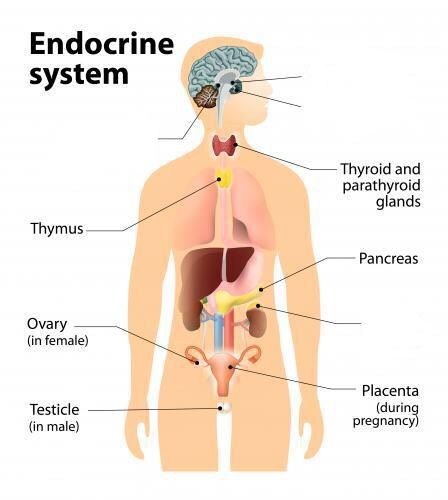
- AHypothalamus
- BPituitary Gland
- Cpineal gland
- Dadrenal gland
10The Pituitary gland is the '[blank_start]master gland[blank_end]' as it [blank_start]controls[blank_end] other glands, [blank_start]stimulating[blank_end] them to release [blank_start]hormones[blank_end]. For example, it produces a hormone called [blank_start]oxytocin[blank_end]- this induces [blank_start]contractions[blank_end] in [blank_start]labour[blank_end], so can be used to [blank_start]artificially[blank_end] [blank_start]induce[blank_end] labour. It is controlled by the [blank_start]hypothalamus. [blank_end]
- Amaster gland
- Bcontrols
- Cstimulating
- Dhormones
- Eoxytocin
- Fcontractions
- Glabour
- Hartificially
- Iinduce
- Jhypothalamus.
11The adrenal [blank_start]medulla[blank_end] within the adrenal [blank_start]gland[blank_end] releases [blank_start]adrenaline[blank_end] into the [blank_start]bloodstream[blank_end]. This causes the necessary [blank_start]physiological[blank_end] changes for the fight or flight response- the [blank_start]stress[blank_end] response. (Shows how [blank_start]Endocrine[blank_end] and ANS work together in stressful event).
- Amedulla
- Bgland
- Cadrenaline
- Dbloodstream
- Ephysiological
- Fstress
- GEndocrine
12Neurons are [blank_start]nerve[blank_end] [blank_start]cells[blank_end] that [blank_start]process[blank_end] and send messages [blank_start]electrically[blank_end] and [blank_start]chemically[blank_end]. Sensory neurons- called [blank_start]afferent[blank_end] nerves as they carry messages from [blank_start]sense[blank_end] receptors in the [blank_start]somatic[blank_end] NS in the [blank_start]Peripheral[blank_end] NS toward the [blank_start]brain[blank_end] and [blank_start]spinal[blank_end] [blank_start]cord[blank_end] in the [blank_start]Central[blank_end] NS. Found in sensory [blank_start]receptors[blank_end] in the body, such as [blank_start]eyes[blank_end], tongue.
- Anerve
- Bcells
- Cchemically
- Dprocess
- Eelectrically
- Fafferent
- Gsense
- Hsomatic
- IPeripheral
- Jbrain
- KCentral
- Lreceptors
- Mspinal
- Ncord
- Oeyes
13Motor neurons are called [blank_start]efferent[blank_end] nerves as they carry messages [blank_start]away from[blank_end] the [blank_start]Central[blank_end] NS and to [blank_start]effectors[blank_end] such a muscles and [blank_start]glands[blank_end]. Relay neurons are found in the [blank_start]brain[blank_end] and [blank_start]spinal[blank_end] [blank_start]cord[blank_end]. [blank_start]Transfer[blank_end] messages from [blank_start]sensory[blank_end] neurons to [blank_start]motor[blank_end] neurons or other [blank_start]relay[blank_end] neurons.
- Aefferent
- Baway from
- CCentral
- Deffectors
- Eglands
- Fcord
- Gbrain
- Hspinal
- ITransfer
- Jsensory
- Kmotor
- Lrelay
14Structure of a neuron: cell body/[blank_start]soma[blank_end]- includes a [blank_start]nucleus[blank_end] which contains the [blank_start]genetic[blank_end] [blank_start]material[blank_end] of the cell. Dendritea- [blank_start]branch[blank_end]-like structures that [blank_start]stick[blank_end] out from the cell [blank_start]body[blank_end] and carry messages from [blank_start]neighbouring[blank_end] neurons. Axon- [blank_start]tube[blank_end]-like 'arm' that electrical [blank_start]impulses[blank_end] travel down. Myelin sheath- [blank_start]fatty[blank_end] layer that [blank_start]surrounds[blank_end] and protects the [blank_start]axon[blank_end]. Also speeds up [blank_start]transmissions[blank_end] of impulses. Nodes of ranvier- gaps that [blank_start]segment[blank_end] the [blank_start]myelin[blank_end] [blank_start]sheath[blank_end] and speed up transmissions by forcing [blank_start]impulses[blank_end] to 'jump'. Terminal [blank_start]buttons[blank_end]- at the end of the [blank_start]axon[blank_end], they [blank_start]communicate[blank_end] with the next neuron.
- Asoma
- Bnucleus
- Cgenetic
- Dmaterial
- Ebranch
- Fstick
- Gbody
- Hneighbouring
- Itube
- Jimpulses
- Ksurrounds
- Lfatty
- Maxon
- Ntransmissions
- Osegment
- Pmyelin
- Qsheath
- Rimpulses
- Sbuttons
- Taxon
- Ucommunicate
15Each neuron is separated by a gap called a [blank_start]synapse[blank_end], this includes the synaptic [blank_start]gap[blank_end]. Signals within neurons are transmitted [blank_start]electrically[blank_end]. Signals between neurons are transmitted [blank_start]chemically[blank_end] by [blank_start]synaptic[blank_end] [blank_start]transmission. [blank_end]
- Asynapse
- Bgap
- Celectrically
- Dchemically
- Esynaptic
- Ftransmission.
16Impulse travels down axon until it reaches the pre synaptic terminal.
- AStep 1
- BStep 2
- CStep 3
- DStep 4
17This triggers the release of neurotransmitter from the synaptic vesicles.
- AStep 1
- BStep 2
- CStep 3
- DStep 4
18Neutrotransmitter is fired into the synaptic gap and bonds with receptor sites on dendrites of the post synaptic neuron
- AStep 1
- BStep 2
- CStep 3
- DStep 4
19The impulse will continue to pass in this way via other neurons
- AStep 1
- BStep 2
- CStep 3
- DStep 4
20Synaptic transmission... 1. Impulse travels down the [blank_start]axon[blank_end] until it reaches the [blank_start]pre[blank_end] [blank_start]synaptic[blank_end] [blank_start]terminal[blank_end] 2. This [blank_start]triggers[blank_end] the release of [blank_start]neurotransmitter[blank_end] from the [blank_start]synaptic[blank_end] [blank_start]vesicles[blank_end] 3. Neurotransmitter is fired into the [blank_start]synaptic[blank_end] [blank_start]gap[blank_end] and binds with [blank_start]receptor[blank_end] [blank_start]sites[blank_end] on [blank_start]dendrites[blank_end] of the [blank_start]post[blank_end] synaptic neuron. 4. The [blank_start]impulse[blank_end] will continue to [blank_start]pass[blank_end] in this way via other [blank_start]neurons.[blank_end]
- Aaxon
- Bpre
- Csynaptic
- Dterminal
- Etriggers
- Fneurotransmitter
- Gsynaptic
- Hvesicles
- Isynaptic
- Jgap
- Kreceptor
- Lsites
- Mdendrites
- Npost
- Oimpulse
- Ppass
- Qneurons.
21Neurotransmitters can have either an excitatory or inhibitory effect on the next neuron. Excitatory neurotransmitter (e.g. [blank_start]Adrenaline[blank_end]) increase the [blank_start]positive[blank_end] charge of the next neuron, and [blank_start]increase[blank_end] the likelihood of it [blank_start]firing[blank_end]. Inhibitory neurotransmitter (e.g. [blank_start]Serotonin[blank_end]) increase the [blank_start]negative[blank_end] charge of the [blank_start]next[blank_end] neuron and make it [blank_start]less[blank_end] likely to [blank_start]fire[blank_end].
- AAdrenaline
- Bpositive
- Cincrease
- Dfiring
- ESerotonin
- Fnegative
- Gfire
- Hnext
- Iless
22The knee-jerk reflex... 1. When a [blank_start]stimulus[blank_end] such as a hammer hits a knee, this is detected by [blank_start]sense[blank_end] [blank_start]organs[blank_end] in the [blank_start]somatic[blank_end] NS, in the [blank_start]Peripheral[blank_end] NS. 2. This causes a message to be sent via a [blank_start]sensory[blank_end] ([blank_start]afferent[blank_end]) neuron towards the [blank_start]spinal[blank_end] [blank_start]cord[blank_end] in the [blank_start]Central[blank_end] NS. 3. This message [blank_start]connects[blank_end] with a relay neuron which [blank_start]transfers[blank_end] it to a [blank_start]motor[blank_end] ([blank_start]efferent[blank_end]) neuron. This then carries the message to an [blank_start]effector[blank_end], such as a [blank_start]muscle[blank_end], which causes the muscle to [blank_start]contract[blank_end], hence the knee jerks.
- Astimulus
- Bsense
- Corgans
- Dsomatic
- EPeripheral
- Fsensory
- Gafferent
- Hspinal
- Icord
- JCentral
- Kconnects
- Ltransfers
- Mmotor
- Nefferent
- Oeffector
- Pmuscle
- Qcontract
Information
- Description
- Quiz on Biopsychology - the Nervous System , created by Jenny Wright on 15/05/2017.
- Author
- Jenny Wright
- Language
- English
- Views
- 199
- Tags
- Rating
- 3.0 out of 5 · 1 rating Rate this quiz