
Flowchart
Basic questioning techniques
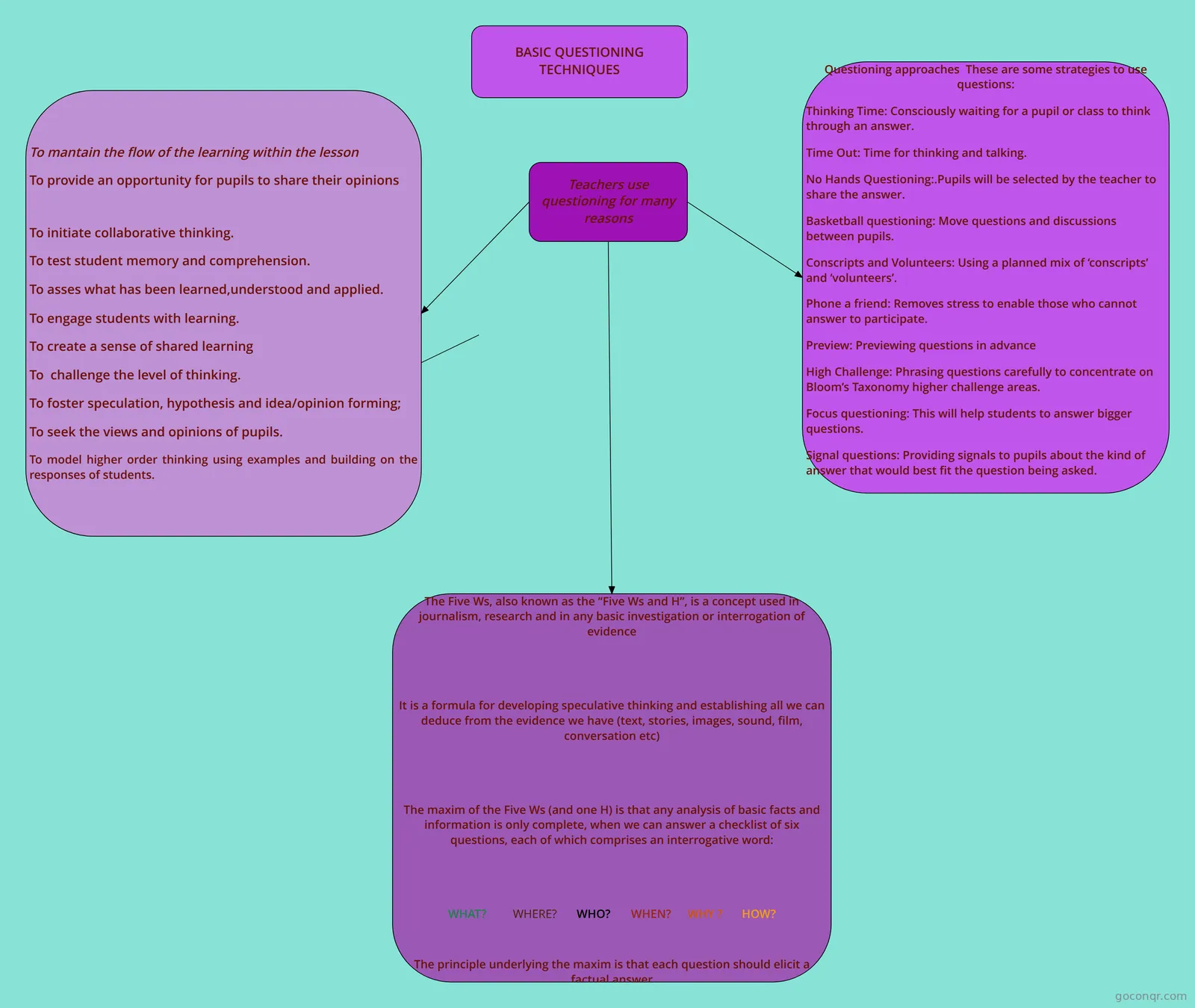
Flowchart: Basic questioning techniques
Flowchart content
BASIC QUESTIONING TECHNIQUES
Teachers use questioning for many reasons
To mantain the flow of the learning within the lesson
To provide an opportunity for pupils to share their opinions
To initiate collaborative thinking.
To test student memory and comprehension.
To asses what has been learned,understood and applied.
To engage students with learning.
To create a sense of shared learning
To challenge the level of thinking.
To foster speculation, hypothesis and idea/opinion forming;
To seek the views and opinions of pupils.
To model higher order thinking using examples and building on the responses of students.
Questioning approaches These are some strategies to use questions:
Thinking Time: Consciously waiting for a pupil or class to think through an answer.
Time Out: Time for thinking and talking.
No Hands Questioning:.Pupils will be selected by the teacher to share the answer.
Basketball questioning: Move questions and discussions between pupils.
Conscripts and Volunteers: Using a planned mix of ‘conscripts’ and ‘volunteers’.
Phone a friend: Removes stress to enable those who cannot answer to participate.
Preview: Previewing questions in advance
High Challenge: Phrasing questions carefully to concentrate on Bloom’s Taxonomy higher challenge areas.
Focus questioning: This will help students to answer bigger questions.
Signal questions: Providing signals to pupils about the kind of answer that would best fit the question being asked.
The Five Ws, also known as the “Five Ws and H”, is a concept used in journalism, research and in any basic investigation or interrogation of evidence
It is a formula for developing speculative thinking and establishing all we can deduce from the evidence we have (text, stories, images, sound, film, conversation etc)
The maxim of the Five Ws (and one H) is that any analysis of basic facts and information is only complete, when we can answer a checklist of six questions, each of which comprises an interrogative word:
WHAT? WHERE? WHO? WHEN? WHY ? HOW?
The principle underlying the maxim is that each question should elicit a factual answer
Information
- Description
- Flowchart on Basic questioning techniques, created by Rosalia Jimenez on 30/03/2020.
- Created by
- Rosalia Jimenez
- Views
- 0
- Tags
- Rating
More on Questioning and Classroom Dialogue