
Flashcards
Chapter 5

Cards in this deck (28)
- 1Chapter 5Chapter 5
- 2TableStores data about things that exist (people, places, objects and events)
Tables have a structure that include rows (records) and columns (fields)
Each table must have a unique names, unique records and unique fields - 3RecordsStores data about an individual thing e.g person, place, object or event
Each record is a row and each record must be unique and must not be repeated - 4EntityAnother name for a record but with a slightly different emphasis
It is data about a single thing
Actually called an ‘entity set’ - 5FieldCategory of information
They are columns within a table
Each field must have a unique field name - 6AttributeAnother name of a field and are used when referring to the characteristics of entities
- 7Primary KeyIs a field that is unique identification for each record.
Within a primary key field each value only appears once - 8Composite KeyA composite key is a primary key that consists of 2 or more fields.
It should be avoided - 9RelationshipsExists between entities
There are 3 types of relationships:
One to One
One to Many
Many to Many - 10Foreign KeyA foreign key is a field in one table that links to a primary key in another table using a relationship.
- 11One to OneThis type of relationship is between ONE entity for one table which relates to only ONE entity from another table.
- 12One to ManyType of relationship which ONE record from one table relates to MANY records from another table
The foreign key always goes on the many side of the relationship. - 13Many to ManyThese are not allowed in relational databases because the foreign key cannot be placed successfully in one table.
To resolve we create a link table - 14Referential IntegrityReferential integrity ensures that data entered into a table on the many side of the relationship must exist in the table on the one side of the relationship. This will mean that the data has integrity.
- 15Duplicate DataRedundant data can occur when relationships have not been set up correctly.
Data is duplicated and because it exists more than once it is classed as being redundant - 16Interpreting ERD's
- 17Creating ERD's (part 1)Identify sets of objects, people, places and events as tables
If necessary, identify which attributes belong to which table
Identify the relationship(s) between the tables
Identify the FK for each relationship - 18Creating ERD's (Part 2)draw a rectangle for each table
label the tables with the entity name
draw a line between each related table
identify the degree of each relationship by using the correct symbols on each line
check that it is possible to use a foreign key - 19Normalisation Forms
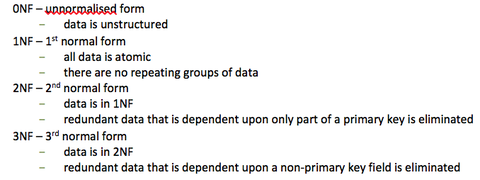
- 20NormalisationNormalisation is a process of breaking down complex data structures into structured tables that can be used for a relational database
- 21Purpose of normalisation• data is not unnecessarily duplicated and consistent
• data structures are easier to maintain
• structure is flexible enough to allow as many / few items as required to be stored
• users can make any kind of complex query, including across tables by the use of primary keys and foreign keys - 22Unnormalised form (0NF)Non-atomic data - a field may contain more than one data item per record
Repeating groups of data-some fields may be repeated for each record
- 23First Normal Form (1NF)Removing the problems of 0NF
•Must have a primary key
Each field name must be unique
•All data must be ATOMIC
one data item per field
•No repeating groups of data
no sets of repeating fields - 24Example of 1NF
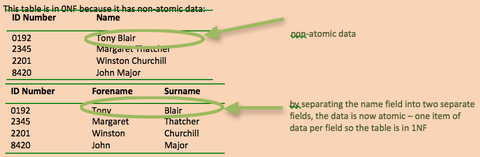
- 25Second Normal Form (2NF)Characteristics
Data must be in 1NF
All non-primary key attributes MUST be dependent on the WHOLE primary key - 26Third Normal Form (3NF)Characteristics
Data must be in 2NF
All non-primary key attributes MUST be dependent on the primary key - 27Advantages of NormalisationNo redundant data
Integrity of data is increased
Database is easier to maintain
More flexibility for future expansion
Security - 28Disadvantages of NormalisationReduced database performance
Coded data
Detailed analysis and design
Complex queries
Information
- Description
- Flashcards on Chapter 5 , created by kiera.basi on 13/10/2014.
- Created by
- kiera.basi
- Views
- 7
- Rating