
Flashcards
Basic Principles of Memory
Cards in this deck (29)
- 1Describe primary memoryportion of present space of time
linked to conscious experience
retrieval is effortless - 2Describe secondary memorygenuine past
unconscious - permanent
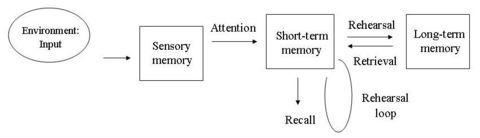
Retrieval is effortful - 3Describe Atkinson and Shriffin's 1968 Modal model of memory
- 4What is sensory memory?sensations that persist after the stimulus has disappeared
- 5How long do sensory memories last?very rapid decay
- 6What do we call visual sensory memories?iconic
- 7What do we call auditory sensory memories?echoic
- 8What name was given to experiments about capacity of sensory memory?Sperling's experiments
- 9Describe Sperling's experimentsmatrix of letters shown for 1/20th second
subjects asked to recall as many letters as possible - 10How many letters did subjects recall in Sperling's experiment?5-6
- 11How did Sperling know that subjects didn't only recall 5-6 letters because they didn't have time to view them all?sounded a tone immediately after letters disappeared which indicated which row of letters to report.
Recall was almost perfect - 12How long does memory for images last? (sensory)1/3 second
- 13Describe Baddeley's 1986 experimentSubjects asked to remember a string of digits whilst performing logic tasks
- 14What did Baddeley's 1986 experiments show?reasoning time increased with digit load
BUT not by much
error rate did not increase - 15What three parts did Baddeley and Hitch propose make up working memory?central executive
visuo-spatial sketch pad
phonological store - 16What was the effect of phonological similarity of words when asked to recall?phonological similarity massively DECREASED recall
no effect of semantic similarity - 17What is the effect of word length on recall? (refer to syllables and reading speed)correct recall related to number of syllables
strong correlation between reading speed and correct recall
correct recall also related to words that are quick to say - 18Give some evidence that the phonological store is separate from other storesSeveral patients have reduced verbal spans
perform normally on other verbal tasks
intact word perception
no problem with speech production - 19Where are lesions in short term memory patients?left hemisphere
parietal and temporal lobes - 20How are the contents of the phonological store refreshed?auditory loop
- 21What is the effect of disruption on the auditory loop?poor retention in phonological store
- 22What is the visuospatial sketchpad divided into?visual cache (form and colour)
innerscribe (spatial and movement information and can rehearse the contents of the visual cache) - 23Describe evidence for visuospatial sketchpadviewing abstract pictures interfered with visual task
tracing the outline of pegs on a board interfered with spatial task - 24What are the effects of exposure on encoding?Not enough by itself (e.g. which way does the queen face on a stamp)
- 25Describe the 3 types of processing and how they relate to the level of processing and retentionprocessing-->level-->retention
orthographic-->shallow-->poor
phonological-->middle-->middle
semantic-->deep-->good - 26Is it better to study then test or study then study more?study then test
- 27What is transfer appropriate processing?processing is goal directed
retrieval is better if uses the same type of processing as encoding - 28What do we mean by state depended memoryRecall is better if tested in an environment similar to the one where encoding occurred
- 29Is retrieval better if using your own cues or someone elses?your own
Information
- Description
- Case study assessment 1 Flashcards on Basic Principles of Memory, created by Medicine94 on 21/10/2014.
- Created by
- Medicine94
- Views
- 48
- Tags
- Rating