
Flashcards
Market Structures
Cards in this deck (27)
- 1Perfect Competition-Many buyers and sellers
-All firms and consumers enjoy perfect knowledge of market conditions
-Homogeneous goods
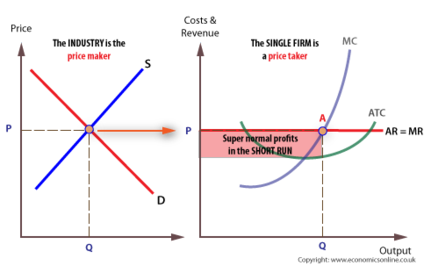
-No/little barriers to entry/exit - 2What happens in the short run of perfect competition?-Supernormal profit is made
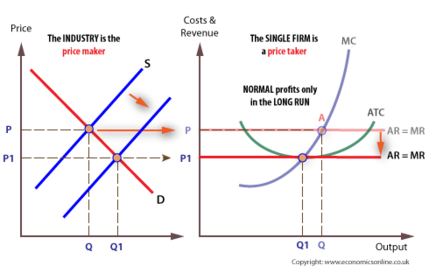
-Act as a signal for firms to enter the market - 3What happens in the long run perfect competition?The supply increases and so the supernormal profit is competed away
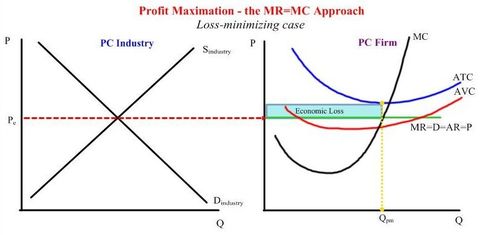
- 4Short term loss in perfect Competition?In the short term, there is a loss but its above AVC so it is contributing to fixed costs.
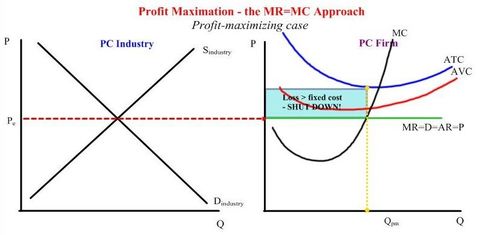
- 5Long term loss in Perfect Competition?
- 6MonopsonyThis occurs when many sellers face only 1 buyer. This allows the firm to exploit its suppliers and means cheaper prices for consumers.
- 7Contestable MarketsThis is when a market is said to have low sunk costs and therefore low barriers to entry and exit.
- 8Monopolistic Competition-Many buyers and sellers
-Low barrier to entry and exit
-Slightly Differentiated goods - 9In the short run, monopolistic competition?- It makes supernormal profit. This acts as a signal for new firms to enter the market.
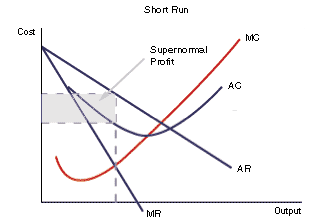
- 10In the long run, monopolistic competition?The supernormal profit is competed away.
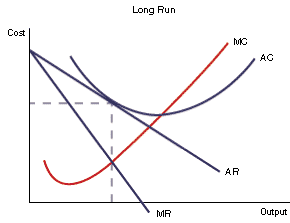
- 11Efficiency of monopolistic competition?-Prices are above the marginal cost - allocative efficiency is not achieved
-unable to exploit economies of scale fully
-Inefficient use of scarce resources as it is heavy advertise. (environmental impact) - 12Difference between monopolistic competition from perfect competition?
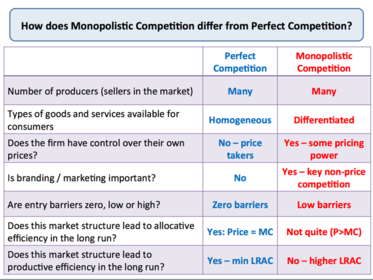
- 13Oligopoly-It is dominated by a few firms
-Interdependence of firms
-High barriers to entry/exit
-Differentiated goods (brand)
-High concentration ratio - 14Non-Price Competition-Advertising
-Branding
-Quality/Innovative
-Packaging
-Free gifts
-Loyalty cards - 15Tacit CollusionWhen other businesses usually accept price changes established by a dominant firm and which firms then follow.
- 16Overt Collusion-A (secret) formal collusion agreement among firms in an industry to control the market.
-E.G. Cartels - act as a anti-competitive behaviour (illegal) but hard to prove. - 17Predatory PricingThe pricing of a good at such a low level that other firms can't compete and forced to leave the market.
- 18Game theoryIt is concerned with predicting the outcome of games strategy in which participants have incomplete information about others' intention.
- 19Monopoly- Only one firm is dominating the industry (100% market share)
-Unique good
-Very high barrier to entry/ exit
- can set price high to make a big abnormal profit. - 20Third-degree price discriminationThis occurs when a firm sells the product at two different prices depending on elasticities.
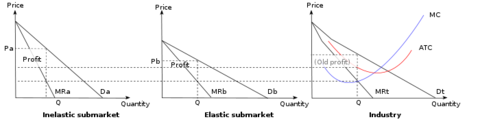
- 21First degree discrimination-It requires the seller of a good or service to know the absolute maximum price that consumers are very willing to pay.
-No dead weight loss. - 22Second-degree price discriminationThis is based on the amount sold with bulk-buying being an example.
- 23Natural MonopolyAn industry can only support 1 firm. This would have been introduced by the government. (e.g. water, gas and electricity)
- 24Monopoly PowerWhen a firm has more than 25% market share
- 25Advantages of Monopoly power-Increase investment - R&D
-Stable employment
-Can compete internationally
-Cross-subsidisation can lead to an increase range of goods and services
-Advantages of E.O.S. - 26Disadvantages of Monopoly Power-Less incentive to be efficient - increase cost then price
-fewer innovations
-Undertake price discrimination to raise producer surplus and lower consumer surplus
-X-efficient - misallocation of resources. - 27Monopoly vs Perfect CompetitionDepends on
level of contestability; Level of regulation; Objective; Level of production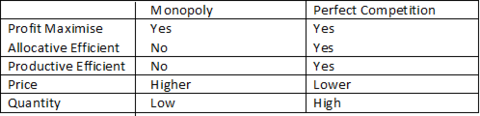
Information
- Description
- A-Level Economics (Business Economics and Efficiency ) Flashcards on Market Structures, created by Mary Doria on 19/02/2016.
- Created by
- Mary Doria · Feb 2016
- Updated
- Jul 25, 2016
- Views
- 2
- Rating