
Flashcards
Molecules of Life (pt 2)
Cards in this deck (27)
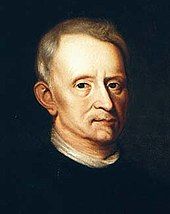
- 1Who Discovered Cells?-Robert Hooke
-Discovered by looking at dead plant cells in a cork (using a compound microscope he built himself) - 2What is a cell?-Smallest unit with the properties of life
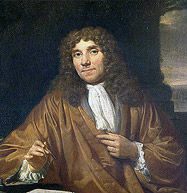
- 3Who was the first to describe protozoa, bacteria, the vacuole of the cell, and muscle fiber?-Anton Van Leeuwenhoek
- 4What does cell theory state?1. Organisms consist of one or more cells
2. The cell is the most basic unit of life
3. All cells come from other cells - 5Why aren't cells bigger?-The greater surface area to volume, the more efficiently materials cross its surface and become disturbed through the interior
*Think about heating a turkey in the oven vs. heating a pea in the oven* - 6Cell membranes are composed of what layers?-Two phospholipid layers
- 7The cell membrane (or plasma membrane) forms a ________ between the ____ and the _______ __________.-Boundary, cell, outside environment
- 8What is a phospholipid?-A molecule composed of three basic parts:
~ A charged phosphate (PO4-)
~ Glycerol
~Two Fatty Acid Chains
~Glycerol and phosphate form "Head"
~Fatty Acids Form "Tail"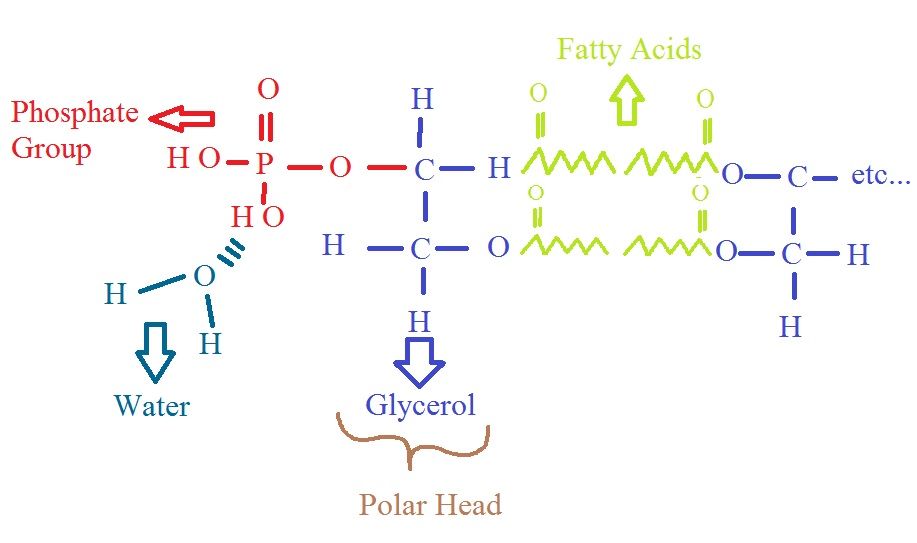
- 9Polar molecules love _____ molecules, so water and the polar head of the ____________ form a ________ bond.-Polar, Phospholipid, Hydrogen
- 10What is it called when non-polar tails are attracted to each other and repel water?-Hydrophillic
- The tails of phospholipids are Hydrophobic - 11What is a "sandwich membrane"?-The polar and non-polar properties of the phospholipids causes them to arrange themselves in layers
- 12What are the the properties of "fluid mosaic model"?-Cell membrane is flexible not rigid
-Makes the cell membrane act like oil on the surface of the water - 13What does selective permeability mean?-The cell membrane allows some, but not all materials to cross
- 14What are different ways molecules can cross the membrane (3)?-Small non-polar molecules easily pass through the membrane
-Small polar molecules are transported via proteins
-Large molecules are moved in vesicles - 15What is Diffusion?-Passsive process that requires no energy (ATP)
-Molecules simply flow from high concentration to low concentration - 16What is Osmosis?-(Diffusion of water) is the diffusion of water across a membrane
- 17What is an Isotonic solution?- A solution whose solute concentration is the same as the solute concentration inside the cell
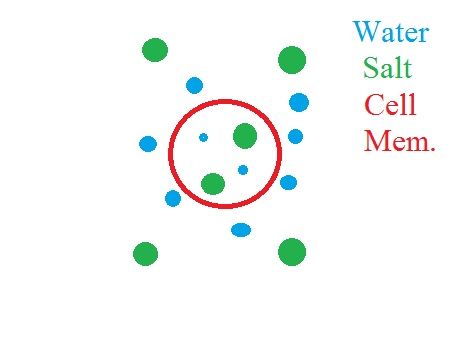
- 18What is a Hypotonic solution?-A solution whose solute concentration is lower than the solute concentration inside a cell
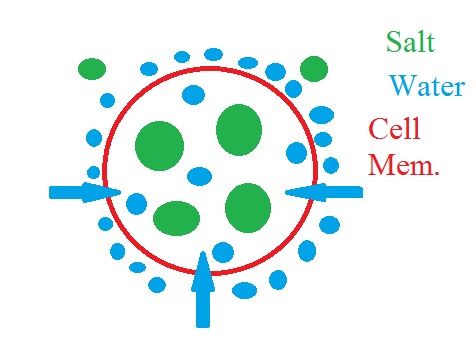
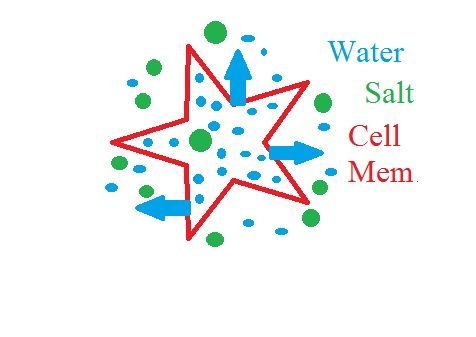
- 19What is a Hypertonic solution?-A solution whose solute concentration is higher than the solute concentration inside a cell
- 20What is Cytolysis?- Bursting cells from too much water absorption
- 21What is Plasmolysis?-When you don't have enough water in your cells
- 22What is "Facilitated Diffusion"?- A form of passive transport for molecules that cannot diffuse through the membrane
- 23What do Ion Channels help transport?-Ions across the membrane
-Ex: Na+, k+, Cl- - 24What does "Active Transport" require?- Energy (ATP), carried out by ION
- Moves molecules from low to high concentration - 25What is Endocytosis?- is the active transport of large molecules through the membrane into the cell by forming a vesicle around external materials
- 26What is Pinocystosis?- is a from of endocytosis that involves the transport of fluids
- 27What is Phagocytosis?- form of endocytosis that involves the transport of large particles (eg. bacteria)