
Flashcards
Chapter 3

Cards in this deck (36)
- 1Internal Energythe total kinetic and potential energy in a system
- 2The Equi-partition Theorem:The average value of the kinetic energy associated with each degree of freedom of a particle, in thermal equilibrium, with temp T is:
1/2kT - 3First Law of Thermodynamics:the internal energy of an isolated system is constant (no ∆)
- 4What is the equation for energy of a closed system?∆U=q+w
q=heat w=work
The change in the internal energy of a closed system is equal to the energy that passes through its boundary as heat or work - 5What is q and w when: 1) Energy is transferred TO the system 2) Energy is LOST from the system1) q > 0 w > 0
2) q < 0 w < 0 - 6Work is?used to change the height of a weigh in the surroundings
- 7Expansion Work:done by a change in volume
(∆V) - 8Non-Expansion Work:pressure and volume not invoked in work
Ex) electrical, stretching, surface expansion - 9Electrical Work:transports charge, Q, through electric potential difference, φ to give:

- 10Total Work =electrical work + expansion work
- 11Expansion Work definition and formula:the mechanic work done on an object (Force over a distance)

- 12Free Expansion definition and formula:expansion against 0 opposing force

- 13Expansion Against a Constant Pressure: (Definition and formula)the expansion against a constant pressure

- 14What is the area in a indicator diagram?expansion work
p(expansion)*∆V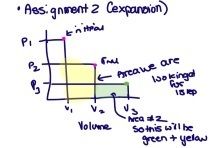
- 15Reversible Process:can be reversed by an infinitesimal change in a property without loss of energy
- 16Thermodynamic Equilibrium:an infinitesimal change in a property of a system in opposite directions balance out
- 17Quasi-static Processthe rate of change of the macroscopic variables is negligibly small
- 18Reversible Expansion: (Definition and formula)when expansion pressure is equal to the pressure of the whole system at any stage of the expansion

- 19Isothermal Reversible Expansion Work:Applies to both COMPRESSION and EXPANSION processes

- 20What Conditions can the maximum amount of work be obtained?Reversible conditions
- 21For a Compression Process, what conditions require the most workIrreversible process
- 22Heat (q)the quantity of energy that flows between system and surroundings due to ∆T
HEAT IS A PROCESS NOT AN ENTITY (ONLY CALCULATED NOT MEASURED) - 23Heat Capacity (C)the amount of heat needed to change the temperature of a substance by a degree
(only applies to systems in single phase, not undergoing phase changes)
- 24What properties are Heat capacity and Molar heat capacity?Heat Capacity: C = Extensive Property
Molar Heat Capacity: C_m = Intensive - 25Constant Volume Heat Capacity:is temperature dependent, cannot do non-expansion work (w=0)
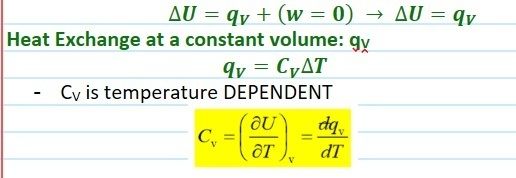
- 26What is Constant Volume Heat Capacity for Monoatomic atoms?- independent of temperature
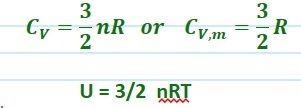
- 27Enthalpy (definition and formula)a reversible process under constant pressure, expansion workS
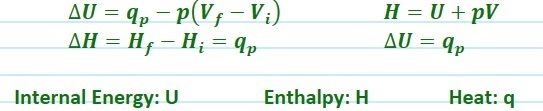
- 28What is ΔH for a process with only expansion work?is equal to heat flow at a constant pressure
= q_p - 29Constant Pressure Heat Capacity formula
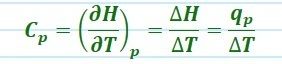
- 30What properties are Constant Pressure Heat Capacity and Molar Constant Pressure Heat Capacity?C_p = Extensive property
C_p,m = Intensive property - 31What formula does ∆H have?
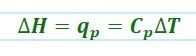
- 32Which one is greater for all gases? C_p or C_V?
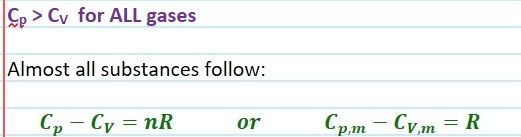
- 33State Function:depends on the current sate of system (changes are independent of the path of system)
EX) U, p, V, T, and H - 34Path Function:a sequence of steps that takes the system from initial to final states ( path dependent)
EX) w, and q (heat can be lost or gained + -) - 35Exact Differential:The overall change in a state function is the sum of all changes in path
EX) dU = Uf - Ui
Δ only - 36Inexact Differentialincremental amounts of quantities of path functions are not exact
EX) there is no such thing as Δq or Δw
(no Δ possible)