
Flashcards
Lecture 34 - Synthesis of Purine Nucleotides
Cards in this deck (19)
- 1Base, nucleosides, and nucleotides Adenine is a nitrogenous ___, specifically a purine A ___ contains a nitrogenous base, e.g. adenine, covalently attached to a sugar, e.g. ribose. (ex: adenosine) A ____ is a nucleoside that contains phosphate groups on the sugar. [ex: adenosine-5'-monophosphate (AMP)]base
nucleoside
nucleotide - 2De novo synthesis of purine nucleotides Ribose-5-phosphate, product of the pentose phosphate pathway, is converted to ___, which is used in both de novo and salvage synthesis pathways. The purine base is then synthesized on the ___ position of the sugar. The purine base is synthesized using atoms from glutamine, THF, glycine, aspartate, and CO2. A nitrogen is covalently attached to Cl of the ___ in the first step of synthesis.PRPP
Cl
sugar - 3IMP, AMP, and GMP Inosine 5'-monophosphate (__) is the first purine nucleotide made in the de novo pathway IMP is the precursor for synthesis of ___. The nitrogenous base is modified IMP is the precursor for synthesis of ___. The nitrogenous base is modifiedIMP
AMP
GMP - 4Nitrogenous bases Recall purines and pyrimidines i.e. small biomolecules In general, we consider 2 purines (two rings): - ____ & ____ and 3 pyrimidines (one ring): ___, _____, ____ Introduce here two additional PURINES ____ & ____adenine & guanine (PUR As Gold)
thymine, cytosine, uracil (CUT the Py)
xanthine & hypoxanthine - 5Nucleosides A nucleoside is a biomolecule containing a nitrogenous base (ex: adenine) covalently attached to the C-l position of a sugar (ex: ribose) via a __-___ linkage Note the numbering of the sugar, e.g. 2' position, and the numbering of the base, e.g. 2 position.β-glycosidic
- 6Nucleotides • Recall from before that nucleotides contain a nitrogenous ___, a ___, and 1, 2 or 3 ____ groups • These are nucleotide monophosphates, i.e. _ phosphate group Note the phosphate is attached to the __ position of the sugar Note the nomenclature: adenosine = ___ adenosine-5 '-monophosphate = ___ deoxyadenosine-5 '-monophosphate = nucleotide with ____ sugarbase, a sugar, phosphate
1
5'
nucleoside
nucleotide
deoxyribose - 7Nucleotide synthesis Purine and pyrimidine nucleotides can be synthesized by two pathways - the de novo pathway (built from "__"): - built from amino acids, ribose-5-phosphate and CO2 - the salvage pathway (makes nucleotides w/ ___ energy): - built from free bases and nucleosides generated by nucleic acid ____scratch
less
breakdown - 8De novo purine nucleotide synthesis Recall that pentose phosphate pathway generates ___ -___ Recall that ribose 5-phosphate is converted to 5-phosphoribosyl 1- pyrophosphate (___) Recall that PRPP is precursor for ___ synthesis PRPP is a precursor for the de novo synthesis of ___ purines and pyrimidines In de novo purine synthesis - inosine 5' monophosphate (__) is generated by building a purine ring attached to the ___ position of PRPP and atoms/molecules are added sequentially to build the baseribose 5-phosphate
PRPP
histidine
both
IMP
C-l - 92 phosphates are transferred from ATP to the alcohol attached to Cl of ribose 5-phosphate The purine ring will be built de novo attached to __ * This enzyme (ribose-phosphate diphosphokinase) can be regulated ____, but not under physiological conditions (by high concentrations of nucleotides)C1
allosterically - 10Where do the components of the purine base originate? 4 NITROGENS — sources are amino acids — (2) ___, (1) ___ & (1) ___ 5 CARBONS— 2 come from ___, I comes from ___, & 2 come from I carbon transfers from ___ derivatives(2) glutamine, (1) glycine & (1) aspartate
glycine
CO2
THF - 11]The biosynthetic pathway of the first nucleotide synthesized in the de novo pathway. Don't worry about the order of addition or exactly which atoms come from which precursor but know all the components you need to build This enzyme, ___-____ ____, is an important point of regulationglutamine-PRPP amidotransferase
- 12Inosine 5 '-monophosphate (IMP) is the product of this pathway The nitrogenase base in IMP is ____ The other purine nucleotides, AMP and GMP are produced by ____ of the nitrogenous base of IMPhypoxanthine
modification - 13IMP synthesis Enzymes in this pathway are organized as a multi-enzyme complex Some enzymes have ___ active sites and catalyze >1 reaction • Important for efficient use of ___ intermediates, e.g. 5-phosphoribosylamine Requires ____ energy — 7 ATP equivalents required — doesn't count the energy required to make the ribose 5-phosphate, amino acids, or THFmultiple
unstable
considerable - 14IMP is precursor to AMP: IMP differs from AMP by 1 ___ group Need nitrogen to convert IMP to AMP Source is ____ ___ is required to make AMP from IMP! IMP is precursor to GMP: IMP differs from GMP by I ___ group Takes _ reactions First reaction oxidizes IMP to xanthosine monophosphate (___) Need nitrogen to convert XMP to GMP Source is ____ ___ is required to make GMP from IMP ___ synthetase (IMP to AMP) and IMP ____ (IMP to XMP) are important points of regulationfunctional
aspartate
GTP
functional
2
XMP
glutamine
ATP
Adenylosuccinate
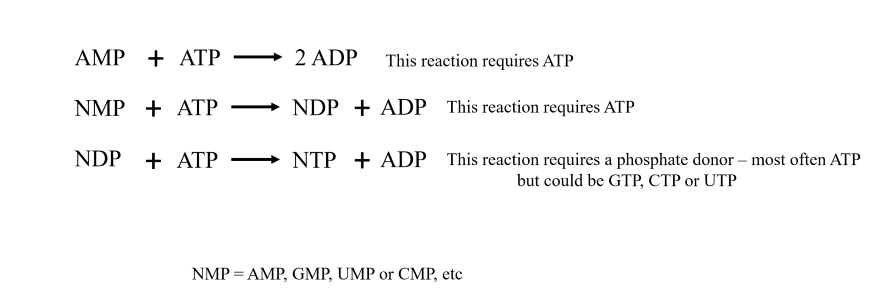
dehydrogenase - 15Synthesis of NDP and NTP from NMP
- 16Regulation of nucleotide synthesis Why - ___ cost of energy: ~7 ATP equivalents to make IMP, 1 GTP to make AMP from IMP, 2 ATP to convert AMP to ATP = consumption of ___ ATP equivalents to make ONE ATP molecule de novo Recall important principles of regulation: • End product feeds back to regulate • Often ____ • Regulation occurs at the top of the pathway and at ___ pointshigh
10
allosteric
branch - 17Allosteric negative feedback of purine synthesis Enzyme is allosterically regulated by very __ concentrations of IMP, AMP and GMP - NOT physiological Major site of regulation is allosteric negative feedback of the activity of ___-___ ____ by IMP, AMP and GMP Adenylosuccinate synthetase (IMP to AMP) is allosterically regulated by NEGATIVE feedback by ___ IMP dehydrogenase (IMP to XMP to GMP) is allosterically regulated by NEGATIVE feedback by ___ & ___high
glutamine-PRPP amidotransferase
AMP
GMP & XMP - 18Balance of synthesis Recall __ required to make AMP and ___ required to make GMP If GMP is low, ___ will be low, therefore synthesis of ___ is reduced while the synthesis of ___ proceeds If AMP is low, __ will be low, therefore synthesis of ___ is reduced while the synthesis of __ proceedsGTP
ATP
GTP
AMP
GMP
ATP
GMP
AMP - 19Recap • There are _ purine and _ pyrimidine nitrogenous bases that you should be able to distinguish • Nucleosides have a nitrogenous base and ___— nucleotides have in addition ___ groups • De novo synthesis begins with ___ and the nitrogenous base is built from ___ attached to the Cl of the ribose • Sources of nitrogen are ___, ___, & ___ • Sources of carbon are ___, __ and 1 carbon transfers via ___ Product is ___ IMP is precursor for ___ & ___ • Allosteric negative feedback regulation is important Synthesis of AMP and GMP is ___4
3
sugar
phosphate
PRPP
scratch
glutamine, aspartate & glycine
glycine, C02, THF
IMP
AMP and GMP
balanced
Information
- Description
- BIOC 531 Exam 3
- Created by
- Marissa Alvarez · Apr 2020
- Updated
- Apr 3, 2020
- Views
- 9
- Rating