Flashcards
Lecture 40 - DNA Repair & Recombination
Cards in this deck (20)
- 1Lecture 40 learning goals Clear understanding of the following key points**DNA damage: Thymine dimers, cytosine deamination, single DNA strand break, double DNA strand break.
Repair mechanisms:
1. Direct repair
2. General excision repair
3. Single strand repair by homologous recombination
4. Double-strand break repair by homologous recombination
5. Double-strand break repair by non-homologous end joining (NHEJ) - 2DNA Repair DNA is the only or one of the few macromolecules that can be repaired since the alternative is ___ for the organism. There are several types of DNA damages — base modifications, nucleotide deletions or insertions, crosslinking DNA strands, and breakage of the strands (breakage of ___ bonds). Causes of DNA damage — ___ agents (e.g. chemicals, radiation) and most common ___ during DNA replication. Severe damage is ___, but short of that can be repaired. Defects in repair mechanisms can lead to ___, e.g. Cancer.deleterious
phosphodiester
environmental
errors
lethal
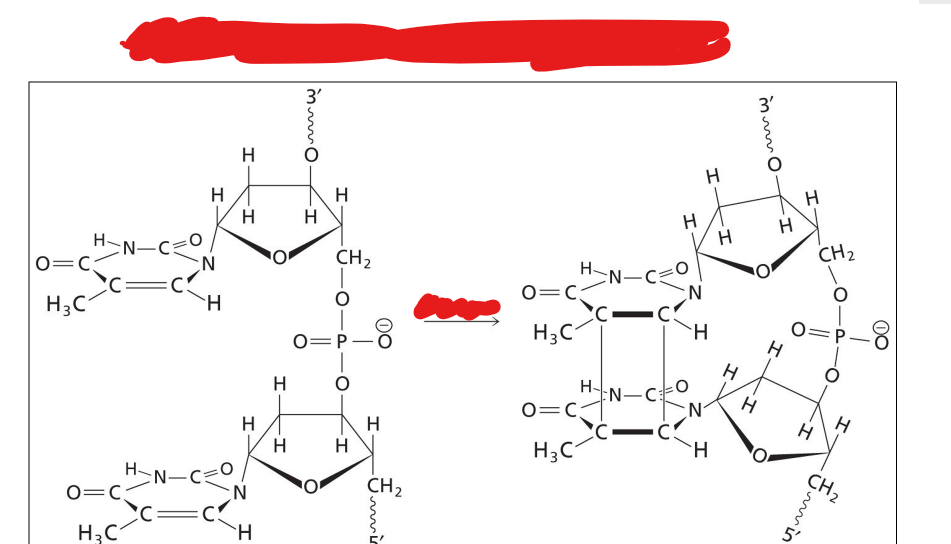
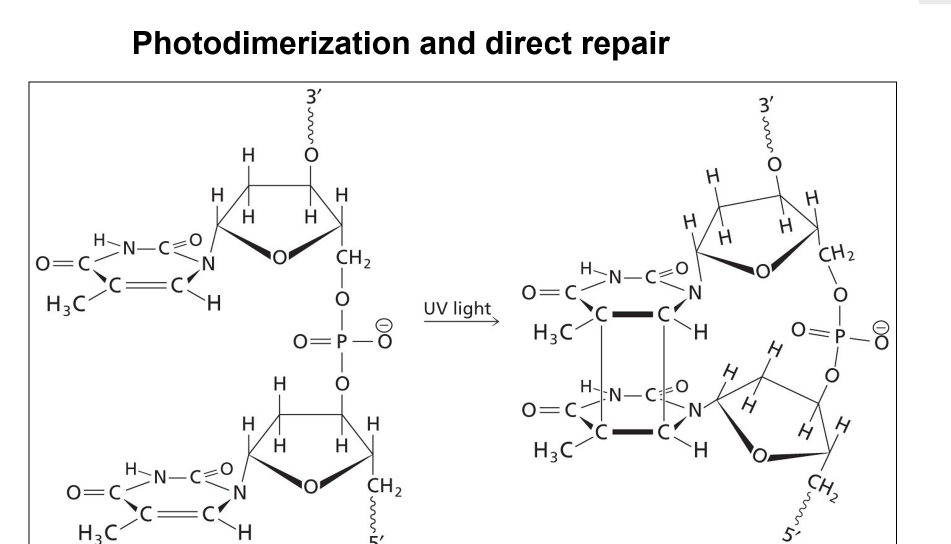
disease - 3Photodimerization and direct repair Photodimerization of adjacent ____ residues can occur. __ ___ causes the formation of Carbon-Carbon bonds between adjacent thymines in DNA (thymine-thymine dimer). T-T dimers ___ with replication and transcription.deoxythymidylate
UV irradiation
interfere - 4—
- 5Direct repair of T-T (CPD) dimers by DNA ____ Direct repair of thymine dimers by an enzyme called DNA ___. Many non-placental organisms have this enzyme. The DNA photolyase recognizes T-T dimers and catalyzes the cleavage of Carbon-Carbon bonds in the presence of ___, restoring structure. The photolyase recognizes and binds to the thymine dimer. In the presence of ___ ___ the enzyme catalyzes chemical cleavage of the dimer, thereby restoring normal base pairing and repairing the DNA.photolyase
photolyase
light
visible light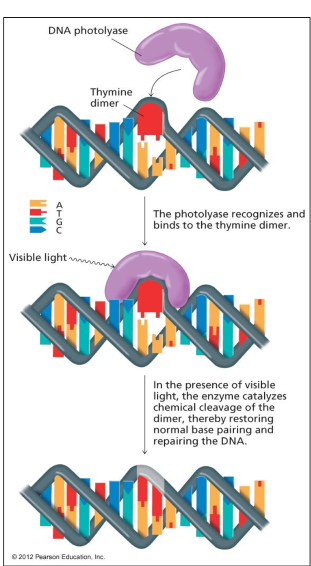
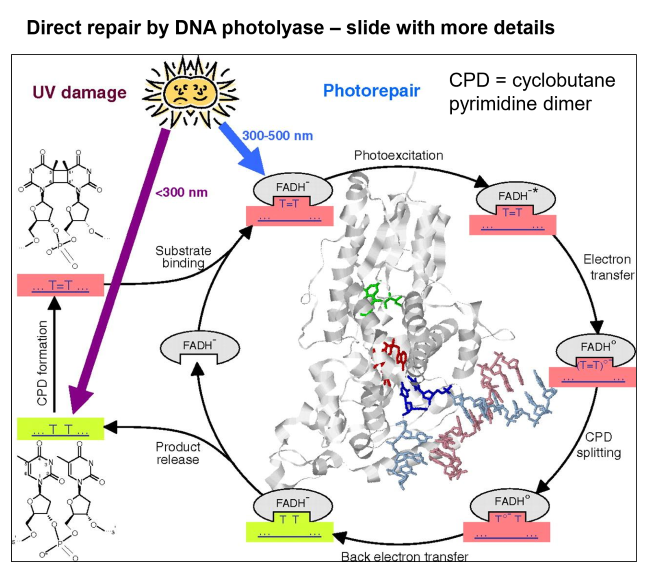
- 6Direct repair of T-T dimers by photolyase Photolyase is a globular single-chain protein of approximately 60 kDa that harbors two buried cofactors: ___ __ ___ (__) in its fully reduced state ___, which is the essential catalytic cofactor, and an antenna pigment, either ___ or a ___ derivative that absorbs blue or near UV light much ___ than FADH-, and efficiently transfers the excitation energy to FADH. A T-T (CPD) dimer recognized by the enzyme is flipped out of the double helix in order to enter the substrate-binding pocket and to be positioned close to the __ cofactor. Once the substrate is bound, ___ is required to excite FADH-, either directly or via energy transfer from the excited antenna pigment. The photo-excited flavin (FADH-*) transfers an electron to the CPD, and consequently, the two intra-CPD bonds ___, and then the electron returns to the flavin (transiently present as neutral radical FADH°.) in order to restore catalytically active FADH-.Flavin adenine dinucleotide (FAD)
(FADH-)
folate or a flavin
stronger
FAD
light
split - 7Direct repair of T-T dimers by photolyase In the Figure, light green and light red boxes represent intact and damaged DNA, respectively. T=T denotes a CPD formed from two thymine bases. Gray ellipses represent photolyase with its FAD cofactor in different states as indicated. Inside the repair cycle, a structural overview is shown of photolyase from A. nidulans with a bound double-stranded DNA oligomer that contained a CPD lesion flipped out of the double helix into the enzyme's binding pocket. Red: FAD cofactor (partially hidden). Green: antenna pigment. Blue: DNA strand containing the CPD lesion. Purple: complementary DNA strand. Note that the two intradimer bonds are already split in this structure.
- 8DNA damage caused by cytosine deamination Cytosine can be spontaneously ___ and converted to ___ by hydrolysis of the amine group. But, under physiological conditions, cytosine is methylated on the 5 carbon position, and as a result, deamination converts cytosine to ___, changing the sequence of genomic DNA and consequently of the gene product if the particular region codes for a protein or functional RNA.deaminated
uracil
thymine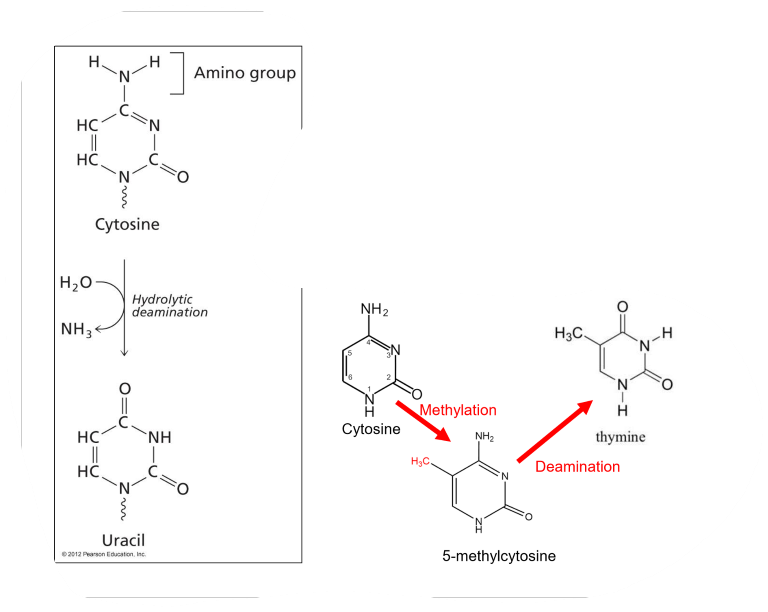
- 9The importance of DNA methylation Immediately after DNA replication, only the parent strand is ____, while the newly synthesized daughter strand is ____. Repair enzymes recognize this methylation and make changes to the ____ strand only. When the proofreading and repair enzymes have checked that the daughter strand is a faithful reverse complimentary copy of the parent, ____ of the daughter strand is carried out by another enzyme (a maintenance DNA methyltransferase). The presence of a methyl mark is equivalent to making the statement at the molecular level that the new DNA strand has been fully ___ and is ___.methylated
unmethylated
daughter
methylation
checked
acceptable - 10Deamination leads to ___ mutations • Spontaneous ___ mutations change a single base pair, leading to a ___ mutation that can introduce a stop codon (____) or a change in protein amino acid sequence (____). • A gene regulatory region point mutation can change gene ____. • 5-methylcytosine (C) deamination to thymine (T) is a frequent cause of ____ mutations; if C is not restored, the normal C-G base pair will become a T-A mutation during replication of one of the DNA strands.point
point
point
nonsense
missense
expression
point - 11General excision repair mechanism Placental organisms do not express DNA ____. Instead, they utilize the base ____ mechanism to repair DNA lesions such as T-T dimers. 1. Excision-repair enzymes detect damaged DNA. An ___ nicks the DNA backbone on BOTH sides of the damage. 2. A ___ or ___ removes the damaged DNA, leaving a gap. 3. DNA ___ fills the gap. 4. The remaining nick is sealed by DNA ___.photolyase
excision
endonuclease
helicase or exonuclease
polymerase
ligase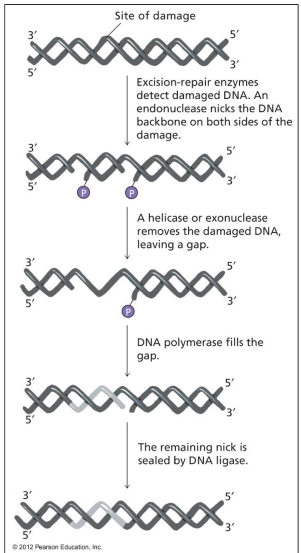
- 12Base excision-repair __ or __ produced by the deamination of C __ or __ is recognized by N-glycosylase hydrolysis of N-glycosidic bond (remove ___) AP endonucleases recognize apurinic and apyrimidinic sites and cleave the sugar- phosphate backbone and removes the ____ ____ The gap is filled by DNA __ _ and the nick is sealed by DNA ____U or T
U or T
base
deoxyribose phosphate
pol I
ligase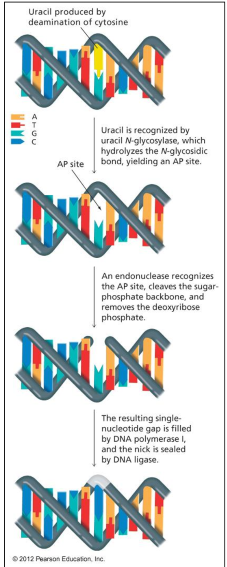
- 13Homologous recombination Exchange or transfer of a piece of DNA with closely ___ sequences between chromosomes or within a chromosome Exchange between paired chromosomes is an example of ____ ____ Under certain circumstances, homologous recombination can be used as a repair mechanism — (a) ___ ___ collapse repair (often single-strand break), and (b) ___-___ break repair.related
homologous recombination
replication fork
double-strand - 14Single-strand DNA break repair by homologous recombination • SS DNA damage can be caused by ___ ___ collapse • Parent strands: light and dark blue. Leading daughter strand: dark red Lagging daughter strand: pink. • Small black arrows following step 4 represent cleavage of the ___ bonds at the crossover of DNA strands in the ___ structure. Note: Women with BRCA-I or BRCA-2 gene mutations have defective ___ ____ repair pathway and thus tend to develop cancer in mammary or ovarian epithelial cells.replication fork
phosphodiester
Holliday
homologous recombination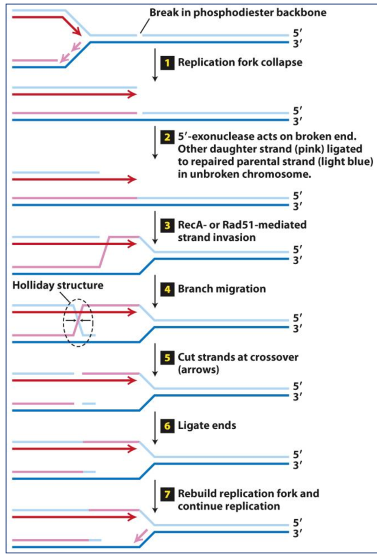
- 15Notes for the preceding Figure Homologous recombination can repair DNA damage by causing the exchange of large regions of chromosomes between the maternal and paternal pairs of homologous chromosomes during ____. Step 1: A nick in one strand causes ___ ___ collapse. Step 2: 5' exonuclease digests the strand with its 5' end at the broken end of the DNA, leaving the strand with its 3' end at the break __-___. The lagging nascent strand (pink) base-paired to the unbroken parent strand (dark blue) is ligated to the unreplicated portion of the parent chromosome (light blue). Step 3: Multiple RecA (bacteria)/Rad51 (eukaryotes) proteins bind to the 3' end of the single-stranded DNA and catalyze its strand invasion into another homologous, double-stranded DNA molecule and base-pairing with its complementary sequence, ____ the other strand.meiosis
replication fork
single-stranded
displacing - 16Notes for the preceding Figure continued Step 4: The target DNA-invading strand hybrid region is extended in the direction away from the break (___ ___) forming a Holliday structure, in which all bases are base-paired to complementary bases in the parent strands (the diagonal lines represent single phosphodiester bonds). Step 5: Cleavage of the phosphodiester bonds that ___ ___ from one parent strand to the other. Step 6: Ligation of the 5' and 3' ends base-paired to the same parent strands generates a structure similar to a ___ ___. Step 7: Rebinding of replication fork proteins extends the leading strand past the point of the original strand break and __-___ lagging-strand synthesis.branch migration
cross over
replication fork.
re-initiates - 17Repair of a double-strand break (e.g. y-irradiation) by homologous recombination • ___-chromosome for resolving DSB • ___-chromosome for exchange of genetic information Note: Strand ___ by the broken DNA strands is key to the resolution of the damage without introducing mutations or deletions.Intra
Inter
invasion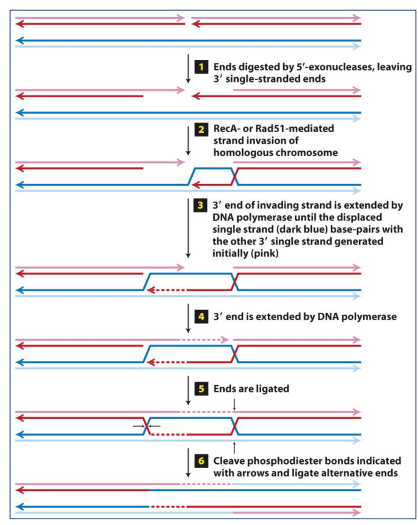
- 18Notes for the preceding Figure Homologous recombination can repair a double-strand break in a chromosome or exchange large segments of two double-stranded DNA molecules. • Step 1: 5'-exonucleases digest ___ broken ends, leaving each with a single-stranded region of DNA with a 3' end. • Step 2: RecA (bacteria)/Rad51 (eukaryotes) catalyzes ___ of one 3' end into the homologous region of the homologous chromosome. • Step 3: DNA ___ extends the 3' end of the invading DNA strand, displacing the parent strand as an enlarging single-stranded ___ of DNA (dark blue). • Step 4: When the loop extends to a sequence that is complementary to the other 5'- exonuclease—digested end of DNA, the complementary sequences base-pair, and DNA polymerase extends this 3' end, using the displaced single-stranded loop of parent DNA (dark blue) as a ___. • Step 5: The new 3' ends are ligated to the exonuclease-digested 5' ends, generating two ___ structures in the paired molecules. Holliday structure branch migration can occur in either direction (not shown).both
invasion
polymerase
loop
template
Holliday - 19Notes for the preceding Figure Continued... Step 6: Cleavage of the strands and ligation of the alternative 5' and 3' ends at each cleaved Holliday structure generates ___ recombinant chromosomes that contain the DNA of one parent DNA molecule on one side of the initial breakpoint (pink and red strands) and the other parent DNA molecule on the other side of the breakpoint (light and dark blue). • Gene ___: The region in the immediate vicinity of the initial breakpoint forms a heteroduplex, in which one strand from one parent is base-paired to the complementary strand of the other parent. The repair of base-pair mismatches between the two parent strands loses sequence differences between the two parental DNAs.two
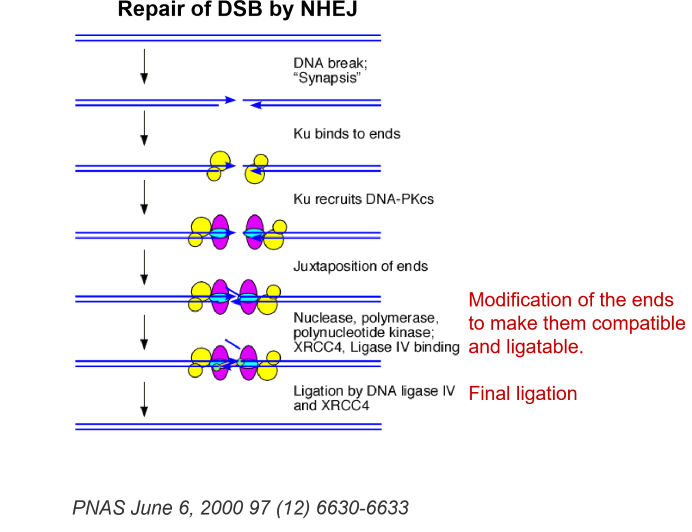
conversion - 20Note for the preceding Figure Non-homologous end-joining (___) is one of two systems using recombination to repair DNA ___-strand breaks, which can be caused by ionizing radiation and anticancer drugs. When sister chromatids are __ available to help repair double-strand breaks by HR, an NHEJ mechanism is initiated. The following are general steps of NHEJ. 1. A Ku-DNA-dependent protein kinase (DNAPK) complex recognizes and binds to the ends of a double-strand break forming a "___". 2. In the synapse, nucleases remove bases from the DNA ends and kinases add phosphate to make it compatible and __. 3. The two double-stranded molecules are ligated together, with several base pairs ____. NHEJ is __-___: base loss causes gene mutation, and incorrect rejoining can cause gross chromosomal rearrangement mutations that affect the expression of genes or create a "hybrid" gene that encodes the N-terminal portion of one amino acid sequence fused to the C-terminal portion of a completely different protein.NHEJ
double
not
synapse
ligatable
missing
error-prone