
Flashcards
C3
Cards in this deck (59)
- 1How did Newlands and Mendelev arrange the elements in the periodic tableNewlands, and then Mendeleev, attempted to classify the elements by arranging them in order of their atomic weights.
- 2How did Mendeleev overcome some of the problems with the early periodic table ?The early periodic tables were incomplete and some elements were placed in inappropriate groups if the strict order of atomic weights was followed. Mendeleev overcame some of the problems by leaving gaps for elements that he thought had not been discovered.
- 3How is the modern periodic table arranged in ?When electrons, protons and neutrons were discovered early in the 20th century, the periodic table was arranged in order of atomic (proton) numbers. When this was done, all elements were placed in appropriate groups.
- 4How is the modern periodic table arranged in terms of electronic structure?The modern periodic table can be seen as an arrangement of the elements in terms of their electronic structures. Elements in the same group have the same number of electrons in their highest occupied energy level (outer shell).
- 5Evaluate the work of Newlands and Mendeleev in terms of their contributions to the development of the modern periodic table
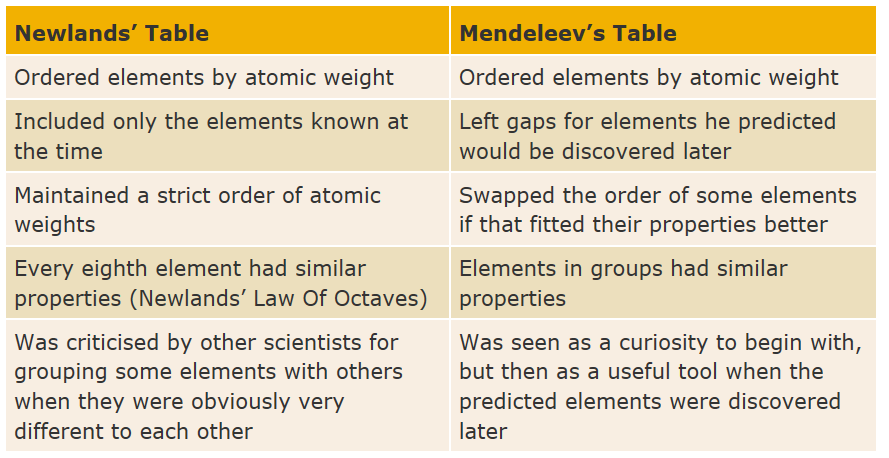
- 6explain why scientists regarded a periodic table of the elements first as a curiosity, then as a useful tool and finally as an important summary of the structure of atoms.The Newland created the law of Octaves so he put all the elements in order of their atomic mass and then realised that generally every eigth element had similar properties. However this grouped together some elements that had really different properties. But then Mendeleev changed this slightly and left gaps in the periodic table for elements that hadn't been discovered yet and even predicted the properties of those elements.
- 7Describe the elements in Group 1 of the periodic table (known as the alkali metals):■ are metals with low density (the first three elements in the group are less dense than water)
■ react with non-metals to form ionic compounds in which the metal ion carries a charge of +1. The compounds are white solids that dissolve in water to form colourless solutions
■ react with water, releasing hydrogen
■ form hydroxides that dissolve in water to give alkaline solutions. - 8Describe what happens in Group 1, the further down the group an element is■ the more reactive the element
■ the lower its melting point and boiling point. - 9Compare group 1 with the transition metalsgroup1
■ have higher melting points (except for mercury) and higher densities
■ are stronger and harder
■ are much less reactive and so do not react as vigorously with water or oxygen. - 10Describe the transition metalsMany transition elements have ions with different charges, form coloured compounds and are useful
as catalysts. - 11Describe the elements in Group 7 of the periodic table (known as the halogens)The elements in Group 7 of the periodic table (known as the halogens) react with metals to form ionic compounds in which the halide ion carries a charge of –1.
- 12Describe what happens in Group 7, the further down the group an element isIn Group 7, the further down the group an element is:
■ the less reactive the element
■ the higher its melting point and boiling point. - 13Describe a displacement reaction in group 7A more reactive halogen can displace a less
reactive halogen from an aqueous solution of its salt. - 14Explain the trends in reactivity seen in group 1 and 7The trends in reactivity within groups in the periodic table can be explained because
the higher the energy level of the outer electrons:
■ the more easily electrons are lost
■ the less easily electrons are gained. - 15State the difference between soft and hard waterSoft water readily forms lather with soap. Hard water reacts with soap to form scum and so more soap is needed to form lather. Soapless detergents do not
form scum. - 16What does hard water contain and where does this come fromHard water contains dissolvedcompounds, usually of
calcium or magnesium. The compounds are dissolved
when water comes into contact with rocks. - 17Describe the difference between hard and soft waterThere are two types of hard water. Permanent hard water remains hard when it is boiled. Temporary hard water is softened by boiling.
- 18Explain how temporary hard water is softened by boiling.Temporary hard water contains
hydrogencarbonate ions (HCO3 –) that decompose on heating to produce carbonate ions which react with calcium and magnesium ions to form precipitates. - 19State the problems associated with both hard water and temporary hard waterUsing hard water can increase costs because more soap is needed. When temporary hard water is heated
it can produce scale that reduces the efficiency of heating systems and kettles. - 20Describe the benefits of hard waterHard water has some benefits because calcium compounds are good for the development and maintenance of bones and teeth and also help to reduce heart disease.
- 21Hard water can be made soft by removing the dissolved calcium and magnesium ions. This can be done by:■ adding sodium carbonate, which reacts with the calcium and magnesium ions to form a precipitate of calcium carbonate and magnesium carbonate
■ using commercial water softeners such as ion exchange columns containing hydrogen ions or sodium ions, which replace the calcium and magnesium ions when hard water passes through the column. - 22Water of the correct quality is essential for life. For humans, drinking water should have sufficiently low levels of dissolved salts and microbes. How is this achieved ?Water of the correct quality is produced by:
■ choosing an appropriate source
■ passing the water through filter beds to remove any solids
■ sterilising with chlorine. - 23Explain the principle by which ion exchange resins workThe resin beads have sodium ions attached to them. As the hard water passes through the column, the calcium and magnesium ions swap places with the sodium ions. The calcium and magnesium ions are left attached to the beads, while the water leaving the column contains more sodium ions. The hard water is softened because it no longer contains calcium or magnesium ions. Some ion exchange resins use hydrogen ions instead of sodium ions.
- 24Some chemicals may be added to drinking water , what are these and why are they added ?Chlorine may be added to drinking water to reduce microbes and fluoride may be added to improve dental health.
- 25Why do some people argue against using fluoridation of waterSome people argue that extra fluoride should not be added to water, even if it does improve dental health. They claim that fluoridation: has been linked to tooth mottling (staining), bone disease and pain forces people to consume fluoride when they drink tap water - taking away their personal choice (making it unethical)
- 26Pure water can be produced by distillation. Why is this expensive ?the large amount of energy needed for distillation and, as a consequence, of the high costs involved.
- 27How can the relative amounts of energy released from substances be measured ?The relative amounts of energy released when substances burn can be measured by simple calorimetry, eg by heating water in a glass or metal container. This method can be used to compare the amount of energy released by fuels and foods.
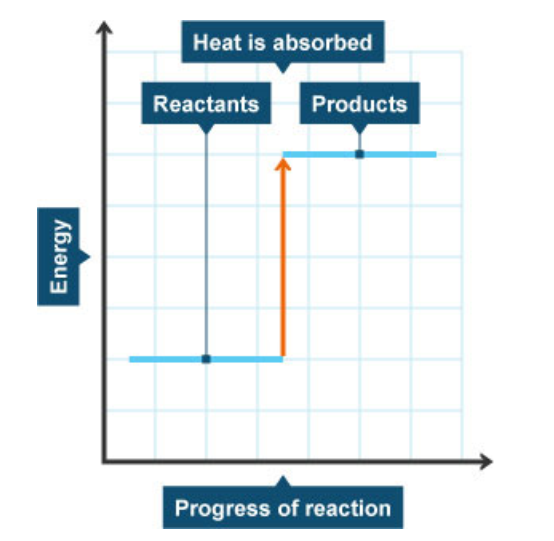
- 28Draw an energy level diagram to represent an endothermic reaction
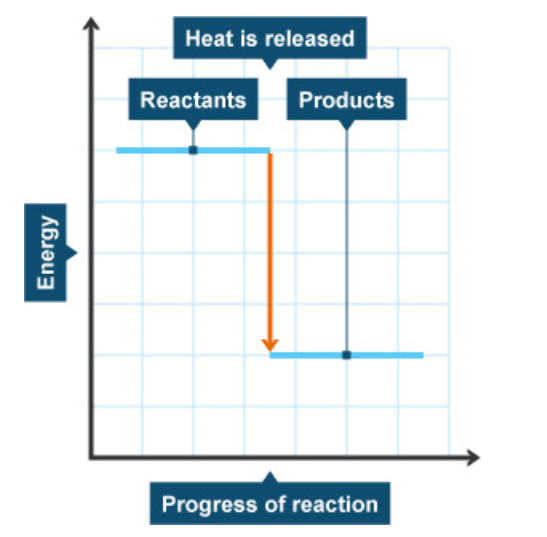
- 29Draw an energy level diagram to represent an exothermic reaction
- 30describe the transfer of energy when bonds are made or brokenDuring a chemical reaction:
■ energy must be supplied to break bonds
■ energy is released when bonds are formed. - 31Describe why heat is released during an exothermic reaction ?In an exothermic reaction, the energy released from forming new bonds is greater than the energy needed to break existing bonds.
- 32Describe why heat is absorbed during an endothermic reaction ?In an endothermic reaction, the energy needed to break existing bonds is greater than the energy released from forming new bonds.
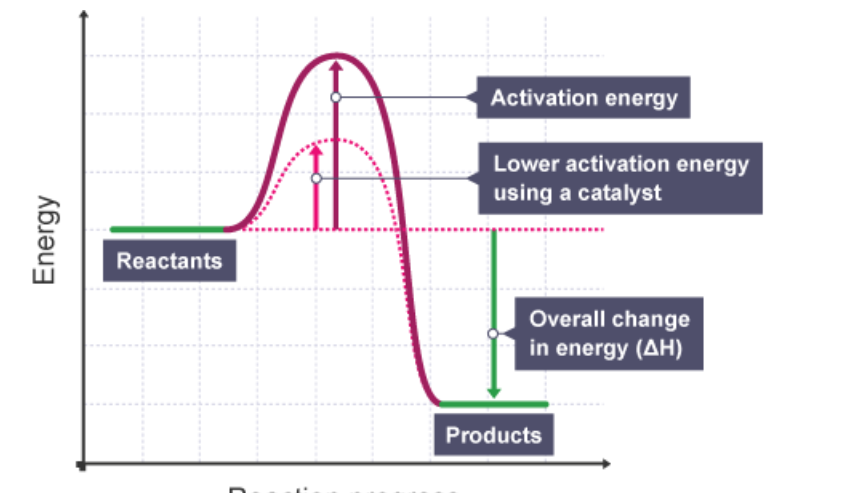
- 33Explain how catalysts help reactions occur?Catalysts provide a different pathway for a chemical reaction that has a lower activation energy.
- 34draw an energy level diagram showing the effect of an enzyme on activation energy
- 35State 2 ways the H can be used in vehiclesHydrogen can be burned as a fuel in combustion engines.
hydrogen + oxygen ==> water
It can also be used in fuel cells that produce electricity to power vehicles. - 36State the benefits of using H as a fuel1. unlike petrol and diesel, hydrogen does not generate carbon dioxide when burnt
hydrogen
2. fuel cells are very efficient - 37State disadvantages of using H as a fuel1. few filling stations sell hydrogen
2. hydrogen must be compressed and liquefied, and then stored in tough, insulated fuel tanks
3. atmospheric pollution may be generated during the production of hydrogen
4. hydrogen fuel cells do not work at very low temperatures, and they may also require a platinum catalyst (expensive) - 38Flame tests can be used to identify metal ions. Lithium, sodium, potassium, calcium and barium compounds produce distinctive colours in flame tests:■ lithium compounds = crimson flame
■ sodium compounds = yellow flame
■ potassium compounds = lilac flame
■ calcium compounds = red flame
■ barium compounds = green flame. - 39describe tests for Al, Ca and Mg ionsAluminium, calcium and magnesium ions form white precipitates with sodium hydroxide solution but only the aluminium hydroxide precipitate dissolves in
excess sodium hydroxide solution. - 40describe tests for Copper(II), iron(II) and iron(III) ionsCopper(II), iron(II) and iron(III) ions form coloured precipitates with sodium hydroxide solution.
Copper forms a blue precipitate, iron(II) a
green precipitate and iron(III) a brown precipitate. - 41describe a test for carbonatesCarbonates react with dilute acids to form carbon dioxide. Carbon dioxide produces a white precipitate with limewater. This turns limewater cloudy.
- 42describe tests for the halidesHalide ions in solution produce precipitates with silver nitrate solution in the presence of dilute nitric acid.
Silver chloride is white, silver bromide is cream and silver iodide is yellow. - 43describe a test for sulfate ionsSulfate ions in solution produce a white precipitate with barium chloride solution in the presence of dilute hydrochloric acid.
- 44What are the raw materials for the haber process and how are they obtained ?The raw materials for the Haber process are nitrogen and hydrogen. Nitrogen is obtained from the air and hydrogen may be obtained from natural gas or
other sources. - 45Describe the haber processThe purified gases are passed over a catalyst of iron at a high temperature (about 450 °C) and a high pressure (about 200 atmospheres). Some of the
hydrogen and nitrogen reacts to form ammonia. The reaction is reversible so ammonia breaks down again into nitrogen and hydrogen:
nitrogen + hydrogen => ammonia
On cooling, the ammonia liquefies and is removed.The remaining hydrogen and nitrogen are recycled. - 46describe a reversible reaction at equilibrium in a closed systemWhen a reversible reaction occurs in a closed system, equilibrium is reached when the reactions occur at exactly the same rate in each direction.
- 47describe how an increase in temperature effects the yield of a reversible reactionIf the temperature is raised, the yield from the endothermic reaction increases and the yield from the exothermic reaction decreases.
- 48describe how an decrease in temperature effects the yield of a reversible reactionIf the temperature is lowered, the yield from the endothermic reaction decreases and the yield from the exothermic reaction increases.
- 49how dose an increase in pressure effect a reversible reaction involving gases ?In gaseous reactions, an increase in pressure will favour the reaction that produces the least number of molecules as shown by the symbol equation for that reaction.
- 50Why not increase the pressure to 1,000 atm, and get lots of ammonia really quickly?In the real world, it all comes down to money. Building high pressure chemical plant is expensive. Running the reaction at about 200 atm gives the highest return (the biggest profit) on investment capital
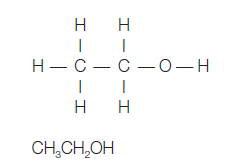
- 51represent the structure of ethanol
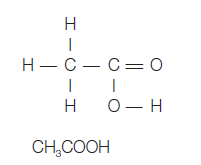
- 52represent the structure of ethanoic acid (a carboxylic acid)
- 53what is the functional group of alcohols and what are the first 3 alcoholsAlcohols contain the functional group –OH. Methanol, ethanol and propanol are the first three members of a homologous series of alcohols.
- 54state the properties of : Methanol, ethanol and propanol■ dissolve in water to form a neutral solution
■ react with sodium to produce hydrogen
■ burn in air
■ are used as fuels and solvents, and ethanol is the main alcohol in alcoholic drinks. - 55How is ethanol converted to ethanoic acid ?Ethanol can be oxidised to ethanoic acid, either by chemical oxidising agents or by microbial action.
Ethanoic acid is the main acid in vinegar. - 56What is the functional group of carboxylic acids ?Ethanoic acid is a member of the carboxylic acids,
which have the functional group –COOH. - 57State the properties of carboxylic acids ?■ dissolve in water to produce acidic solutions
■ react with carbonates to produce carbon dioxide
■ react with alcohols in the presence of an acid catalyst to produce esters
■ do not ionise completely when dissolved in water and so are weak acids
■ aqueous solutions of weak acids have a higher pH value than aqueous solutions of strong acids with the same concentration. - 58what is the functional grouop of estersEthyl ethanoate is the ester produced from ethanol and ethanoic acid. Esters have the functional group
–COO–. - 59what are the properties of eters ?They are volatile compounds with distinctive smells and are used as flavourings and perfumes.