
Flowchart
Lipid Degradation Prep
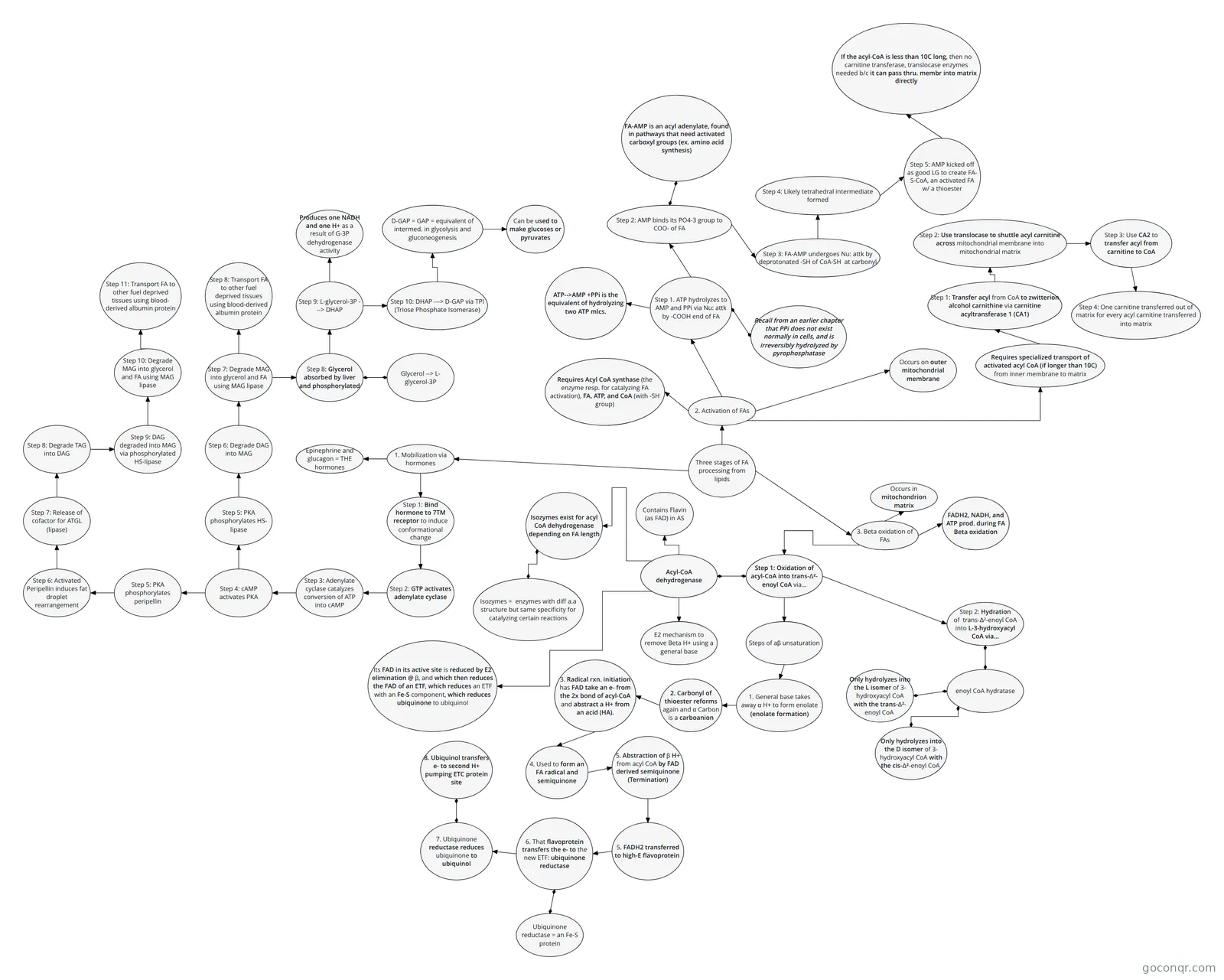
Flowchart: Lipid Degradation and Fatty Acid Processing
Flowchart content
Three stages of FA processing from lipids
1. Mobilization via hormones
2. Activation of FAs
3. Beta oxidation of FAs
Epinephrine and glucagon = THE hormones
Step 1: Bind hormone to 7TM receptor to induce conformational change
Step 2: GTP activates adenylate cyclase
Step 3: Adenylate cyclase catalyzes conversion of ATP into cAMP
Step 4: cAMP activates PKA
Step 5: PKA phosphorylates peripellin
Step 5: PKA phosphorylates HS-lipase
Step 6: Activated Peripellin induces fat droplet rearrangement
Step 7: Release of cofactor for ATGL (lipase)
Step 8: Degrade TAG into DAG
Step 9: DAG degraded into MAG via phosphorylated HS-lipase
Step 6: Degrade DAG into MAG
Step 7: Degrade MAG into glycerol and FA using MAG lipase
Step 8: Transport FA to other fuel deprived tissues using blood-derived albumin protein
Step 10: Degrade MAG into glycerol and FA using MAG lipase
Step 11: Transport FA to other fuel deprived tissues using blood-derived albumin protein
Step 8: Glycerol absorbed by liver and phosphorylated
Glycerol --> L-glycerol-3P
Step 9: L-glycerol-3P ---> DHAP
Step 10: DHAP ---> D-GAP via TPI (Triose Phosphate Isomerase)
Produces one NADH and one H+ as a result of G-3P dehydrogenase activity
D-GAP = GAP = equivalent of intermed. in glycolysis and gluconeogenesis
Can be used to make glucoses or pyruvates
Step 1. ATP hydrolyzes to AMP and PPi via Nu: attk by -COOH end of FA
Requires Acyl CoA synthase (the enzyme resp. for catalyzing FA activation), FA, ATP, and CoA (with -SH group)
Step 2: AMP binds its PO4-3 group to COO- of FA
Step 3: FA-AMP undergoes Nu: attk by deprotonated -SH of CoA-SH at carbonyl
Recall from an earlier chapter that PPi does not exist normally in cells, and is irreversibly hydrolyzed by pyrophosphatase
Step 4: Likely tetrahedral intermediate formed
Step 5: AMP kicked off as good LG to create FA-S-CoA, an activated FA w/ a thioester
ATP-->AMP +PPi is the equivalent of hydrolyzing two ATP mlcs.
FA-AMP is an acyl adenylate, found in pathways that need activated carboxyl groups (ex. amino acid synthesis)
Occurs on outer mitochondrial membrane
Occurs in mitochondrion matrix
Requires specialized transport of activated acyl CoA (if longer than 10C) from inner membrane to matrix
Step 1: Transfer acyl from CoA to zwitterion alcohol carnithine via carnitine acyltransferase 1 (CA1)
Step 2: Use translocase to shuttle acyl carnitine across mitochondrial membrane into mitochondrial matrix
If the acyl-CoA is less than 10C long, then no carnitine transferase, translocase enzymes needed b/c it can pass thru. membr into matrix directly
Step 3: Use CA2 to transfer acyl from carnitine to CoA
Step 4: One carnitine transferred out of matrix for every acyl carnitine transferred into matrix
FADH2, NADH, and ATP prod. during FA Beta oxidation
Step 1: Oxidation of acyl-CoA into trans-Δ²-enoyl CoA via...
Isozymes exist for acyl CoA dehydrogenase depending on FA length
Contains Flavin (as FAD) in AS
Acyl-CoA dehydrogenase
Isozymes = enzymes with diff a.a structure but same specificity for catalyzing certain reactions
E2 mechanism to remove Beta H+ using a general base
Steps of aβ unsaturation
1. General base takes away α H+ to form enolate (enolate formation)
2. Carbonyl of thioester reforms again and α Carbon is a carboanion
3. Radical rxn. initiation has FAD take an e- from the 2x bond of acyl-CoA and abstract a H+ from an acid (HA).
4. Used to form an FA radical and semiquinone
5. Abstraction of β H+ from acyl CoA by FAD derived semiquinone (Termination)
5. FADH2 transferred to high-E flavoprotein
6. That flavoprotein transfers the e- to the new ETF: ubiquinone reductase
7. Ubiquinone reductase reduces ubiquinone to ubiquinol
8. Ubiquinol transfers e- to second H+ pumping ETC protein site
Ubiquinone reductase = an Fe-S protein
Step 2: Hydration of trans-Δ²-enoyl CoA into L-3-hydroxyacyl CoA via...
Its FAD in its active site is reduced by E2 elimination @ β, and which then reduces the FAD of an ETF, which reduces an ETF with an Fe-S component, which reduces ubiquinone to ubiquinol
enoyl CoA hydratase
Only hydrolyzes into the L isomer of 3-hydroxyacyl CoA with the trans-Δ²-enoyl CoA
Only hydrolyzes into the D isomer of 3-hydroxyacyl CoA with the cis-Δ²-enoyl CoA
Information
- Description
- Biology Biology Flowchart on Lipid Degradation Prep, created by Chinazor Okeke on 18/04/2017.
- Created by
- Chinazor Okeke
- Views
- 5
- Tags
- Rating
More on Fatty Acid Oxidation and Lipolysis